

The individual assessment of Jivraj Singh, a Class 8 student at a government school in Jodhpur, shows that he is ‘excellent’ at understanding and using statistics (3/3 stars), and has excellent knowledge about ancient civilisations and rights and duties in the Constitution too. His understanding of stories and poems is at an ‘improving’ level (2/3), as is his grasp of number rules in mathematics and the natural environment and resources in science.
The assessment also indicates that, along with his friend Aditya, Jivraj is at an improving level in solving numerical problems, learning and using new words, and understanding the properties and changes of matter. While Aditya is rated as ‘learning’ (1/3) in understanding democratic governance, Jivraj is ‘learning’ to apply science to everyday life.
The individual assessments of Jivraj and Aditya on each topic – from learning to excelling – are part of an Artificial Intelligence (AI) initiative by the Jodhpur district administration and education department officials, with separate reports prepared in a matter of seconds for each student.
As part of the second phase of the Competency-based Census Assessment and School Reporting Pilot Project, covering over a thousand schools across all 15 blocks of Jodhpur, answer sheets of over 70,000 students of Classes 6–9 were graded using AI in five subjects — English, Hindi, Mathematics, Science, and Social Science — resulting in over 3 lakh assessments across Hindi and English-medium schools.
The highlight: while earlier the assessment used to take weeks, the entire process of preparing analytical reports for students, teachers, principals and schools was completed within three days, with the grading and scoring of one answer sheet now taking a few seconds, saving the 5–7 minutes spent manually earlier.
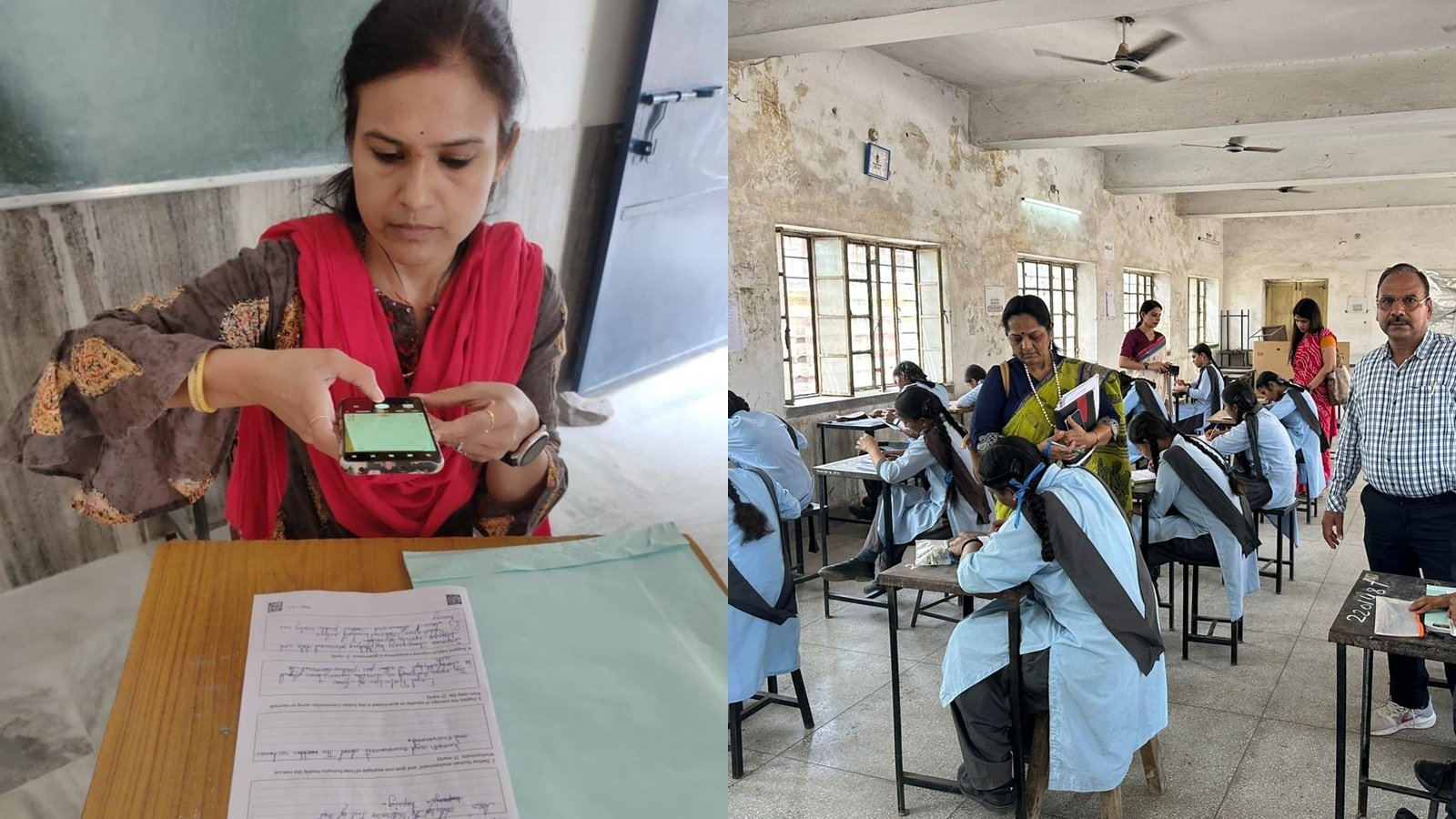
Teachers now scan the answer sheets using the AI app, after which the sheets are graded by the application. “While earlier the system had been used to check responses for multiple-choice questions, this is the first time in the country that it has been employed to analyse subjective responses,” says an expert associated with the project.
For the concerned teachers too, based on the results, dozens of topics across subjects are now rated on a scale of 0–10, with a lower score indicating a topic that needs to be taken up and improved on a “high priority”, while a higher score indicates good performance by students and a lower priority.
Story continues below this ad
The results of the assessment, completed this month, will be formally shared at the first Parent-Teacher Meeting (PTM) of the year to be held next month, giving parents a clear and analytical view of the progress of their school and children. (Source: Express Photo)
District education department officials say that this not only ensures an error- and “bias-free” assessment process, the detailed analytical report cards for each student also help teachers plan “targeted remedial interventions”.
At a higher level, the AI report card of the school rates performance in every subject on a scale of 1–10, portrayed as steps of a ladder, providing the results of the top-performing schools on a parallel ladder for context. These are also shared with parents to help them make better decisions regarding their children’s education and choose an appropriate school.
The results of the assessment, completed this month, will be formally shared at the first Parent-Teacher Meeting (PTM) of the year to be held next month, giving parents a clear and analytical view of the progress of their school and children.
Jodhpur’s Chief District Education Officer, Rajni Shekhawat, says that the biggest challenge earlier was the lack of uniformity, with schools following different grading and assessment patterns.
Story continues below this ad
“The process earlier did not clearly show the specific learning gaps across subjects or grades. Another important gap was on the parents’ side. Parents could see their own child’s report card, but they had very little information about how the school itself was performing. They could not easily see the overall learning levels in the school or how their school compared with others nearby. Without that information, it was difficult for parents to engage schools in meaningful conversations about the quality of education their children were receiving or make informed decisions about where to enrol their children,” she says.
For the first time, principals and teachers could see patterns in learning across grades and subjects, she says. “In several schools, we noticed (in the pilot’s first phase) that once the data was presented in this way, discussions quickly shifted toward identifying specific learning gaps. In the long run, this will create a stronger sense of accountability for learning across the system.”
“The school report cards have helped make this information easier to use for all of us,” she says, “Principals could see how their school was performing across grades and subjects, and teachers could identify areas where students needed additional support.”
The initiative, launched by then Jodhpur District Collector Gaurav Agrawal last year, has seen the district administration throw its weight behind the project. It is now being led by District Collector Alok Ranjan and Chief Executive Officer of Zila Parishad Ashish Mishra, along with the Education Department, the District Education Officer (DEO), Chief Block Education Officers (CBEOs), District Institute of Education and Training (DIET) Jodhpur, schools and thousands of teachers.
Story continues below this ad
Additionally, Central Square Foundation is the academic consultant, EdOptimize is the technical partner, and Central Electronics Limited, a Government of India Public Sector Undertaking, is also associated with the project to strike a balance “between academic rigour and technological robustness”, officials said.
At the time, District Collector Gaurav Agrawal had said: “I think this model is the future, because the value it offers is amazing; for the system, the testing agency, the parents, the schools. It’s a win-win for everybody. The most beautiful part is that it is very easily scalable and the technology is cheap.”
“All it needs is commitment, and administrative and political will to take it up,” he had said.
The first phase of the pilot project was “successfully” implemented in 54 government English-medium schools of Jodhpur block in October 2025, covering more than 3,000 students of Classes 6 to 8, where assessment was conducted in English, Mathematics, Science and Social Science, and the AI-based system was tested and validated.
Story continues below this ad
Officials say that the project is in line with the National Education Policy (NEP) 2020, which places special emphasis on competency-based assessment, continuous learning monitoring, and providing access to school quality information to the public.
DIET Principal Manju Sharma says that the “AI-based assessment is not only an evaluation tool for teachers but also enables them to be more effective in the teaching process. It also reduces the administrative workload of teachers and enables them to deliver focused and data-driven teaching.”
For now, the process is underway to train resource persons from all 15 blocks to ensure that capacity building is effectively transferred to school principals and teachers.
