

Post Content
“I’m very hopeful that ISVs and organisations out of India will leapfrog with AI and come out with solutions not only for India’s problems or challenges — it could be financial inclusion, healthcare, or agriculture. I think some big innovations are just waiting to happen,” said Vijayant Rai, Managing Director for India at Snowflake.
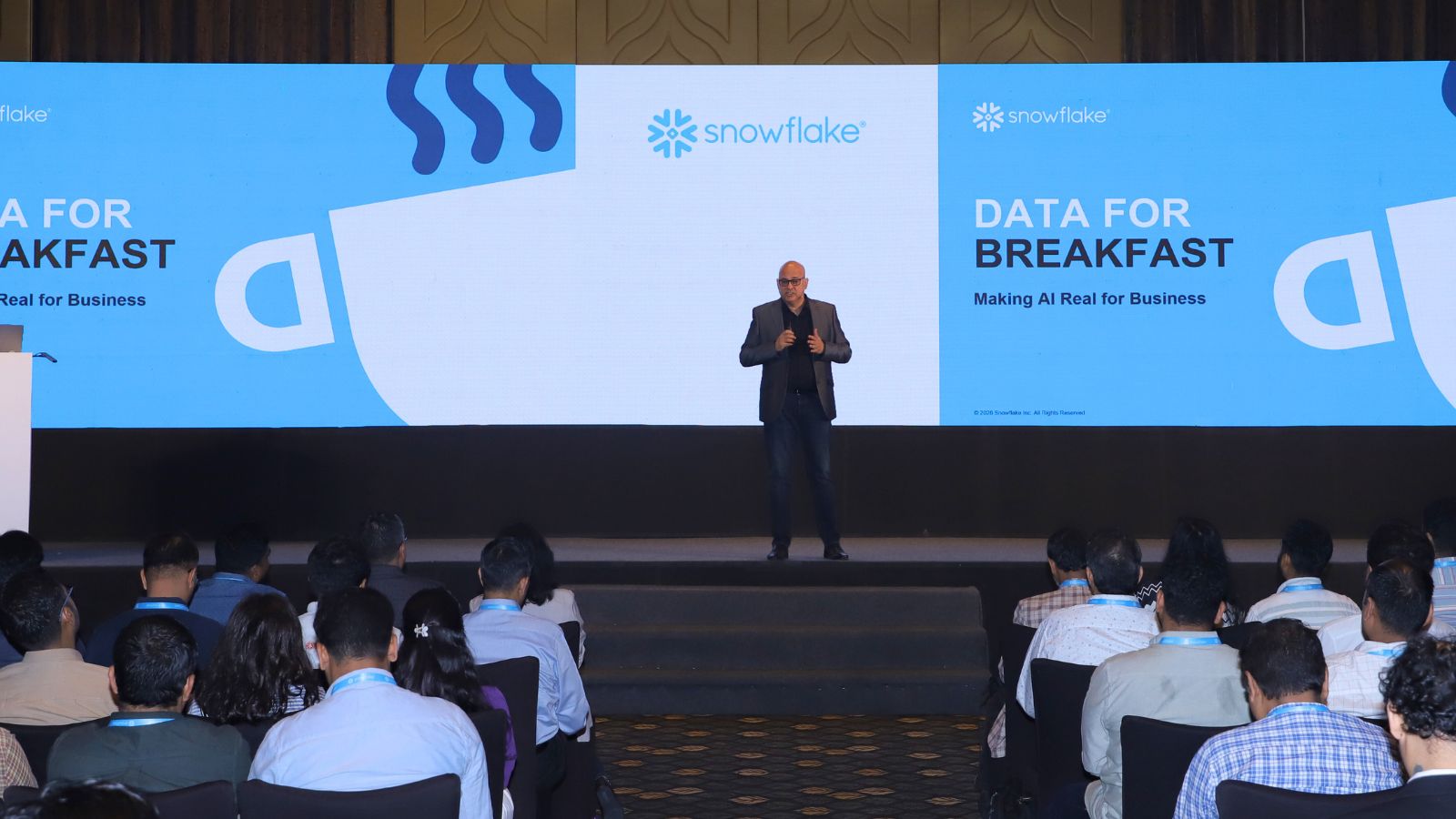
On the sidelines of Snowflake’s Data for Breakfast event series in Delhi, Rai discussed the growing appetite for AI and data solutions among practitioners. While speaking to indianexpress.com, he underscored why India is uniquely positioned to drive AI innovation at scale, while also candidly addressing the challenges enterprises face in their AI transformation journeys.
The scale of AI adoption
The numbers emerging from Snowflake’s platform suggest enterprise AI has crossed the adoption threshold. According to Rai, the company recently “declared revenues of $4.4 billion for the previous year, which was FY26” with “13,300+ customers now on the platform”. What’s more revealing is the AI utilisation rate. “9,100 customers out of those 13,300 are already using AI on the platform.”
These represent a significant majority actively engaging with AI capabilities, moving beyond experimentation. “India as well is very similar,” Rai noted. “We see a lot of our customers who are already in the Snowflake data cloud now moving towards AI use cases.”
Also Read | ‘Your data stays yours’: Sridhar Ramaswamy highlights Snowflake’s strong AI guardrails
The shift toward agentic AI is particularly pronounced. Rai pointed to WakeFit as a concrete example: “They’re using Snowflake Intelligence and Cortex AI for a number of agentic processes, including for their front-end staff, for their operation staff, for inventory, for all of those aspects, for their GTM or for their customer-facing areas.”
The three core challenges
Despite the momentum, Rai was forthright about the challenges faced by enterprises. He identified three key challenges. First is the context problem. “AI is as good as the context you give it, right? Otherwise, you have hallucinations and all of that,” he explained. “So there is a challenge in ensuring that whatever AI design you’re building for your organisation has the context of your business, your goals, your vision. That’s the number one challenge we see with AI and enterprises.”
Second is data fragmentation, an issue that persists despite years of discussion around data unification. “You still have data lying in different places,” Rai observed. “So unification of data is still an important consideration to ensure you get the adoption you need on AI.”
Story continues below this ad
The third challenge is organisations attempting to retrofit AI onto existing processes. “A lot of organisations are trying to look at their existing processes and sort of push AI onto it, right?” Rai said. “It sometimes creates even more complexity than getting any gains out of it.”
Also Read | ‘Micro-dramas are redefining how India watches content’: Meta India head Arun Srinivas
However, his prescription is clear. “When you’re looking at AI, don’t look at it in fragments. Look at it in terms of how you can bring in AI across your organisation for different processes.” He emphasised that successful AI implementations require business-specific context. “Your AI is built for your company. Unlike a public LLM which looks at everything on the internet, you’re looking at it from a perspective of your company, your customer, and those definitions so that your AI is giving you powerful feedback.”
India’s dual advantage
During the conversation, Rai highlighted two factors that create a compounding advantage for India. “What really helps us stay ahead in this race is the availability of the large talent pool we have, the resource pool which India provides, not only for India but globally as well,” he said. “The technical talent pool – that’s a big advantage in every sense.”
The second factor is India’s demonstrated ability to implement technology at an unprecedented scale. “India has traditionally leapfrogged generations whenever big technology changes happen. And what I can definitely see is the scale of India in terms of the size of the market. Some of our customers cater to markets that are only second to, or even equal to, China,” Rai noted.
Story continues below this ad
He acknowledged that the scale is staggering. “We work with some of the largest digital natives who serve 80-100 million customers on a regular basis. That’s the scale India provides,” he said. Drawing parallels to past innovations, he added: “We have seen that even in the past with things like UPI, the payment stack, and Aadhaar and all of that. So as a country, we know how to do a billion-scale transformation.”
The human element in an AI world
On the contentious question of AI’s impact on employment, Rai struck a balanced tone that acknowledged disruption while emphasising the opportunity. “As AI happens, a lot of things would get automated with AI. Professionals would need to start moving towards upskilling themselves as well,” he shared.
However, he argued that certain capabilities remain distinctly human territory: “Domain knowledge is going to become very crucial. Strategic thinking and context become very important. And these things AI will never do.”
He cited security oversight and strategic decision-making as examples of skills that will remain in high demand. “You still need people who can take those calls, those strategic decisions. You need people who can, for example, from a security perspective, check if everything is going fine with different AI tools and engines.”
Story continues below this ad
Also Read | Why do sovereign AI projects fail? IBM’s chief scientist Ruchir Puri on the pitfalls governments face
Rather than displacement, Rai framed the shift as elevation: “This is actually an opportunity for professionals to sort of move up the chain, as a lot of things where there is scale which can be automated will get automated. But the opportunity for talent to go upwards and get more strategic in nature is going to be there.”
Democratising AI capabilities
The evolution of AI tools themselves is accelerating this transformation. Referring to products like Cortex Code, Rai illustrated how technical barriers are falling: “Even, for example, business users like myself, I use it because in simple English language, I can ask a question, and it’ll do things for me.”
The implications here are significant. “The tools are now available for folks who have domain knowledge to actually really accelerate stuff. Because it’s simple English, you don’t need Python or SQL to work on it. Just ask it and it’ll do it for you. So yeah, that’s where I think the world is at right now.”
Snowflake India has structured its approach around acquisition of new enterprise customers across sectors and expansion within existing customer bases. The results, while not detailed numerically, suggest strong momentum.
Story continues below this ad
Building on this shift towards more intuitive and accessible AI tools, Snowflake has also introduced Project SnowWork, an autonomous enterprise AI platform currently in research preview. Designed to accelerate workflows, it acts as a proactive AI partner that can execute multi-step tasks through simple conversational prompts while maintaining enterprise-grade security.
