

Post Content
Light and matter show wave-particle duality – that is, they exist both as particles and waves. Experiments in recent years have shown that anti-matter too exists as both particle and wave. But first, what is antimatter?
For many of us, anti-matter sounds like something from a sci-fi writer’s imagination. But antimatter is real – and stranger than any fiction.
Every particle of matter that exists has a mirror twin, identical in almost every way, but with an opposite charge. When the two meet, they end each other in a pure flash of energy.
Antimatter was first theorised nearly a century ago in a mathematical model; in four years, it passed into the scientific realm with the discovery of the positron, the electron’s antimatter twin.
Also Read | Why Nasa shut down a key Voyager 1 instrument after 49 years
Though it was understood that antimatter, like all matter, would also exhibit wave-particle duality, it was never proven in experiments.
Until in 2019, a team of Swiss and Italian researchers put single positrons through a double-slit-like experiment and obtained results that showed wave interference.
What is the double slit experiment?
The double slit experiment was first used in 1801 to give evidence of the wave nature of light.
Story continues below this ad
It was originally done by shining light through two narrow, closely spaced slits. It was seen that the light produced a pattern of bright and dark fringes on a screen, rather than just two spots – meaning it behaved as two waves interfering with each other. A hundred years later, Albert Einstein proved the particle nature of light through his explanation of the photoelectric effect.
Later experiments showed that electrons, too, displayed wave interference.
But to scale up the experiment on antimatter, what kind of particle could be used? The answer to this question is an ‘atom’, whose existence itself is astonishing.
Enter Positronium — the ‘atom’ that shouldn’t exist
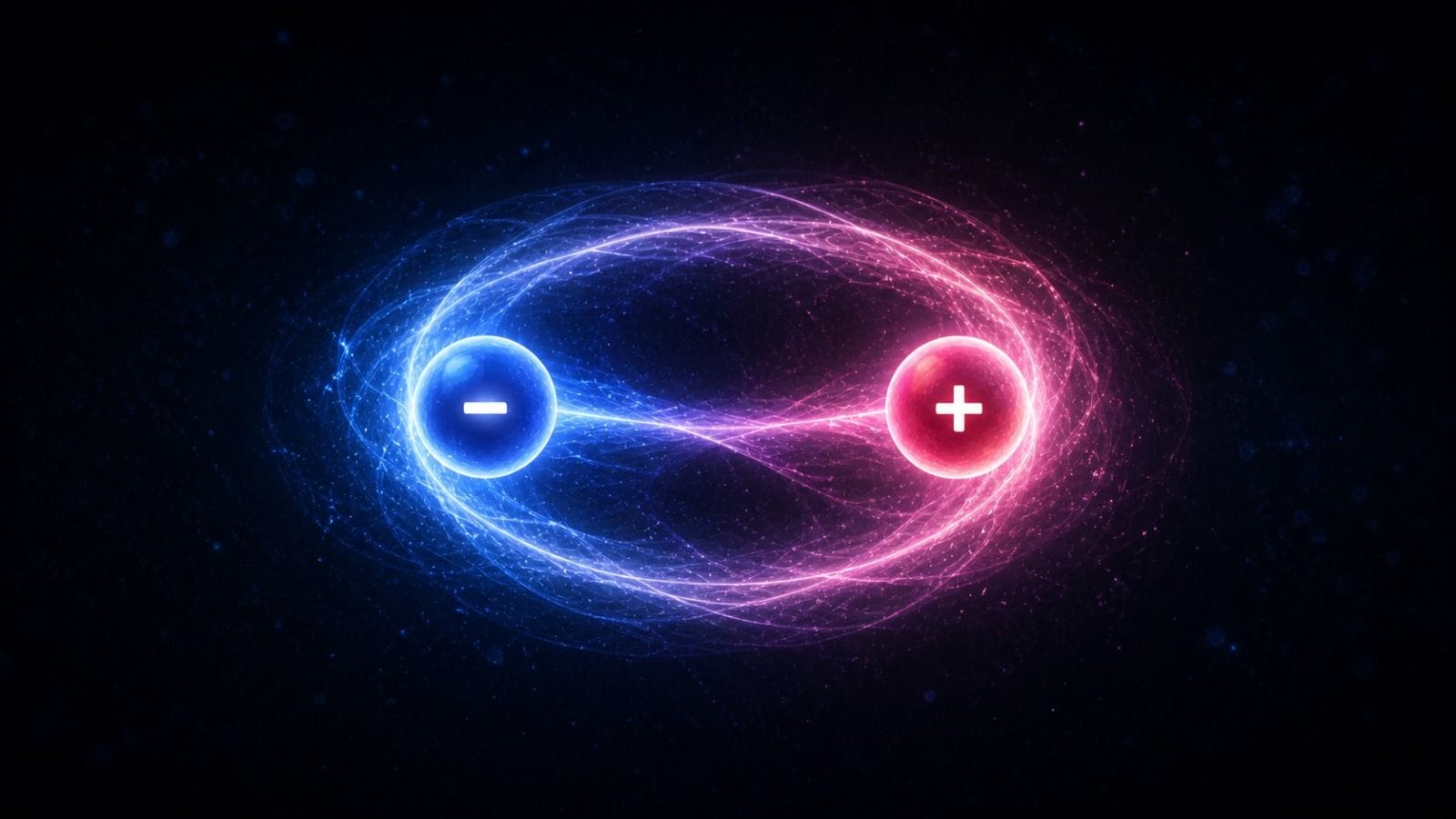
Positronium is an atom made of an electron and a positron – its antimatter twin. But instead of destroying each other, the two orbit each other, maintaining a delicate partnership for a very small amount of time. Technically, it is a matter-antimatter bound state.
Because both particles have exactly equal mass, positronium is unlike any other atom. Hydrogen, for instance, has a heavy proton at its centre and a much lighter electron orbiting it. Positronium has no such imbalance – it’s perfectly symmetrical, two equal particles spinning around a shared centre before self-annihilating.
Story continues below this ad
Also Read | Humans are still evolving, major DNA study suggests
That unique quality made scientists curious: How would positronium behave if it were turned into a beam and subjected to a double slit experiment?
A beam of positronium
A research team from Tokyo University of Science, led by Professor Yasuyuki Nagashima, along with Associate Professor Yugo Nagata and Dr. Riki Mikami, tried to answer that question. Their results, published recently in Nature Communications, show for the first time that a beam of positronium diffracts – bending and interfering like a wave – just as electrons do.
Creating this beam was itself a feat of precision. The researchers first generated positronium ions with a negative charge, then used an exactly timed laser pulse to strip away the extra electron.
What remained was a fast-moving, electrically neutral stream of positronium ‘atoms’ – clean enough to produce clear interference effects.
Story continues below this ad
This beam was then directed at a sheet of graphene – a layer of carbon atoms arranged in a honeycomb pattern. The spacing between those carbon atoms closely matched the quantum wavelength of the positronium, making it a natural diffraction surface. As the positronium passed through the two-to-three-layer graphene sheet, a distinct diffraction signal emerged on the detector, confirming wave-like behaviour.
The experiment was conducted in ultra-high vacuum, keeping the graphene surface pristine and the results unambiguous.
Two particles, one wave
Here’s what makes the result especially striking. Positronium is made of two particles – an electron and a positron. You might expect them to behave independently, each going its own quantum way. But they didn’t. They diffracted together, as a single unified quantum object – one singular wave.
Also Read | Artemis timeline shifts: Can NASA still land astronauts on the Moon in 2028?
The lead scientist in the experiment, Prof. Yasuyuki Nagashima, told the Science Daily: , “For the first time, we have observed quantum interference of a positronium beam, which can pave the way for new research in fundamental physics using positronium.”
Story continues below this ad
Why this matters
Beyond the elegance of the physics, this discovery has real practical potential. Because positronium carries no electric charge, it can probe the surface of materials without damaging them – something charged particles can’t always do. That makes it particularly useful for studying insulators or magnetic materials that tend to be disrupted by conventional charged beams.
Dr Nagata said the experiment marked a major advance in fundamental physics.” It not only demonstrates positronium’s wave nature as a bound lepton-antilepton system (a system that behaves like a tiny atom) but also opens pathways for precision measurements involving positronium,” he told the web portal.
The visible universe began with matter winning against antimatter – by a small margin. More discoveries on the nature of antimatter could rewrite many things we thought we knew about the universe.
(This article has been curated by Nityanjali Bulsu, who is an intern with The Indian Express)
