

Post Content
For a generation raised on the images of NASA’s Apollo missions, the question feels almost absurd: we landed on the Moon in 1969 – why can’t we just do it again?
Yet here we are, more than fifty years after Neil Armstrong made that “giant leap for mankind” humans still haven’t returned to the lunar surface. NASA’s modern program, called Artemis, is inching toward that goal but carefully, slowly, and with delays that often frustrate the public.
The reason is not a lack of ambition. It is that landing on the Moon is one of the most difficult engineering challenges humanity has ever attempted, and doing it safely, sustainably, and for the long term is even harder.
The Apollo era was simpler, and riskier
In July 1969, Neil Armstrong stepped onto the Moon and declared, “That’s one small step for [a] man, one giant leap for mankind”.
What often gets forgotten is just how risky that mission was. The Apollo program was driven by Cold War urgency. Engineers worked under intense time pressure, and astronauts accepted levels of risk that would be considered unacceptable today.
Also Read | Galactic cosmic rays: Invisible rain that never stops falling
One striking anecdote captures this reality: during the Apollo 11 landing, the onboard computer overloaded with alarms just minutes before touchdown. Mission control, after tense deliberation, told the astronauts to proceed anyway. Had that judgment call gone otherwise, history might have unfolded very differently.
Apollo succeeded brilliantly: but it was not designed for repeatability or permanence. It was a risky sprint.
Story continues below this ad
Artemis Is trying to do something harder
The Artemis program is not just about planting a flag again. It aims to build a sustained human presence on the Moon, especially near the south pole where water ice may exist.
That means solving problems Apollo never had to: Like,
🚀Long-duration life support
🚀Safer and reusable landing systems
🚀Reliable deep-space communication
🚀Infrastructure that can support future missions
The key phrase there is test flight. Artemis is being built step by step, with each mission testing critical systems before astronauts ever attempt a landing.
Going back to the Moon is harder now
So why hasn’t Artemis landed humans already?
The short answer: too many new technologies have to work together perfectly.
The current plan involves multiple pieces:
Story continues below this ad
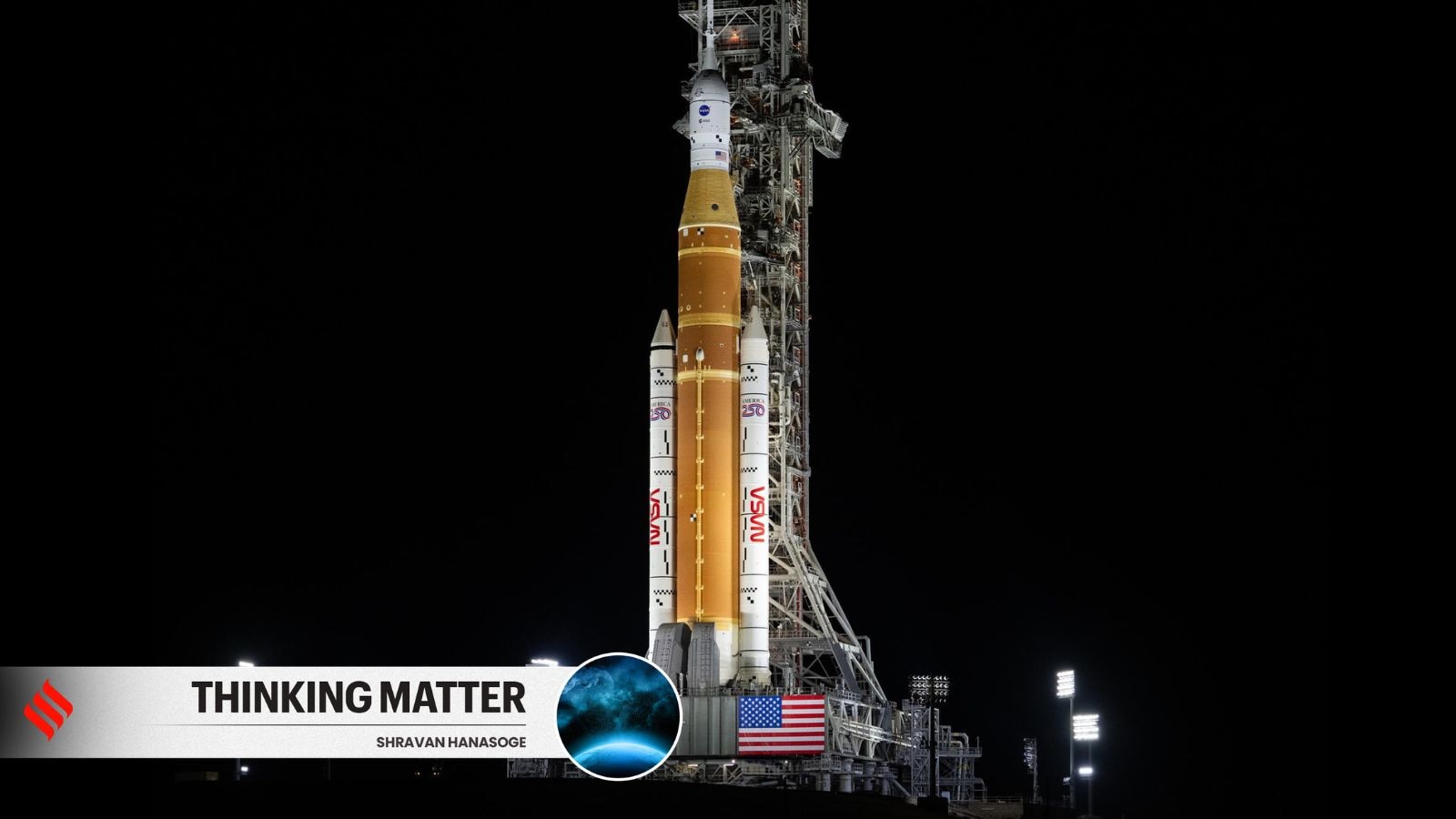
🚀The Space Launch System (SLS) rocket to lift astronauts off Earth
🚀The Orion spacecraft to carry them to lunar orbit
🚀A commercial lunar lander (built by companies like SpaceX and Blue Origin) to take them down to the surface
Each of these is enormously complex – and delays in any one of them affect the entire mission.
Recent Artemis missions have been delayed due to issues like hydrogen fuel leaks, helium pressurisation problems, and concerns about the Orion heat shield. Even small technical issues matter when human lives are involved.
Story continues below this ad
More fundamentally, the lunar lander itself, based on SpaceX’s Starship, is still under development and has faced delays due to its sheer scale and complexity.
This is not Apollo redux. It is a much more intricate system-of-systems problem.
A program that keeps changing
Originally, NASA planned to land astronauts with Artemis III as early as 2024. That timeline has steadily slipped.
Today, the first crewed landing is expected closer to 2028, with earlier missions focusing on testing systems rather than landing.
Story continues below this ad
Also Read | If an asteroid heads for Earth, can we stop it?
Even Artemis III, once envisioned as the landing mission, has been reshaped into a test mission in Earth orbit, emphasizing caution over speed.
This may feel like backtracking, but it reflects a deliberate shift: NASA is choosing reliability over spectacle.
A lesson from the past
There’s a telling moment from Apollo 13 – the mission that never landed.
When an oxygen tank exploded mid-flight, the mission transformed from exploration into survival. Engineers on the ground had to improvise solutions using whatever materials were available onboard. The astronauts returned safely, but only just. That mission left a lasting imprint on NASA’s culture: failures in space are unforgiving.
Story continues below this ad
Modern Artemis planning reflects that lesson. Systems are tested repeatedly and redundancies are built in. Risks are analyzed in painstaking detail.
It is slower but far safer.
Why Artemis Is still exciting
Despite the delays, Artemis represents one of the most ambitious space programs ever attempted.
For the first time, NASA is combining government missions with private companies, bringing in players like SpaceX and Blue Origin to build key hardware. This hybrid approach could reshape how space exploration is done.
The program also aims to land the first woman and the first person of color on the Moon, expanding the symbolic legacy of lunar exploration. Unlike Apollo, Artemis is not a one-off. It is designed to lead to:
🚀Permanent lunar bases
🚀Resource extraction (such as water ice)
🚀A stepping stone to Mars
Story continues below this ad
As one report noted, the goal is not just to return, but to establish a lasting presence .
The bigger picture: A new space race
There is also a geopolitical backdrop. Countries like China are advancing their own lunar ambitions, aiming for a presence on the Moon in the coming decades.
This adds urgency, but also complexity. Artemis is not just a scientific mission; it is part of a broader competition for influence in space.
Also Read | Space junk menace: How it could crash into our future tech
At the same time, international collaboration remains central. Artemis II, for example, includes astronauts from multiple countries, reflecting a shift from the nationalistic Apollo era.
Story continues below this ad
Why this time feels different
The irony is that NASA can land on the Moon – it has done so before. But Artemis is not about proving that it’s possible; rather it’s about doing it in a way that can be repeated, expanded, and sustained. This makes it a much harder challenge.
The Moon is therefore no longer a finish line: it is now a starting point.
And so the delays, the redesigns, and the cautious steps are not signs of failure but actually represent signs that the goal itself has changed.
When humans finally step onto the Moon again – likely later this decade – it won’t just be a return. It will be the beginning of something far more permanent.
Shravan Hanasoge is an astrophysicist at the Tata Institute of Fundamental Research.
