

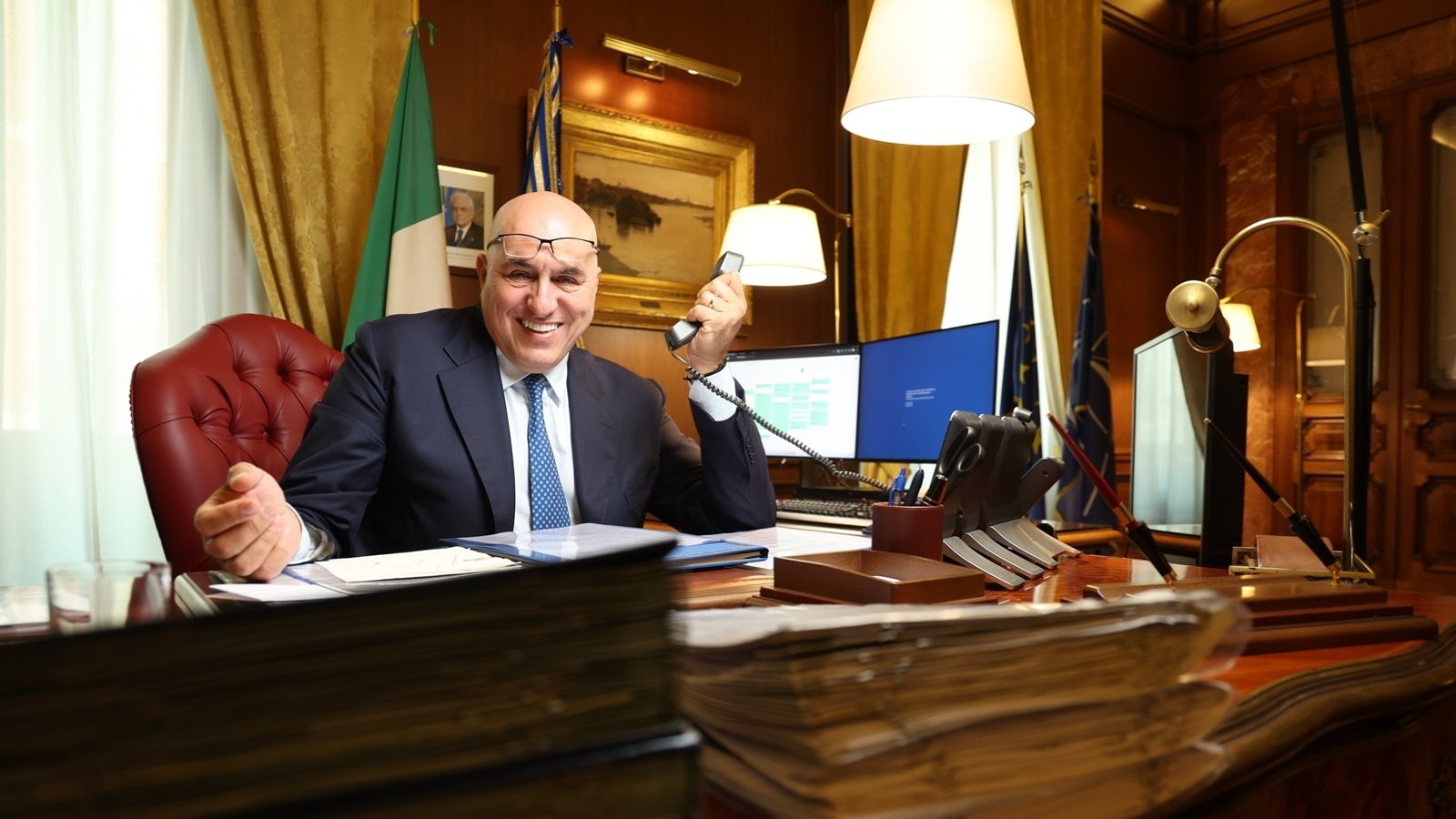
Ahead of Prime Minister Narendra Modi’s likely visit to Italy late next month, Italian Defence Minister Guido Crosetto, one of the senior ministers in PM Giorgia Meloni’s government, is scheduled to visit India Tuesday and hold bilateral talks over the next two days.
In his four decades in Italian politics, Crosetto, who co-founded the Fratelli d’Italia (Brothers of Italy) party with Meloni, in an exclusive interview over email with Shubhajit Roy, talked about his agenda for his meeting with Defence Minister Rajnath Singh, the trajectory of the India-Italy bilateral ties after a difficult phase, maritime cooperation with India, the challenges emerging from the closure of Strait of Hormuz, and Italy’s view of China’s approach in the Indo-Pacific. Edited excerpts:
From an undersecretary in the Defence ministry in (Silvio) Berlusconi government to co-founder of Brothers of Italy, along with PM Giorgia Meloni, you have been one of the top leaders in the party and the Defence Minister. How do you see your journey and where does India fit in Italy’s worldview as you plan to meet Defence Minister Rajnath Singh?
My institutional and political progress — until I and Prime Minister Meloni co-founded Fratelli d’Italia — was guided by the will to serve the country, based on a sense of responsibility and strategic vision. In an increasingly complex and competitive global context, security, credibility and industrial capacity are the essential pillars that we must reinforce by building solid alliances and cooperation.
In this context, India is a strategic partner, a great democracy and a central actor for global balance, with whom we share the need for stability and a responsible approach to major international challenges.
The meeting with Defence Minister Rajnath Singh is a major step to consolidate an already intense dialogue by translating it into concrete initiatives, strengthening the cooperation between our Armed Forces and defence companies, and building a shared vision on current and future challenges, to the benefit of international stability and prosperity.
India and Italy agreed to negotiate a defence industrial roadmap during a meeting between PM Narendra Modi and PM Meloni in November 2024 among other decisions. What is the progress on the roadmap and which are the new areas of cooperation in defence?
Story continues below this ad
By signing the 2025-29 Joint Strategic Action Plan, Italy and India have explicitly provided for negotiating a Defence Industrial Roadmap aimed to create a structured industrial and technological cooperation. No longer a buy-and-sell relationship, but an advanced partnership based on co-development, co-production, transfer of technology and know-how sharing, to enhance the complementarities between our industries. The roadmap aims to create a concrete, lasting platform, able to strengthen the industrial capabilities of both countries while contributing to international stability in the long run.
Italy has had a strong navy, with aircraft carriers, frigates and submarines. What is the scope of cooperation in this area?
Based on its history and location, Italy is a deeply maritime country, boasting one of the most advanced Navies. That’s exactly why the naval domain is one of the most natural sectors in which to strengthen cooperation with India.
Hence, our respective Navies will soon kickstart a Maritime Security Dialogue to strengthen interoperability, coordination and information exchange. In the operational plan, cooperation can evolve by establishing closer relations between our Navies in the sectors of training and education, paying special attention to the security of maritime routes. Finally, the value of naval cooperation between Italy and India is even greater: contributing to maintaining major maritime routes open and secure means we not only support security, but also regional stability and global trade.
Story continues below this ad
The West Asia war led to the closure of the Strait of Hormuz. With a strong maritime security relationship, how can India and Italian navies cooperate and have a role in freedom of navigation in the region — especially at a time when US President Donald Trump has asked the US military to blockade the Strait?
The Strait of Hormuz is one of the global chokepoints, where what’s at stake is not only regional security, but the equilibrium of global trade, energy supplies and logistics chains. It is of essence to reiterate that no single actor can use an international strait as an instrument of pressure or blockade. This holds even truer for Hormuz, as well as other crucial passages like the Strait of Malacca, of vital importance for Asian economies. In this context, Italy and India can play a significant role by strengthening the relations between their Navies to reaffirm a fundamental principle: strategic routes must remain free from all forms of geopolitical coercion.
India, for its regional importance and direct interest in energy routes; and Italy, for the role it plays in the Euro-Atlantic and Mediterranean, are natural partners when it comes to promoting a multilateral approach to maritime security. At a stage of acute tensions as this one, at the diplomatic, political and military level, a coordinated engagement becomes even more important to guarantee freedom of navigation, while contributing to global economic stability.
After the Russia-Ukraine war, Operation Sindoor and the war in West Asia, drones and missiles have become a major element of modern warfare. How do you see Italy and India cooperating on these new age tech and the use of AI?
Story continues below this ad
Recent wars — from Ukraine to the Middle East to Operation Sindoor — confirm that the battlefield has become multi-domain, being characterised by drones, missiles, electronic warfare and increased recourse to AI. A strong asymmetry is also emerging, due to drones becoming increasingly inexpensive and more accessible, while defence systems become more costly.
Hence, cooperation between Italy and India must focus on emerging technologies, also by adopting a “cheap-to-cheap” approach — using inexpensive defence systems to counter low-cost threats — to be able to respond to new threats in a sustainable way.
Our two countries can collaborate in the sectors of industry and applied research by engaging academia, innovation centers and corporations. Future deterrence will depend especially upon the capacity to timely update and integrate different weapons systems. This is why structured technological cooperation can make the difference.
India and Italy defence ties went through a rough patch with the Italian marines issue and the AgustaWestland allegations. Now, with Leonardo and other companies back in fray, how do you see the way forward?
Story continues below this ad
We can’t deny that the relationship between Italy and India has gone through difficult phases in the past. Today, however, the context has deeply changed. Having been able to overcome those difficulties has allowed us to start a new phase, based on greater political trust, a more intense institutional dialogue and forward-looking cooperation. This path has been confirmed by concrete steps like the renewal of the 2023 Agreement on Cooperation in the Defence Sector, and the new 2025-2029 Joint Strategic Action Plan: a mark of the shared will to strengthen our partnership.
In this perspective, the return and presence of realities like Leonardo and Fincantieri are a concrete opportunity to develop solid industrial collaborations based on trust, technology transfer and enhanced competences.
Reinforcing multilateral approaches and reliable partnerships is essential to tackle global tensions and prevent crises, contributing to greater international stability and achieving shared benefits in the long run.
In view of Italy’s growing interest in the Indo-Pacific Region, how do you view China’s assertive presence in the region and its Belt and Road Initiative, especially at a time when the Trump administration doesn’t seem to be giving high priority to this region?
Story continues below this ad
Dynamics in the Indo-Pacific are not exclusively Asian matters: they reverberate globally on the security of maritime routes, value chains, critical technologies, energy and raw materials. That’s why Italy looks to the region with growing interest, aware that what goes on there immediately affects also Euro-Atlantic equilibria.
China’s assertive presence is a structural datum that we must tackle realistically, rather than by ideological approaches. Beijing is concurrently an important economic player and systemic competitor, capable of projecting influence by means of its infrastructures, technology and maritime presence. In this perspective, the Belt and Road Initiative cannot be viewed as a purely commercial project, but also as a tool of geopolitical and industrial projection. Italy deems that the Indo-Pacific should remain an open, pluralistic space, ruled by International law, free from coercive logic. That’s why, within a continuously evolving international context, strengthening our partnership with key regional actors becomes even more important. In this regard, our dialogue with India, of significant strategic relevance, is one of the natural pillars of a free, open, stable regional order, in line with the Italian vision.
