

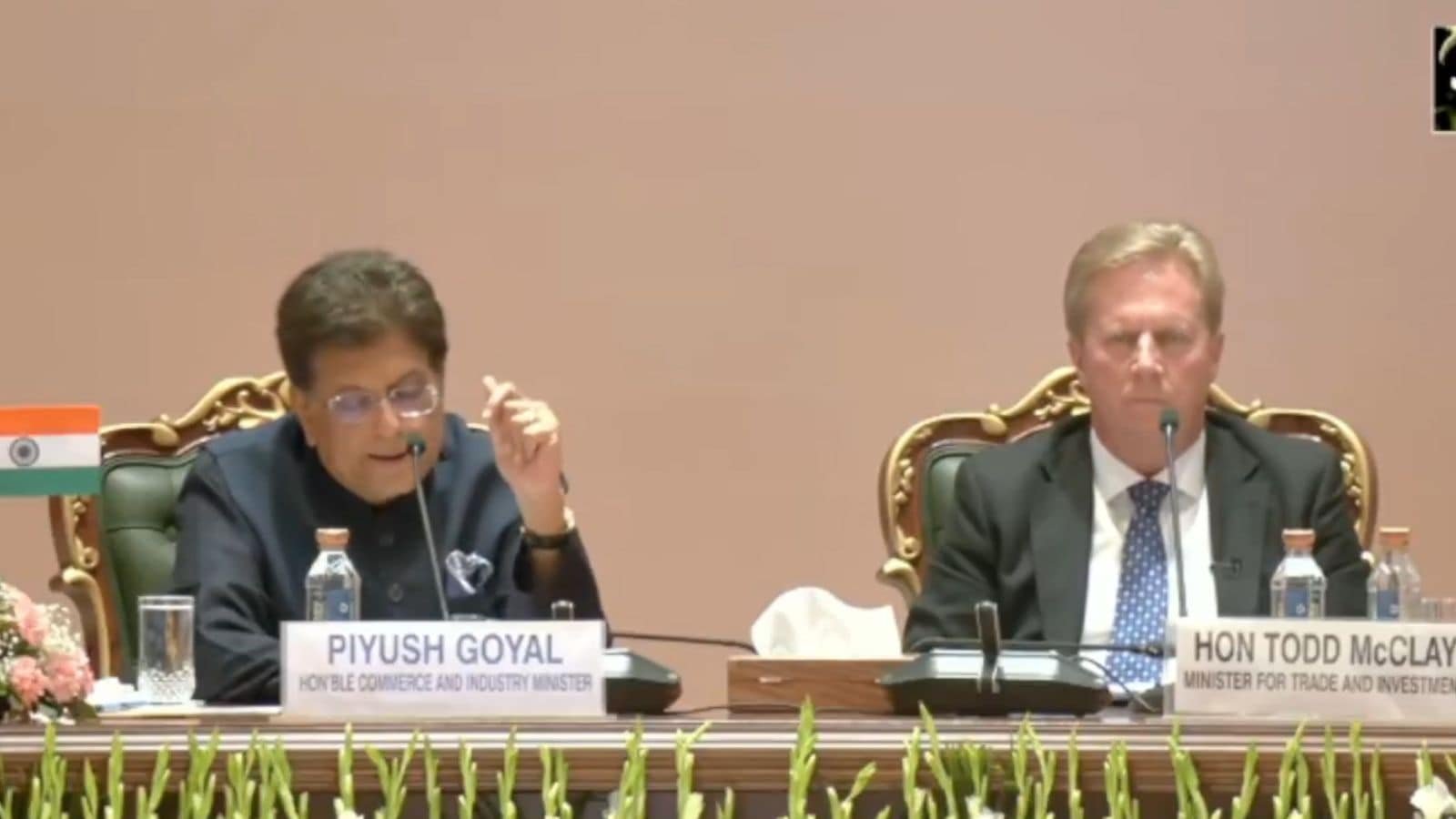
India on Monday signed a free trade agreement (FTA) with New Zealand, securing full tariff elimination on all Indian exports to New Zealand, while reducing tariffs on 95% of New Zealand’s imports into India.
As per the agreement, Wellington has also “committed” to invest $20 billion in India over the next 15 years.
India and New Zealand had completed negotiations in December last year when India was facing steep US tariffs.
The investment commitment has been a new feature in India’s recent trade pacts with developed countries, largely to strike a balance since New Delhi is offering steep tariff relaxation to the partner countries, but is receiving a minor reduction in tariffs in return, as average tariffs in advanced countries are typically 2-3%. New Zealand’s average import tariff is just 2.3%, compared with India’s 16.2%.
Prime Minister Narendra Modi said on X that the FTA will benefit Indian farmers, youth, women, MSMEs, artisans, startups, students and innovators. “The investment commitment of $20 billion by New Zealand will further strengthen our cooperation in agriculture, manufacturing, innovation and technology,” he said. Speaking on the signing, Commerce and Industry Piyush Goyal said the investment commitment from New Zealand signals strong confidence in India’s growth story.
New Zealand Prime Minister Christopher Luxon said the FTA matters not just because of what it does economically, but because of what it says strategically. “At a time of global uncertainty, this FTA is a clear commitment by both sides to stable, predictable, and rules-based trade,” he said. Experts pointed out that New Zealand’s current investment in India has been below $1 billion over the past 25 years.
Goods market access
The Commerce Ministry said India has offered tariff liberalisation on 70.03% of tariff lines covering 95% of bilateral trade value, while keeping 29.97% of tariff lines excluded to protect India’s sensitive sectors. It said the FTA provides duty-free access for 100% of India’s exports to New Zealand, covering all tariff lines. In FY26, India’s exports to New Zealand stood at $711 million, largely comprising aviation fuel, textiles, pharma and machinery. Imports included raw materials, scrap metals, coal and farm-linked inputs totalling $587 million. “Earlier, New Zealand maintained peak tariffs of up to 10% on key Indian exports, including ceramics, carpets, automobiles, and auto components. With zero-duty market access from entry into force as New Zealand’s other trade partners, Indian products will be fully competitive in New Zealand,” it said. New Zealand said its top wins under the deal will be exports of forestry, sheep meat, wool, coal, tariffs on New Zealand’s key fish and seafood exports phased out over 7 years, and tariffs on New Zealand wine reduced by 66-83% over 10 years from entry into force.
‘Preferential’ access for apples
Story continues below this ad
New Zealand said it is the “first country to secure preferential access for apples” in any Indian FTA, and the first kiwifruit exporter to secure tariff-free access for kiwifruit plus a 50% tariff reduction outside quota. Under the deal, the quota on apples begins at 32,500 tonnes in the first year of the deal, rising to 45,000 tonnes from the sixth year. Apples below the price threshold get no concession, and imports above the quota face normal MFN duty. The concession is also linked to New Zealand’s cooperation under the Apple Action Plan. If it fails to meet commitments, India can suspend market access.
“Apple imports already account for nearly one-fifth of India’s domestic production. New FTA concessions to New Zealand, along with pressure from the US, EU and other partners, could further increase the share of imported apples in India. Cheap apples from Iran and Turkey are already affecting lower-grade Indian apples,” former trade officer and founder, Global Trade Research Initiative Ajay Srivastava said. Lower-duty apples from New Zealand, the US and the EU could soon compete in mid-premium and premium markets, especially in cities and during the off-season, and this could hurt apple growers in Kashmir and Himachal Pradesh, who already face high transport costs, poor cold-chain facilities, weak marketing systems and unstable prices, he said.
Exclusion category, investment caution
The Commerce Ministry said it has kept dairy (milk, cream, whey, yoghurt, cheese, etc.), animal products (other than sheep meat), agricultural products (onions, chana, peas, corn, almonds etc.), sugar, artificial honey, animal, vegetable or microbial fats and oils, arms and ammunition, and Gems and Jewellery among others under the “exclusion category”.
However, on dairy, New Zealand said the FTA includes a commitment to implement a dedicated fast-track mechanism to “facilitate the supply of New Zealand products duty-free to India” for further manufacturing and export. “This includes dairy ingredients and opens the door for greater collaboration and will create new opportunities for New Zealand exporters in India’s supply chains, including into its growing number of FTA partners,” it said. “India has committed that, should it offer dairy access to comparable countries in the future, it will consult with New Zealand on the prospect of extending similar treatment to us. This is alongside a commitment to review the FTA one year after entering into force,” Wellington said.
Story continues below this ad
Mobility boost, visa schemeUnder the deal, New Zealand has agreed to create new mobility pathways for Indian students, professionals and young workers and has allowed Indian students in New Zealand to work 20 hours per week. STEM bachelor’s and master’s graduates will get three-year post-study work visas, while doctorate holders will get four years, it said.
A new temporary employment pathway will allow 5,000 skilled Indian professionals to work in New Zealand at any time for up to three years, especially in sectors such as IT, healthcare and education. In addition, a Work and Holiday visa scheme will allow 1,000 young
Indians each year to live and work in New Zealand for 12 months, as per the agreement.
Data showed that New Zealand has a large services surplus with India, mainly because Indian students and tourists spend heavily there. In FY2025, India’s services imports from New Zealand were $550 million, against services exports of $255.8 million.
Story continues below this ad
Investment commitmentAs per the trade deal, the investment commitment comes with several riders. The text said that the parties recognise that India’s economic development over the last two decades was accompanied by a sustained increase in nominal FDI into India, reflecting the confidence of foreign investors in the potential of the Indian economy.
“Based on this observation, and on estimated nominal GDP growth rate of India over the next 15 years, in line with the past growth rates, New Zealand aims to strengthen its FDI footprint in India, leveraging a full implementation of this Agreement by the Parties…in case of occurrence of any unforeseen circumstances including global pandemic, war, geopolitical disruptions, financial crisis or sustained economic underperformance, or other similar factors beyond New Zealand’s control which have had a material bearing on the progress to achieve the objective, the parties may adjust the investment objective by mutual agreement …,” the text read
Ajay Srivastava said that the promised $20 billion New Zealand investment over 15 years should be treated with caution. “New Zealand’s actual investment in India has been below US$1 billion over the past 25 years. The EFTA experience shows that headline investment promises do not always turn into real inflows,” Srivastava said.
