

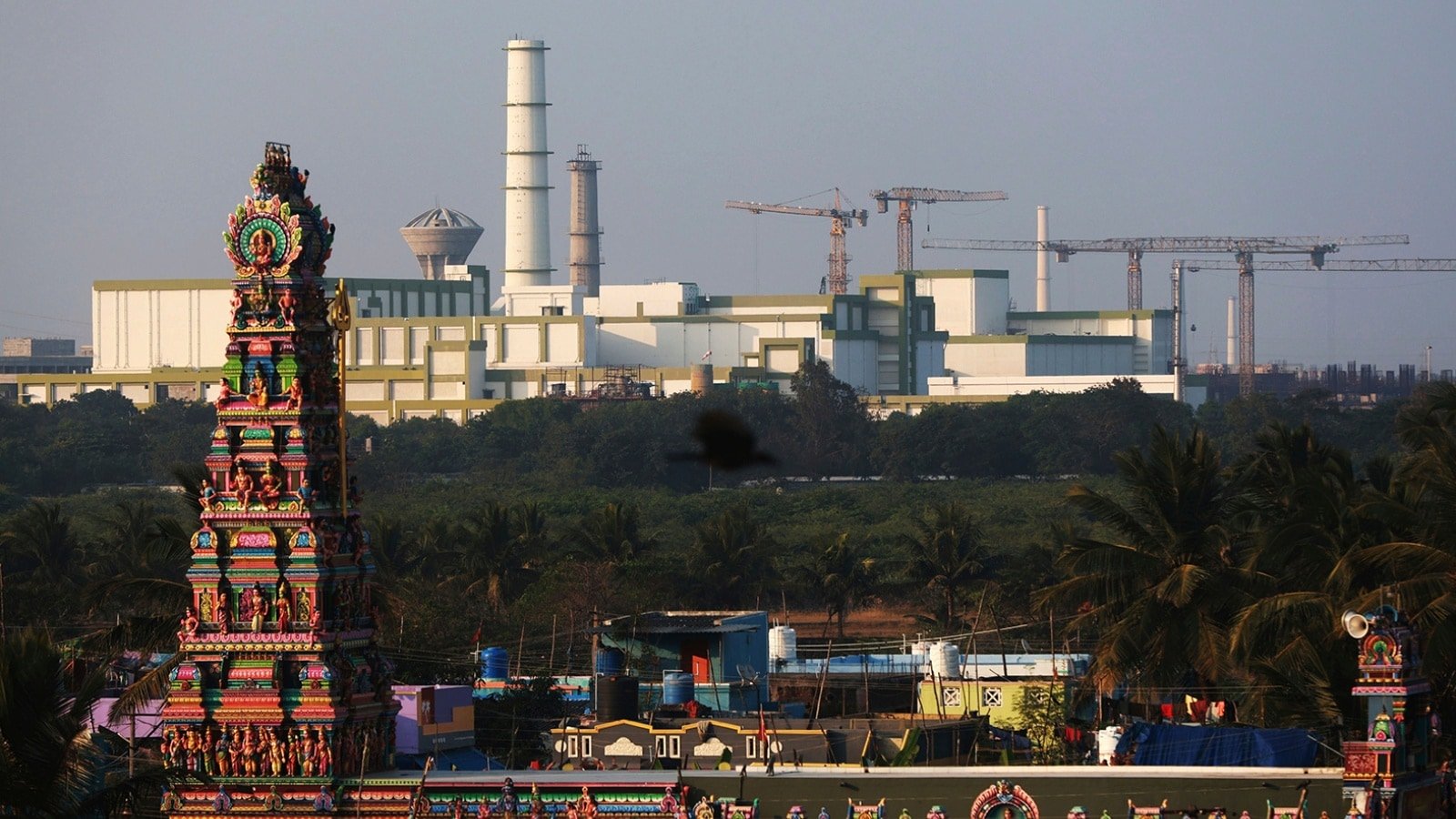
A temple in the foreground of the Madras Atomic Power Station at Kalpakkam, Tamil Nadu. (AP Photo)
A high-powered US nuclear ‘executive mission’ is headed to India later this month with a two-pronged agenda: Taking stock of India’s nuclear energy landscape less than six months after a landmark legislation opened up this critical sector and to communicate the American industry’s interest, as well as coordinate US government messaging, on the emergent opportunities in this field.
Organised by the Washington DC-based Nuclear Energy Institute, a lobby group of America’s commercial nuclear energy industry, and the US India Strategic Partnership Forum, the industry delegation’s visit is expected to have meetings with External Affairs Minister S Jaishankar and Union Power Minister Manohar Lal, besides likely meetings with Andhra Pradesh Chief Minister N Chandrababu Naidu, Maharashtra Chief Minister Devendra Fadnavis and Gujarat Chief Minister Bhupendra Patel.
Deliberations planned during the course of the delegation’s five day schedule (May 17-21) include meetings with the Department of Atomic Energy top brass, NITI Aayog, other energy ministries and representatives of state-owned Nuclear Power Corporation of India Ltd (NPCIL) and NTPC Ltd.
Also Read | SHANTI Bill: How India is overhauling its nuclear power sector
The delegation would likely land in New Delhi on May 17 and stay until May 19, before heading to Mumbai on May 20 for a series of meetings spanning two days. US Ambassador Sergio Gor and the US Embassy staff are likely to set the agenda for the delegation’s series of formal meetings that get underway on the morning of May 18.
The Mumbai leg is likely to include meetings with India’s private sector energy players including Reliance Industries Ltd, the Adani Group, Tata Power Company Ltd, JSW Energy, Vedanta, Larsen & Toubro Ltd, Tata Consulting Engineers and Hindalco Industries.
Last December, Parliament had passed the Sustainable Harnessing and Advancement of Nuclear Energy for Transforming India (SHANTI) Act, 2025, marking a major shift in how India’s tightly-controlled nuclear power sector will be governed in the coming years. For the first time, the Act enabled private players to enter the operations side of this critical sector as well as areas such as fuel management, which had remained under tight public-sector control for decades.
SHANTI Bill and RTI | By keeping itself out of RTI ambit, why SHANTI Bill has raised transparency concerns
Alongside the increased role for the private sector in nuclear plant operations, the deployment of imported Light Water Reactor-based projects, aided by foreign funding, are two outcomes in the wake of the passage of the new legislation, which opens up the possibility of more imported LWR-based nuclear projects of the kind that are being set up by the Russians in Kudankulam, Tamil Nadu. India is also keen to look at the possibility of the deployment of small modular reactors or SMRs.
Story continues below this ad
Explained
Looking at future
The SHANTI law aims to transform the country’s energy landscape. Private players will be allowed into operations and fuel management, accelerating capacity while breaking state monopoly. The focus on imported light water reactors and small modular reactors suggests a move towards next-generation technology that is simpler to finance and deploy.
Although India’s civil nuclear programme has expertise in manufacturing pressurised heavy water reactors – from 220MWe PHWRs to the new 700MWe reactors – an impediment of sorts for the country’s nuclear establishment is its reactor technology. Based on heavy water and natural uranium, the PHWRs are a technology that India’s nuclear establishment has a mastery over, but one that is increasingly out of sync with the LWRs that are now the most dominant reactor type across the world. The Americans, the Russians and the French are among the leaders in LWR technology. Also, India’s dominant nuclear technology – its mainstay PHWRs – has scalability issues.
The government’s move to look outwards for collaborations on nuclear is driven by two clear policy imperatives: the desperate need for base load alternatives to coal-fired capacity to tide over the limitations of renewables; and more importantly, the external outreach for nuclear collaborations is driven more by the need for capital than the need for technology, a top government official had indicated ahead of the passage of the nuclear amendments.
Also Read | SHANTI Bill is India’s second shot at nuclear energy leadership
The SHANTI Act was passed amid Opposition’s concern over allowing private players and changes in the liability regime, particularly the whittling down of provisions fixing responsibility on equipment suppliers in the event of a nuclear accident. This new Act replaced two earlier legislations – the Atomic Energy Act, 1962 (AE Act) and the Civil Liability for Nuclear Damage Act, 2010 (CLNDA) – and effectively redrew the rules that govern India’s nuclear power sector. From who can build and operate plants and how accident liability is capped, to the role of the safety regulator and the mechanisms for dispute resolution and compensation, all of these have been tweaked or changed.
