

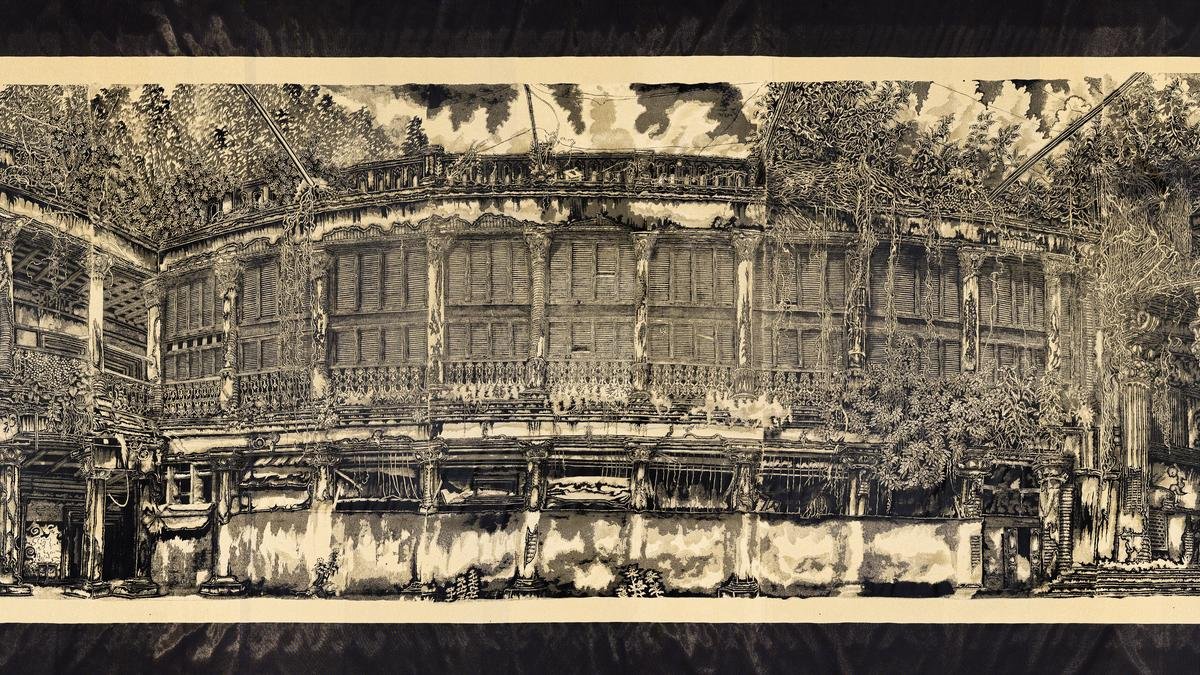
At The Weight of Light, currently on view at the Art Centrix Space gallery in Vasant Kunj, Delhi, French artist Thomas Henriot brings together years of observation, travel, and quiet engagement with architecture in India. The works on display are not just drawings of places; they feel like time spent with them.
On display are eight tapestries and 14 drawings.
Henriot’s process is simple but demanding. He works with Korean bamboo paper and Chinese ink, using a traditional ink-and-wash technique. There are no preliminary sketches. “There’s no first drawing and there’s no sketch. I work directly with brush and ink on the paper, you can’t correct,” explains Henriot.
He sits on the ground, often for long stretches, sometimes days, working from morning to evening. “It’s actually a sort of meditation process. I start around 8am and go on till 6pm.” For him, this is not labour-intensive. “I have been doing this for almost 25 years. For me this is the easiest way to work.”
What he is really doing in that time is observing. Not just looking, but absorbing the energy and vibe of the place
He understood it as a meditative process when he came to India and starting working on the ghats of Banaras. “I realised that this is yoga.”
This approach becomes especially visible in the works he has created across India. Whether it is the ghats of Varanasi, the deep stepwells of Jaisalmer, or the regal and expansive Mehrangarh Fort, Henriot spends hours sitting within these spaces before drawing them.
His works don’t capture a single moment but a succession of moments.
Light plays an important role in his art. Monica Jain of Art Centrix Space, who has also curated the show, remarks, “Thomas treats light like a living entity; he captures it shifting and as he does that, everything comes alive.”
He observes how light shifts through the day, which is why his drawings don’t appear static. They seem to change as you look at them.
At the centre of the exhibition is the Basu Bati Palace, a structure Henriot has returned to again and again over the years. Basu Bati is an iconic structure that is loaded with history and culture; drawings were created on-site during Henriot’s residency with the Basu Foundation for the Arts.
“I could observe during more than a decade the evolution of the old palace. Sadly, it’s not being restored, so I have seen slowly Nature take on the architecture.”
The palace, now in a state of visible decay, becomes a powerful subject. Paint peels, walls crack, and plants begin to take over. Henriot does not separate these elements. In his work, architecture and Nature exist together.
Interestingly, his process reflects this idea. He begins by drawing Nature first and only later places the architecture behind it. “In my drawing, architecture depends on Nature,” he explains.
The result is work that feels layered and alive and not rigid or fixed.
What makes this body of work even more striking is how it has moved beyond paper. Henriot has collaborated with Brochier Soieries, a silk manufacturer established in 1890 in Lyon, France, to translate his drawings into large-scale textiles using the jacquard weaving technique. These are not simple reproductions.
At the centre is a monumental tapestry of the Basu Bati Palace. Measuring 700 by 200 cm, it is woven with 20,000 threads in silk, cotton and gold. It captures every detail: the cracks, the overgrowth, and the fading structure. The gold threads do not decorate the image; they add meaning to highlight how the structure lives on in people’s memories.
For Henriot, this shift into textiles was intentional. “I wanted the painting not only to be in a frame… I wanted it to live in a different way,” he says.
There is also something important about where this work is shown. Much of his practice exists outside the traditional studio. He prefers working in public spaces, staying connected to the environment and the people around it.
“The stroke is something alive, and once it is made, it cannot be changed.”
Perhaps that is why his works feel the way they do. They are not just images of places like Banaras or Jodhpur. They are experiences of time, light, decay, and renewal, held in ink, and now, in thread.
The exhibition is on at Art Centrix Space, Jain Farm, Vasant Kunj, till May 12. Art Centrix Space plans to exhibit the works in Kolkata soon.
Published – May 08, 2026 09:37 am IST
Read Comments
Copy link
Telegram
SEE ALL
Remove
Related Topics
The Hindu MetroPlus
