

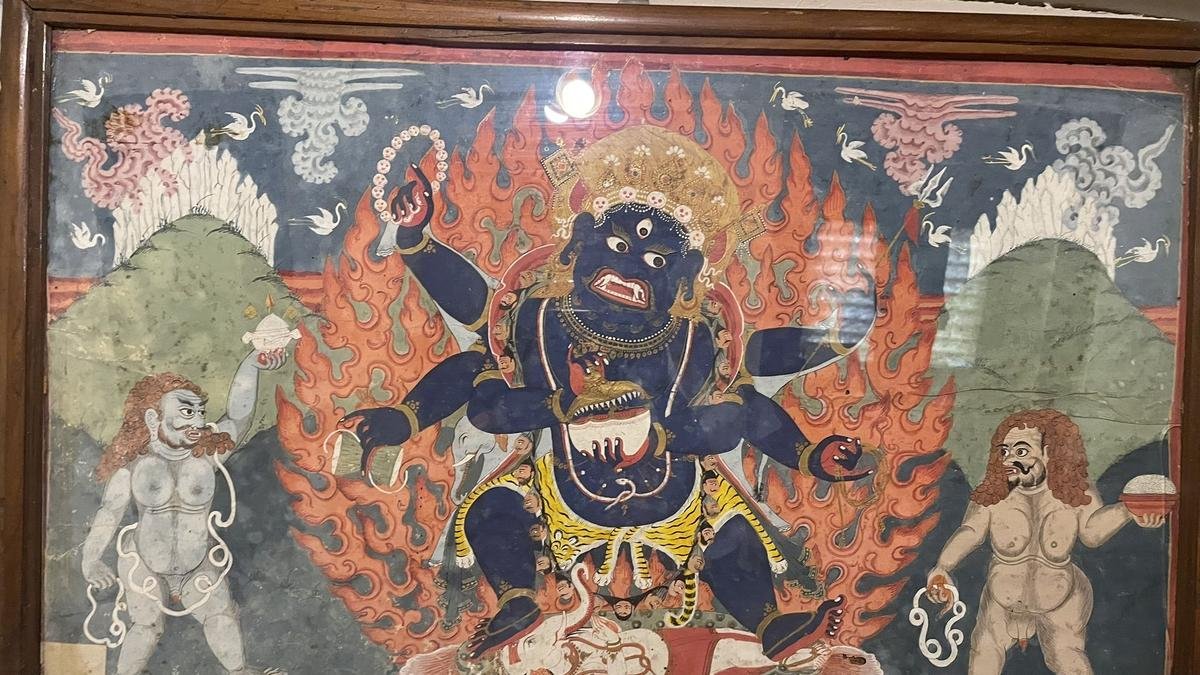
The first thing that struck me in Bhaktapur, Nepal, was the silence — not the absence of sound, but a kind of reverential hush that settled over its brick lanes and temple courtyards. It was the kind of quietness that prepared one for what lay behind unassuming wooden doors: worlds within worlds, painted with devotion, discipline and patience.
One of my most memorable experiences at this UNESCO World Heritage Site was being at the workshops of thangka artists — some barely 18, others well into their 70s and 80s — who have spent their lives practising an art form that is as much a spiritual pursuit as a visual expression. Volleying between these studios, witnessing centuries-old traditions unfold was deeply immersive.
The five-tiered Nyātāpola temple, in Bhaktapur, the tallest one in Nepal.
| Photo Credit:
Special Arrangement
In one such workshop, tucked into a narrow alley off Durbar Square, was seated the 72-year-old master artist Tsering Lama. His fingers, stained with pigment, moved steadily across a canvas as he outlined the serene face of a Bodhisattva. “You don’t paint a thangka,” he told me without looking up. “You enter it.”
Sacred grammar
That idea — of ‘entering’ rather than creating — became the thread that tied my experience together. Thangka, rooted in Tibetan Buddhism, is not merely a decorative art. It is a disciplined spiritual practice governed by strict iconographic rules. Every line, proportion and colour have a prescribed meaning. The geometry of a deity’s face, the angle of a hand gesture, the placement of a lotus — all these are dictated by ancient texts passed down generations.
In another workshop, 19-year-old Sonam carefully sketched a grid onto a blank canvas. “This is the foundation,” he explained. “Without the right proportions, the deity loses its spiritual integrity,” said the teen, who has been apprenticing since the age of 12, learning first to draw basic forms before graduating to more complex compositions. “It takes years before you are allowed to paint a face,” he added.
The process begins long before the first brushstroke. Cotton canvas is stretched over a wooden frame and coated with a mixture of chalk and animal glue, then polished smooth with a stone. Only then does the artist start to draw, mapping out the composition with mathematical precision. Watching this unfold, one is struck by how little room there is for error — and how much room there is for devotion.
Hands, stained with pigment, move steadily across a canvas.
| Photo Credit:
Special Arrangement
Time seemed to stand still inside these workshops. Hours pass as artists grind natural pigments using stone mortars — lapis lazuli for deep blues, cinnabar for vivid reds, crushed malachite for greens. Gold dust is mixed carefully and reserved for the most sacred elements. The air carried the faint metallic tang of minerals and the earthy scent of handmade materials.
“Natural colours have life,” said 45-year-old artist Pema Shrestha, holding up a small bowl of blue pigment. “Synthetic paints are easier, cheaper — but they don’t carry the same energy.” He remains committed to traditional methods despite rising costs and shrinking margins. “This is not just about selling paintings, but about preserving a lineage,” he added.
For Buddhists in Nepal, thangkas function as visual scriptures and meditation tools. They guide practitioners through complex cosmologies, offering a map of spiritual understanding. Deities are rendered with precise iconography — each gesture (mudra), posture and attribute are layered with meaning. A raised hand might signify protection; a lotus could represent purity; a flaming halo might denote transformation.
Colours, too, are deeply symbolic — Gold represents enlightenment; blue signifies infinity and wisdom; and red, power and compassion. Watching these hues come alive on canvas, one can understand how a thangka is less a painting and more a coded language — one that requires years of study to read and a lifetime to master.
A view of Bhaktapur Durbar Square.
| Photo Credit:
Special Arrangement
It was in a sunlit studio overlooking a courtyard where 28-year-old artist Mingma, a fourth-generation thangka painter, was at work. His grandfather, now 84, still works alongside him, occasionally correcting a line or offering guidance. Said Mingma, “We don’t learn from books alone, but by watching, doing, and being corrected.”
When asked about the challenges faced by younger artists, he paused and said, “The biggest challenge is patience. People want quick results, quick money. Thangka doesn’t give you that.” A single piece can take weeks or even months to complete, depending on its complexity.
There are economic pressures, too. While the demand for thangkas exists — especially among tourists and collectors — mass-produced replicas have flooded the market, often at a fraction of the price. “It’s difficult to compete with machine-made or factory work,” said Mingma. “But those pieces don’t carry the same spirit.”
Despite these challenges, there’s a quiet resilience within these communities. Many have adapted by offering training programmes to international students. In one such studio, a group of students from Europe were hunched over their canvases, trying to replicate the delicate lines of a Buddha under the watchful eye of their teacher.
“This interest from foreigners gives us hope,” shared teacher Tsering Lama. “It shows that our tradition still has value.” Yet, for most artists here, the motivation transcends recognition or financial reward. An elderly artist, applying gold leaf to a halo, shared that constant learning, even after decades of practice, keeps him going. The humility and that sense of pursuit seem to define the world of thangka painting.
For the artists Thangka is more than just a painting.
| Photo Credit:
Special Arrangement
As I left Bhaktapur, the images stayed with me — not just of the finished works, but the process behind them. The grinding of pigments, the steady hands, and the intergenerational conversations that unfold in quiet studios. In a rapidly changing world, where speed often trumps substance, these workshops stand as quiet acts of resistance.
How to Reach Bhaktapur
Bhaktapur lies about 13 km from Kathmandu and is a 30–45 minute drive from Tribhuvan International Airport.
Taxis are the most convenient option, while local buses and shared tempos run regularly from Kathmandu’s Ratna Park and Bhaktapur Bus Park.
Where to Stay
For an immersive experience, stay within the old city near Durbar Square. Charming heritage properties offer easy access to temples and thangka workshops.
Published – May 05, 2026 05:37 pm IST
Read Comments
Copy link
Telegram
SEE ALL
Remove
Related Topics
Friday Review
