

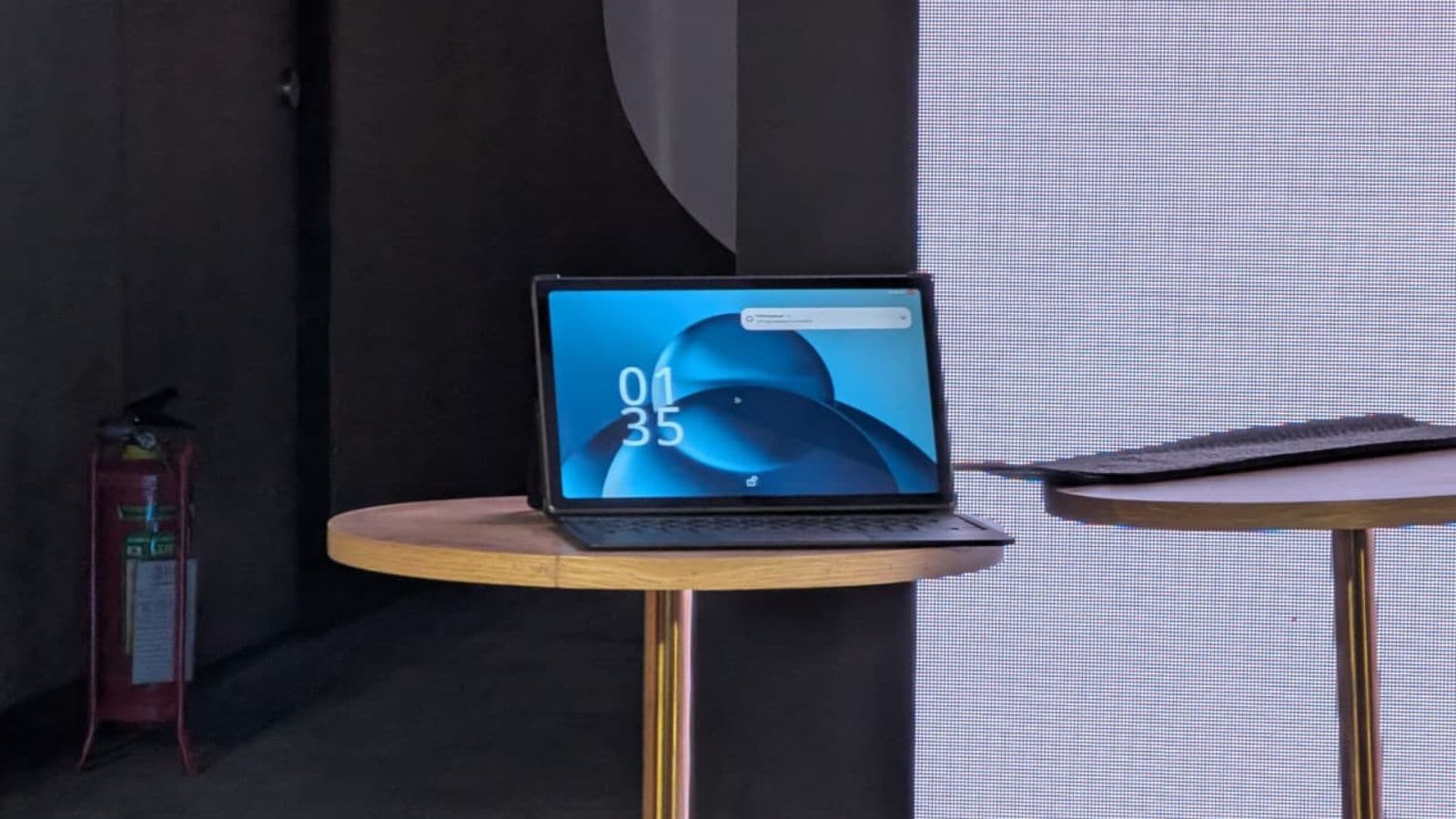
Post Content OmniPad 12, which is being launched in India first, is an important product for HP in the mid-tier tablet market. (Image: Anuj Bhatia/The Indian Express)
HP Inc is making a comeback in the tablet category after exiting the market in 2011, renewing its efforts to win over consumers from Apple Inc, Samsung Electronics, and Chinese rivals. The Palo Alto, California, headquartered company Monday launched the OmniPad 12, a tablet aimed at students, first-time users, and professionals on the go, beginning with India, the world’s fastest-growing market for global brands.
Priced at Rs 48,999 and available from June, the OmniPad 12 is HP’s latest attempt to challenge Apple’s iPad and other entry-level tablets dominating classrooms and first-time buyer markets, with its dual-mode functionality.
The tablet is powered by Qualcomm Inc’s Snapdragon processor, runs on Alphabet Inc’s Android operating system, and features a 12-inch touchscreen display, a detachable keyboard, and up to 18 hours of battery life.
Renewed effort
HP’s re-entry into the tablet market had been kept under wraps until the device debuted Monday at an event at the company’s Gurgaon office.
HP, the world’s second-largest PC maker by market share, is not new to the tablet category. The company once sold tablets under the TouchPad brand, which rivalled the iPad. However, it proved to be one of the shortest-lived tablet brands on the market.
HP is making a comeback in tablets. (Image credit: HP)
In 2010, HP acquired a struggling mobile device maker for $1.2 billion and saw an opportunity to differentiate its tablets from rivals through the WebOS operating system, one of the first mobile operating systems with strong multitasking capabilities. The HP TouchPad, however, failed to gain traction. Later, HP switched to Android for the Slate 7, a budget tablet, but that experiment did not take off.
Also Read | HP unveils IQ as on-device AI, high-performance PCs to help accelerate enterprise AI adoption
Despite being a household name, HP failed to make a dent in the tablet and smartphone categories, a tacit admission that the iPhone and Google’s Android operating system had achieved a dominant position among consumers. The final nail in the coffin came when HP ceased production of its tablets and smartphones and exited both categories after only two years.
Story continues below this ad
Tapping India
Young consumers don’t even remember WebOS or the TouchPad, yet years later, HP is making a comeback in tablets, with India among the most critical markets for any large tech company. It is a massive market with an expanding middle class and a young consumer base, and it potentially serves as a test market for companies to launch products first and then replicate the formula in other markets.
Tablets may have matured as a category, with the iPad remaining a popular choice among consumers. This still makes the OmniPad 12, which is being launched in India first, an important product for HP in the mid-tier tablet market, particularly in price-sensitive markets like India.
Even though the iPad is the undisputed global leader, in India, HP’s primary competitors will be Samsung Electronics, Lenovo Group Ltd, and Xiaomi Corp. Combined, all major players, including Apple, shipped roughly 4.4 million tablets in 2025.
Challenges for HP
Over the years, tablets have gained features and processing power to run nearly any app, to the point that brands are marketing them as laptop replacements. However, from a product standpoint, they still cannot match PCs.
Story continues below this ad
“It is a good decision for HP to enter this space when the tablet market has been growing. Parents are buying them for their kids, for personal OTT consumption, and light productivity,” Navkendar Singh, Associate Vice President, International Data Corporation, told indianexpress.com.
Singh pointed out the availability of much better-quality tablets from Chinese brands at more affordable price points. He said that he sees some challenges for HP, particularly its image as a PC brand. “It will be tough since consumer tablets are positioned in consumers’ minds closer to the phone category than to PCs,” he said.
Also Read | HP refreshes EliteBook laptop lineup with AI-centric X G2 series
Singh also noted that positioning and distribution of the OmniPad 12 will be key. “This will require a different kind of marketing and placement in large format retail stores and online channels.”
He said the key challenge for HP or any major consumer-facing tech brand entering a new product category, especially at this point in time, is how to secure enough memory and components and price the product correctly. The world is facing an unprecedented crisis in which AI companies are buying up memory chips, driving prices for those components, which are also used in laptops and smartphones, to soar.
