

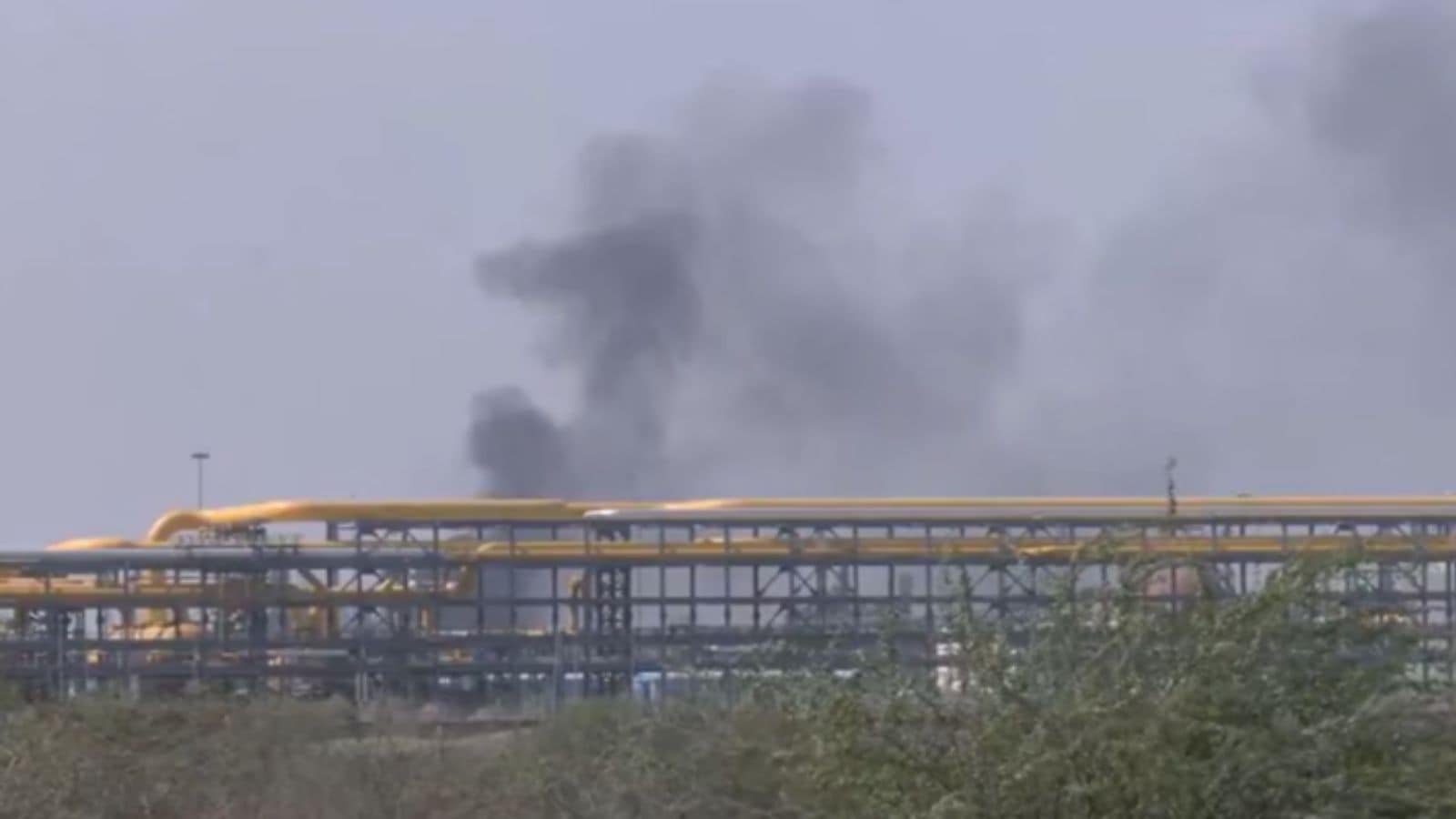
Tuesday’s planned inauguration of the HPCL Rajasthan Refinery (HRRL) refinery by Prime Minister Narendra Modi has been postponed after a fire broke out at the facility on Monday, the Ministry of Petroleum and Natural Gas (MoPNG) announced. The fire broke out in the crude distillation unit—a primary unit in an oil refinery—on Monday afternoon. The nearly Rs 80,000-crore HRRL refinery, located in Rajasthan’s Balotra district is set to be India’s first greenfield oil refinery since Indian Oil Corporation’s Paradip refinery was commissioned in 2016.
According to the MoPNG, the fire has was brought under control and there are no reports of any casualties due to the incident. A probe has also been launched into the incident.
“Due to an unfortunate fire incident today in the vicinity of the Crude Distillation Unit at the HRRL refinery, the scheduled dedication of the refinery by the Hon’ble Prime Minister on 21.04.2026 has been postponed. The fire has been brought under control. There are no reports of any casualties. An investigation has been initiated to ascertain the cause(s) of the incident and to undertake necessary remedial measures. A revised date for the dedication will be announced in due course,” MoPNG said in a post on social media platform X.
HPCL said that prima facie, it appears that leakage of hydrocarbons through one of the valves or flanges in the heat exchanger circuit caused the fire.
“The fire was promptly brought under control by the emergency response team of HRRL with support from the local Administration. There is no loss of life or injury to any personnel. The fire was localized in the heat exchangers stack. Crude Distillation Unit (CDU), Vacuum Distillation Unit (VDU), and all other Units of the CDU section were quickly isolated. All are structurally safe and unaffected. No other section of the refinery has suffered any impact,” HPCL said in a statement on X.
The cause of the fire and its impact are being assessed and investigated by a team of “internal and external experts”, the refiner added.
The CDU is the primary processing unit—the first unit in which crude oil is fed—in a refinery. This critical unt uses heat to separate crude oil into different fractions like naphtha, kerosene, diesel, gas oil, and residue, based on their different boiling points. These fractions are then sent to other refinery units for further processing, which leads to production of more fuels like petrol, aviation turbine fuel, and heating oil.
Story continues below this ad
The crude processing capacity of the HRRL refinery and petrochemical complex is 9 million tonnes per annum (mtpa), which includes 2.4 mtpa of petrochemical production. The refinery, which was to start commercial operations from July 1, is expected to process about 7.5 mtpa of imported crude and 1.5 mtpa of crude oil produced in Rajasthan. HRRL is a joint venture between public sector refiner Hindustan Petroleum Corporation (HPCL) and the Rajasthan government, with an equity participation of 74% and 26%, respectively.
Refineries can be vulnerable to accidents during the pre-commissioning and commissioning phases, as these phases see initial processing of hydrocarbons by new units and equipment. In fact, a few days before IOC’s Paradip refinery was to be inaugurated in February 2016, a fire had broken out at the facility.
The HRRL project was first announced in 2008, but could not take off for years due to differences with the state government on fiscal incentives. Once the issues were resolved, work on the project site began in 2018. The facility is a highly complex one and will be able to process nearly all types of crudes. The HRRL refinery has a Nelson Complexity Index of 17, making it the most complex public sector refinery in India; Reliance Industries’s (RIL) mega refining complex has a higher complexity level than the HRRL refinery. The Paradip refinery, inaugurated a decade ago, has a Nelson Complexity Index of 12.2. Higher the Nelson Complexity Index, the more advanced a refinery is, particularly in terms of being able to process low quality and cheaper crudes.
The complex will produce Bharat Stage VI (BS-VI) grade petrol, diesel, apart from other fuels and various petrochemical products. Apart from robust fuel demand, demand for petrochemicals in India is slated to rise rapidly in the years to come. Despite its large size and population, the per-capita petrochemical consumption in India is significantly lower than developed economies.
Story continues below this ad
The HRRL refinery will mark a key addition to India’s refining capacity, taking it close to 270 mtpa. Although India depends on imported crude to meet over 88% of its requirement, the country is the world’s third-largest consumer of crude oil and the fourth-largest refiner. According to outlooks by most international energy think tanks, India is set to overtake China as the biggest driver of oil demand globally within the next few years.
