

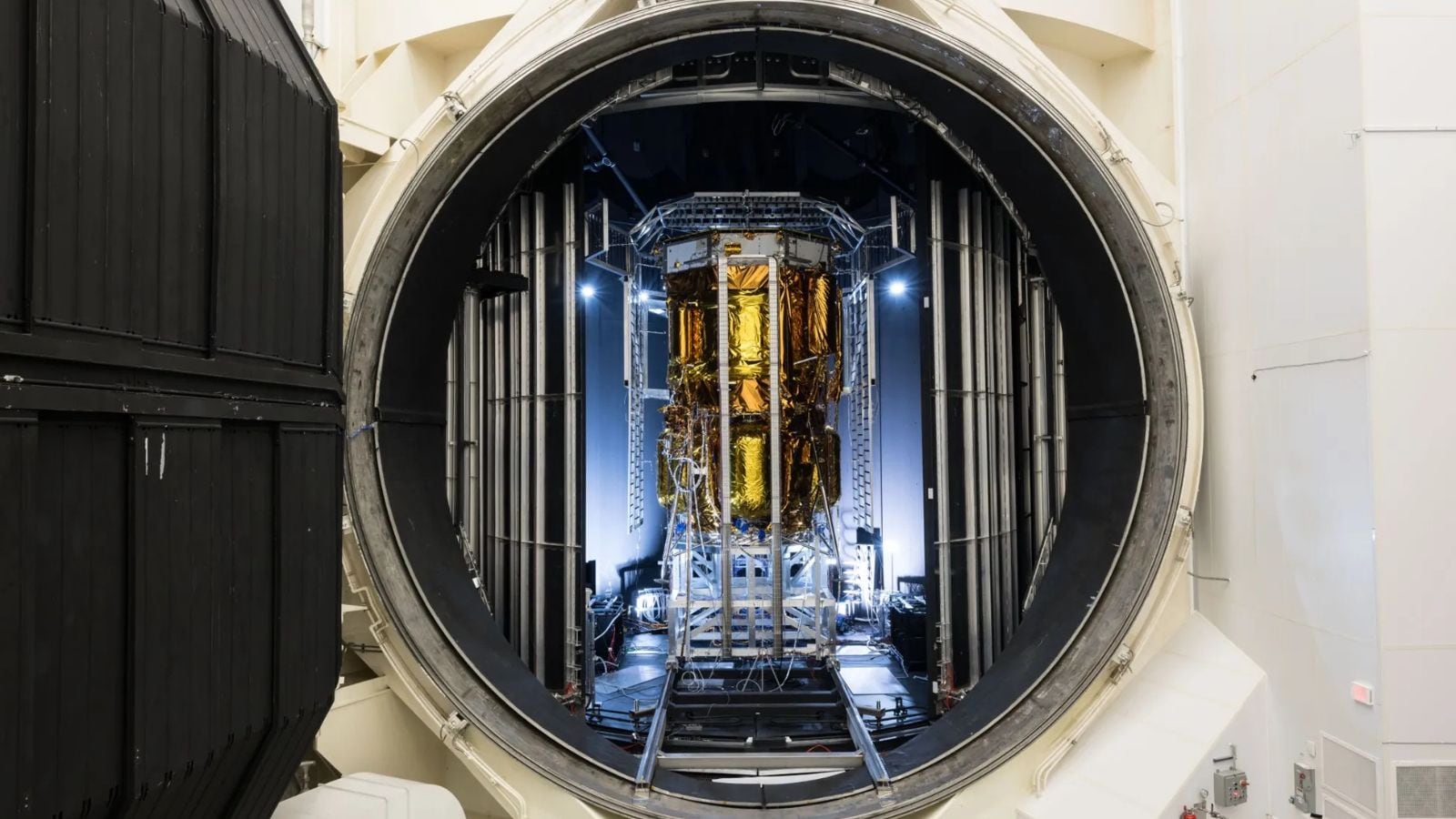
Post Content This lander does not carry any crew but can deliver necessary cargo and other items to the Moon’s surface. This unmanned craft is part of the effort aimed at achieving the goals set out by the Artemis program. (Image: Nasa)a
Blue Origin has successfully completed a major round of testing for its lunar lander inside a specialised vacuum chamber at Nasa’s Johnson Space Center, marking an important step towards future Moon missions.
The spacecraft, known as Blue Moon Mark 1 (MK1) or “Endurance”, underwent environmental testing inside Thermal Vacuum Chamber A, one of the largest facilities of its kind in the world. MK1 is subjected to the same conditions experienced in space, such as freezing cold temperatures and almost no air.
What the test means
The purpose of this test was simply to confirm that the lander could withstand the conditions in space and work effectively. Therefore, engineers managed to recreate the environmental conditions the lander would face on its way to the Moon.
Testing on Earth helped to determine if the lander’s structure, thermal control systems, and overall performance were ready for a lunar mission.
The test was conducted in collaboration between Nasa and a private space firm, namely Blue Origin, which have entered into a Space Act Agreement.
What Is Blue Moon MK1?
This lander does not carry any crew but can deliver necessary cargo and other items to the Moon’s surface. This unmanned craft is part of the effort to achieve the goals set out by the Artemis programme.
Also Read | Astronomers identify 27 potential twin-sun planets similar to Star Wars’ Tatooine
MK1’s primary mission will be to demonstrate some vital capabilities necessary for a successful landing on the lunar surface. Some of these include accurate landing techniques, the use of cryogenic propellant systems, and the ability to autonomously perform guidance, navigation, and control.
Story continues below this ad
The lander itself will aim for the south pole of the Moon. The area is highly promising because it may be used as a future base for exploring the rest of the moon. It has water ice, which will provide resources for future missions.
In addition to performing experiments of its own kind, MK1 will also carry out several scientific experiments onboard. One of these is the Stereo Cameras for Lunar Plume-Surface Studies, consisting of several high-quality cameras that will be capturing interactions between the plume generated by the engines and the Moon’s surface during landing. The other is the Laser Retroreflective Array.
Preparing for human missions
While MK1 is a cargo mission, it plays a much larger role in the long-term plan. The technologies being tested will directly contribute to the development of Blue Origin’s Mark 2 (MK2), a larger, crew-capable lander designed to transport astronauts between lunar orbit and the Moon’s surface.
Also Read: Why Nasa shut down a key Voyager 1 instrument after 49 years
Story continues below this ad
The insights gained from MK1’s design, testing, and operations will help improve safety, reliability, and mission planning for future human landings.
A step towards sustained lunar exploration
The Nasa method will enable the private company to make use of the resources provided by the space agency, which will aid in expediting the process without compromising on safety.
Now that testing is done, Blue Moon MK1 takes one step forward in becoming a reality, a crucial part of the creation of a human presence on the Moon.
© IE Online Media Services Pvt Ltd
