

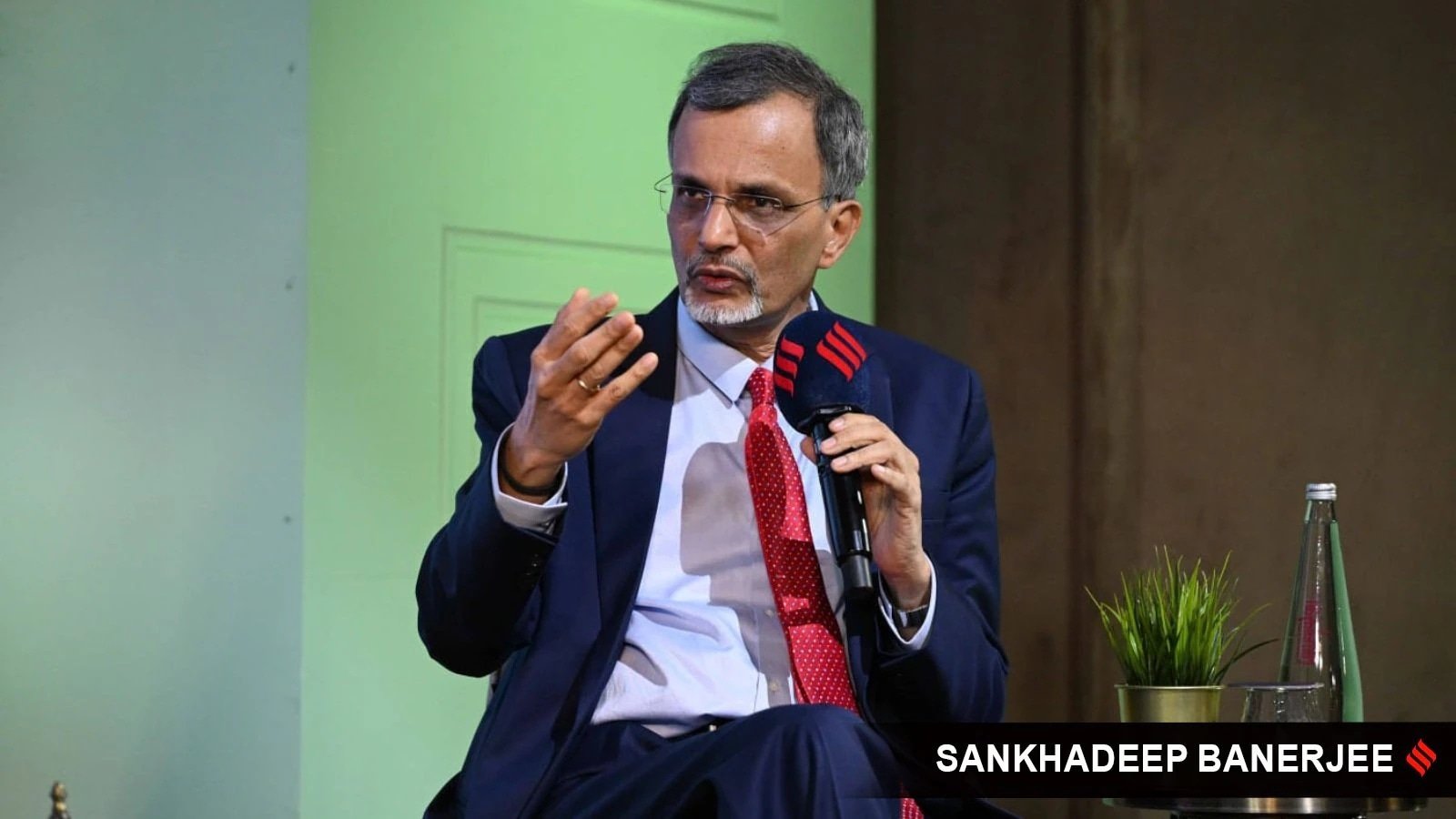
Chief Economic Advisor V Anantha Nageswaran. (Source: Express File)
The Indian government is “not insulated” from how states react to the West Asia crisis, Chief Economic Advisor (CEA) V Anantha Nageswaran said, adding that demand for more funds due from fiscally-stretched states at a time of external shock adds to the Centre’s own challenges.
Speaking at a seminar on state finances organised by the Institute of Economic Growth on Monday, Nageswaran said any honest assessment of state finances must be against the challenging global backdrop. And while the shocks don’t originate at the state level, that’s where they are absorbed, with stress landing on areas such as food and fuel subsidies, fertiliser allocation, agricultural support, and employment programmes.
“In other words, states are not insulated from what happens in the Strait of Hormuz. And I can also tell you that the sovereign is not insulated by how states respond to the Strait of Hormuz as well, because ultimately the combined fiscal deficit is what feeds into the current account deficit,” the government’s top economist said.
While the Centre’s fiscal deficit target of 4.3% of GDP for 2026-27 has come under pressure due to the rising costs from the impact of the war in West Asia, international investors and global ratings agencies look at the combined deficit at the national and state level.
Referring to a recent finance ministry analysis of 18 states’ budgets for 2026-27 that found half of them were set to post a revenue deficit, Nageswaran said that when external shocks hit, it is fiscally-constrained states that “press the hardest on the Centre and they do so at the very moment when the Centre itself is going to be facing significant challenges in the current financial year in meeting its fiscal deficit goals”.
“The resulting dynamic therefore places stress on the general government fiscal position which is now assessed by global investors as an integrated whole, not merely as a Union government number… Fiscal indiscipline at the subnational level is no longer a closed, domestic accounting matter. It is visible and it is priced,” the CEA said.
While the government has largely shielded households from the energy shock caused by the war in West Asia, the fiscal arithmetic has become “more complicated and will likely remain so” for much of 2026-27, Nageswaran said on Monday, with fertiliser costs set to be substantially higher, leading to a higher subsidy bill. Saying that India’s public finances is in “very large measure a story of its states”, the CEA said that as the country moves towards a higher income status, the efficiency and quality of resource allocation at the state level will increasingly determine not just the pace of growth but how inclusive and sustainable it is.
Story continues below this ad
In its Monthly Economic Review report for April, released last week, the finance ministry had said of the 18 states whose 2026-27 budgets had been analysed, eight – Odisha, Jharkhand, Uttar Pradesh, Goa, Gujarat, Uttarakhand, Telangana, and Bihar – were expected to post a revenue surplus, with an average fiscal deficit of 2.94%, interest payments amounting to 8.61% of revenue receipts, and outstanding liabilities and capital outlay at 24.24% and 4.08% of their state GDP, respectively. In contrast, nine states – Chhattisgarh, Maharashtra, Karnataka, Haryana, Rajasthan, Andhra Pradesh, Kerala, Punjab, Himachal Pradesh – with a budgeted revenue deficit in 2026-27 had worse average numbers across the board: a fiscal deficit of 3.44%, interest payments at 16.1% of revenue receipts, and outstanding liabilities and capital outlay at 31.6% and 2.04% of state GDPs, respectively.
“But this is where economic analysis ends and political economy begins. The fruits of capital expenditure are probably felt with a time lag. So, there is a time inconsistency problem between who gets to spend and who gets to reap the benefits of it,” Nageswaran said, adding that this problem doesn’t occur with cash transfers that have expanded significantly in recent years. And while targeted cash transfers support consumption, smoothen incomes at times of uncertainty, and empower women and marginalised groups, Nageswaran said it is a problem when these recurring and committee expenditures are in lieu of investments and pushes up revenue deficits, which are then financed through borrowings. Over time, this trade-off becomes visible in the form of infrastructure gaps and quality of public services, the CEA said.
