

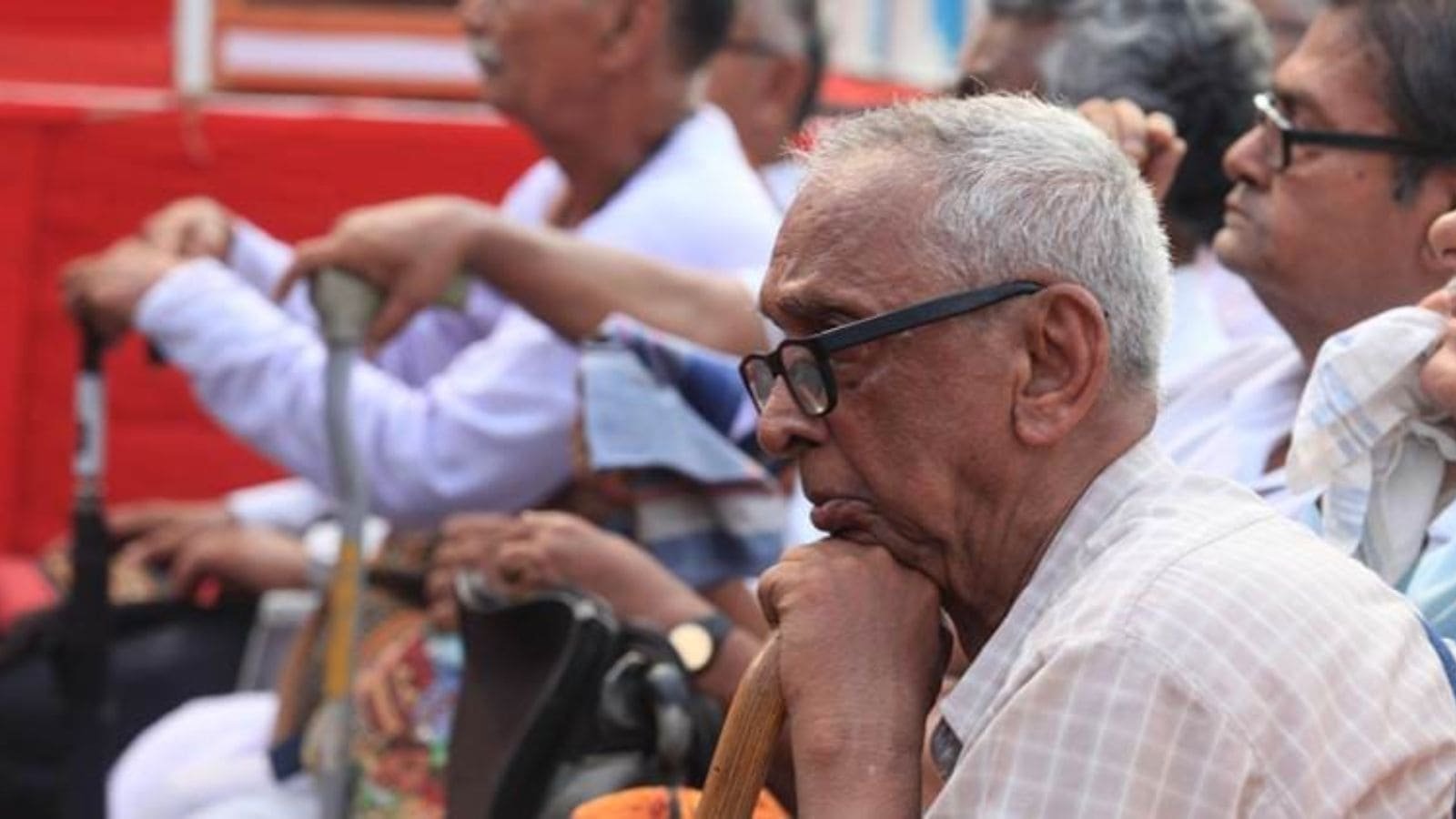
With the Centre’s contribution to monthly old age pensions unchanged at Rs 200–500 per beneficiary since 2012 under the National Social Assistance Programme (NSAP), the real value of these fixed cash transfers has “significantly eroded” due to inflation, an evaluation commissioned by the Union Ministry of Rural Development has found.
According to the report, inflation has reduced the real value of these cash transfers by around 45 per cent and adjusted to the current Consumer Price Index (CPI), a pension of Rs 200 would now need to be about Rs 353 to retain its original purchasing power.
The findings are part of a report titled “Impact Assessment and Evaluation of the National Social Assistance Program (NSAP),” which was submitted to the ministry recently. The evaluation study was conducted across Assam, Andhra Pradesh, Telangana, Uttar Pradesh, Bihar, Haryana, Gujarat, Jammu and Kashmir, Tamil Nadu, and Chhattisgarh.
Also Read | Old Pension Scheme unsustainable for states; concept of funded pension account essential: PFRDA Chairperson Sivasubramanian Ramann
The study points out that the monthly pension amount was revised to Rs. 200 for old age people between 60 and 79 years of age, to Rs. 300 for widows (40-79 years) and persons with disability (18-79 years), and Rs. 500 for beneficiaries of 80 years of age and above in 2012.
“Since then, there has been no upward revision in this amount, although consumption expenditure has grown substantially over the years and in the context of India making rapid strides on the economic front and recently becoming the 4th largest economy of the world,” states the study conducted by the Academy of Management Studies (AMS), a Delhi-based research and consulting firm.
“Considering 2012 as the base with CPI at 100, it rose to 191 in 2024, reflecting a 91% cumulative increase… Based on this increase, the pension amount should have proportionately risen from Rs. 200 and Rs. 500 to Rs. 382 and Rs. 955, respectively.”
“Further, average inflation of about 5% annually (2010-2024) has significantly eroded the real value of fixed cash transfers. The central pension component of Rs 200-500 per month has remained unchanged since 2012. Adjusted with the current CPI, the value of Rs 200 would now need to be Rs 353 merely to preserve its earlier purchasing power. Thus, in effect, the real benefit has fallen by nearly 45%,” it says.
Recommendations
Story continues below this ad
The study has recommended a National Floor Pension (NFP) on the lines of the National Floor Level Minimum Wage set by the Ministry of Labour and Employment.
“This would ensure a minimum level of financial assistance uniformly across all states. The NFP should be linked to the Consumer Price Index to automatically adjust with inflation, with annual revisions based on the cost of living. Additionally, states should be encouraged to provide top-ups to the central share in a uniform and transparent manner to reduce regional disparities in benefit levels,” states the report.
Launched in 1995, NSAP is a key social welfare scheme that provides pensions to vulnerable groups, including the elderly, widows, and persons with disabilities. Currently, NSAP covers five schemes, including Indira Gandhi National Old Age Pension Scheme (IGNOAPS), Indira Gandhi National Widow Pension Scheme (IGNWPS), Indira Gandhi National Disability Pension Scheme (IGNDPS), National Family Benefit Scheme (NFBS), and the Annapurna Scheme.
Under IGNOAPS, the Centre provides financial assistance of Rs 200 per month to individuals aged 60–79 years and Rs 500 per month to those aged 80 and above. Currently, more than 221 lakh beneficiaries are covered, the study noted.
Story continues below this ad
Also Read | Tamil Nadu, a pioneer in pension reforms two decades back, now reverses course
Under IGNWPS, the Centre provides Rs 300 per month to widows aged 40–79 years and Rs 500 to those 80 and above. According to the study, more than 67 lakh beneficiaries are currently covered.
Financial assistance of Rs 300 per month is provided to individuals with severe or multiple disabilities aged 18–79, and Rs 500 to those aged 80 years and above. According to the study, more than 8.8 lakh beneficiaries are covered.
The amount of one-time financial assistance under NFBS is fixed at Rs 20,000. This is provided to families after the death of a primary breadwinner aged 18 to 59. The report says that the assistance amount of Rs 20,000 under NFBS should have increased to Rs 38,200 (approximately Rs 40,000).
Under the Annapurna Scheme, 10 kg of food grains per month, free of cost, are provided to those senior citizens who, though eligible, were not receiving old-age pension.
Story continues below this ad
“States providing higher top-ups, such as Andhra Pradesh, Telangana, and Haryana, showed better outcomes in income stability and well-being. Revising the pension amount would therefore help ensure that NSAP continues to uphold its objective of providing dignity, security, and meaningful support to vulnerable citizens,” the study adds.
