

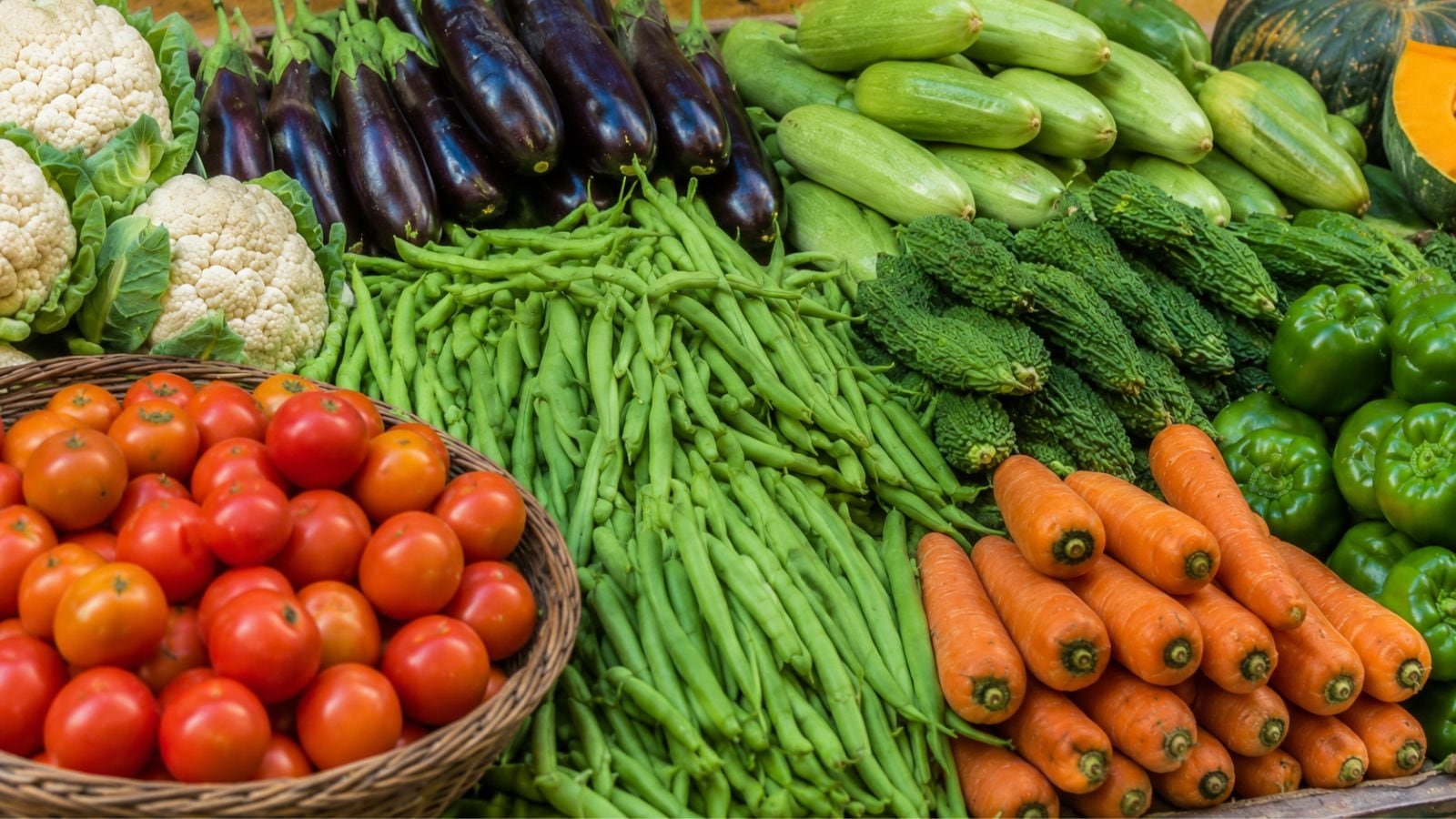
National statistics reveal a growing gap between rural and urban inflation rates as energy and climate risks loom. (Image generated using AI)
Retail prices rose 3.48% year-on-year in April, only slightly higher than the 3.4% increase recorded in March, as the government’s efforts to shield consumers from the West Asia energy shock continued to bear fruits. However, certain categories are increasingly seeing prices rising at a faster pace, with eating out in particular becoming more expensive, according to data released by the Ministry of Statistics and Programme Implementation (MoSPI) on Tuesday.
“After 74 days of the West Asia conflict, the upside risks…seem to be materialising at a snail’s pace. That indicates the consumer remains largely protected so far,” Dharmakirti Joshi, Chief Economist at ratings agency Crisil, said.
In April, the ‘restaurant and accommodation services‘ category saw prices rise 4.2% year-on-year, sharply higher than the 2.9% increase seen in March, “reflecting the impact of higher commercial LPG prices and shortages impacting menu prices at eateries”, ANZ economists Dhiraj Nim and Sanjay Mathur said.
Also Read | Rupee at record low of 95.63, CEA sounds alarm: Preventing further fall a key imperative
The price index for the ‘restaurant and accommodation services’ category jumped 1.5% month-on-month in April as against sequential increases of a mere 0.4% in March and 0.2% in February. In comparison, the headline CPI was up 0.3% month-on-month in April, with the Consumer Food Price Index 0.2% higher, indicating subdued overall price momentum.
Retail prices, on the whole, have yet to show any impact of the West Asia war, with core inflation – an indicator of underlying price pressures – unchanged at 3.7% for the fourth month in a row, according to calculations by The Indian Express. This suggests, according to Piramal Finance Chief Economist Debopam Chaudhuri, that manufacturers across affected sectors such as plastics, pharmaceuticals, and personal care products “continue to absorb a significant part of the increase in input costs”.
While inflation remains within the Reserve Bank of Indi’s (RBI) tolerance band of 2-6%, the data shows higher input costs are being passed on to households.
In February, prices of 236 of the 358 items in the CPI basket were higher compared to January. This number rose to 286 in March and was broadly similar at 282 in April. Meanwhile, the number of items whose prices have fallen compared to the previous month decreased from 106 in February to 57 in March and 60 in April.
Story continues below this ad
“Rural inflation at 3.74% is at 15-month high and with around 90% year-on-year increase in the price of Indian crude basket in April, some spillover to the domestic price pressure is imminent in the coming months,” warned Rajni Thakur, Chief Economist at L&T Finance. Urban inflation stood at 3.16% in April.
Also Read | ExplainSpeaking: Why PM Modi’s call to save forex could slow down India’s growth
Interest rate hikes on the horizon?
At 3.48%, the April headline retail inflation based on the Consumer Price Index (CPI) was lower than what economists had expected and remains below the RBI target of 4%. However, the central bank as well as other economists are predicting prices will rise at a faster rate in the coming months. The RBI has forecast CPI inflation to average 4.6% in FY27: 4% in April-June, 4.4% in July-September, 5.2% in October-December, and 4.7% in the first three months of 2027. “Persistently elevated energy prices due to the West Asia conflict and possible El Niño conditions (which could have a negative impact on southwest monsoon) pose upside risks to inflation,” the RBI’s Monetary Policy Committee had said last month while leaving the repo rate unchanged at 5.25%.
According to Upasna Bhardwaj, Chief Economist at Kotak Mahindra Bank, the inflation outlook “remains clouded”. And while the RBI is seen staying on ‘wait and watch mode’ to assess the pass-through of higher global energy prices to consumers, “the risks for early rate hikes, probably from October onwards, are building up.”
Story continues below this ad
While MPC members have said that talk of interest rate hikes are not justified at the present juncture – external member Ram Singh told The Indian Express last week that such talk was “over the top” – economists are increasingly expecting the committee to raise the policy repo rate this year. Monday, HSBC economists said they expect the repo rate to be raised by 50 basis points (bps) in the second half of FY27 due to the “energy and El Niño shocks coinciding”. HSBC expects CPI inflation to average 5.6% this fiscal, a full percentage point higher than what the RBI has forecast.
The MPC is scheduled to next meet June 3-5.
