

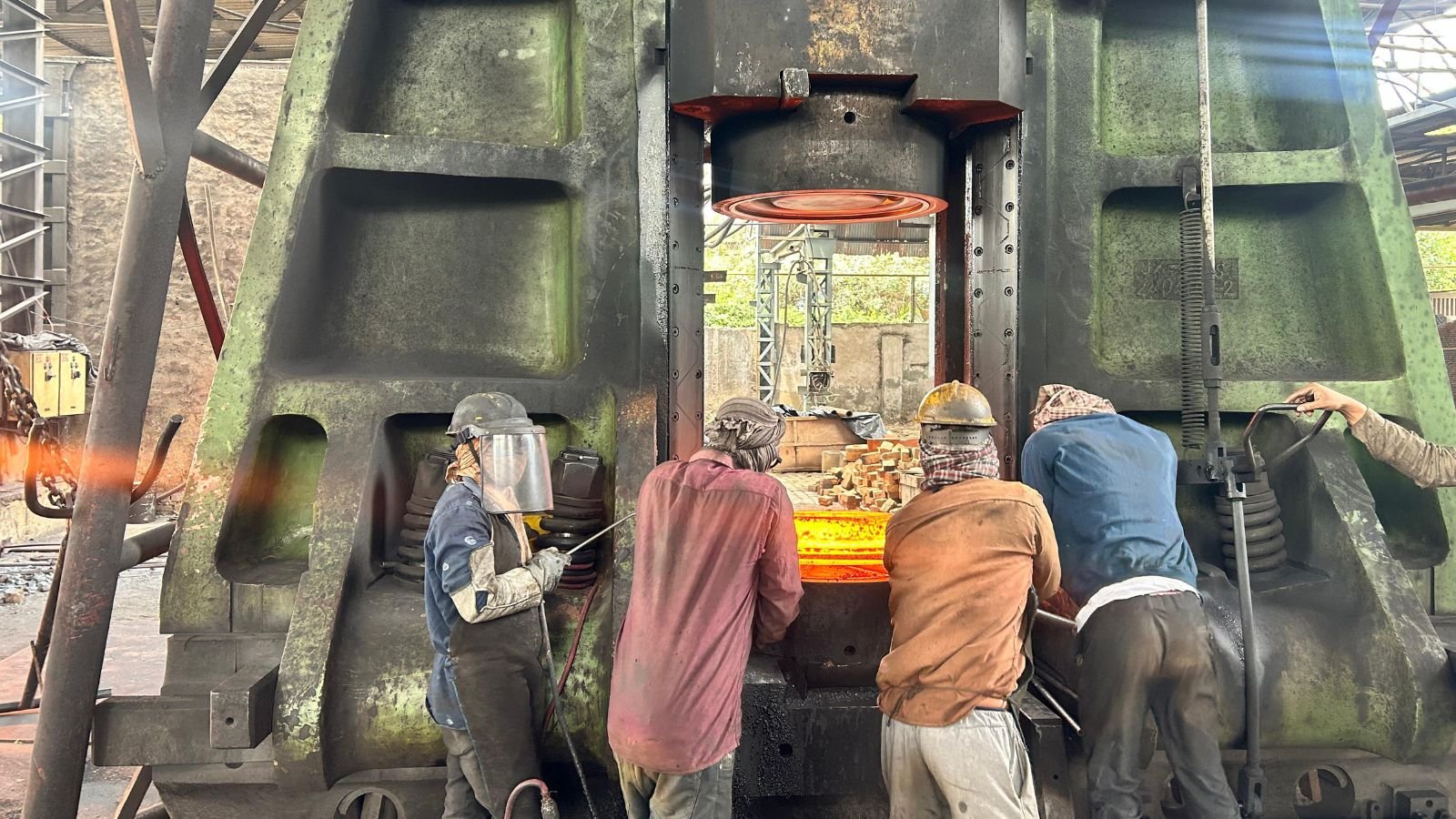
In workshops that once ran at full tilt, production schedules are now being redrawn in cautious increments, and order books are beginning to thin. In the big industrial cluster of Western Uttar Pradesh, the furnaces may not have gone cold yet, but they no longer roar the way they used to.Meanwhile, an air of uncertainty has settled across the area.
The steady rhythm of manufacturing has faltered, as a fuel crisis triggered by the Iran war tightens its grip on supply lines. For manufacturers of engineering goods — a key industrial sector for the Indian economy — the main question is how to keep machines running when the energy that powers them is suddenly scarce, erratic, and expensive.
Pankaj Aggarwal, CEO of CD Industries located on Bulandshahr Road in Ghaziabad, said that since the gas supply issue began, his factory’s quota was cut by 65%, with the company receiving only a little more than a third of their daily requirement, even as prices soared. This has directly resulted in increased manufacturing costs and a reduction in overall output. The factory, which manufactures forged metal flanges, relies on PNG supplied by IGL to power its furnaces.
“Our daily requirement of PNG is 1,800 cubic ft per minute (CFM). However, nearly 1,170 CFM is being cut every day. This has severely impacted our production, reducing it in the same proportion. The impact is greater on industries like ours, where fuel components account for nearly 50% of the total cost of producing flanges. Our average daily production is 30 metric tonnes,” Aggarwal, whose company has about Rs 100 crore of turnover, told The Indian Express.
“The prices of our goods in the domestic market have increased by 10-12%, and export prices have risen by 5-7%. While all industries are suffering due to fuel shortages, those dependent solely on LPG are the worst affected,” he added.
Flanges are used to join or connect pipes, valves, pumps, and other piping systems particularly in oil and gas exploration rigs, and fuel is needed to power the furnaces that keep the metal heated so that it can be beaten into a desired shape.
It is part of the broader engineering goods sector, which is the largest industrial segment in India and accounts for more than 3.5% of the GDP. The engineering goods export of India had a share of 25.22% out of the total exports during FY24, as they jumped to $109.22 billion as compared to $106.93 billion during FY23. In FY25 (April to December), India’s top five export destinations in the sector were the US (15.82%), the UAE (7.36%), Saudi Arabia (5.24%), Singapore (4.46%) and Germany (3.52%). Both the UAE and Saudi Arabian markets have been hit in the war.
Story continues below this ad
“Around 50% of our total production is meant for export,” Aggwarwal said, adding that the US is the firm’s main overseas market. Due to uncertainty perpetuated by the ongoing war, fresh orders have dried up, he said, adding that they only have a runway of about two months, after which their current order book will dry up. “I’m not sure when the fresh orders will come next, and if we will have enough fuel supply to service them,” he added.
Aggarwal also mentioned that, in an ideal situation, they have about four to five months’ worth of work in advance. “Fuel is our primary concern, and everyone is closely monitoring its availability. The government does not need to instruct us to conserve energy. We are already optimising its use. Prices are likely to increase significantly, which may cause short-term resistance, but people will eventually have to adjust.
The only long-term solution is to become self-reliant and diversify imports,” he said.Sanjeev Sachdev, general secretary of the Industrial Area Manufacturers’ Association in Ghaziabad said that already, the fuel shortage has led to more than 20 units being closed in the industrial belt. Many workers have also left as their living expenses shot up owing to increasing food costs on account of the price hike in cooking cylinders.
The Ghaziabad industrial area comprises nearly 27,000 factories of various types such as engineering goods (machine parts and automobile spare parts), food processing, textile, chemical, plastic, paper etc.
Story continues below this ad
“There are around 450 units on Bulandshahr Road alone. Out of these, 20-25 factories that rely on LPG were severely affected and had to shut down temporarily. Supply has still not been fully restored. These include gas welding and gas coating units. Nearly 20% of Ghaziabad’s total industrial production has been impacted by the fuel crisis. Around 80,000 workers are employed in factories along Bulandshahr Road,” Sachdev said.
“I believe the government should make decisions based on practical considerations rather than theoretical ones. We, the MSMEs, are industrial farmers. We convert raw materials into quality products and take it to houses. Yet, we are being consistently penalised, because we cannot cry, cannot express our problem. The government should provide short-term flexibility in the use of alternative fuels until the crisis is resolved,” he added.
