
When Ionut Nedelea donates blood, he likes knowing he’s helping out a fellow Romanian in need. He also likes pocketing a little extra cash.
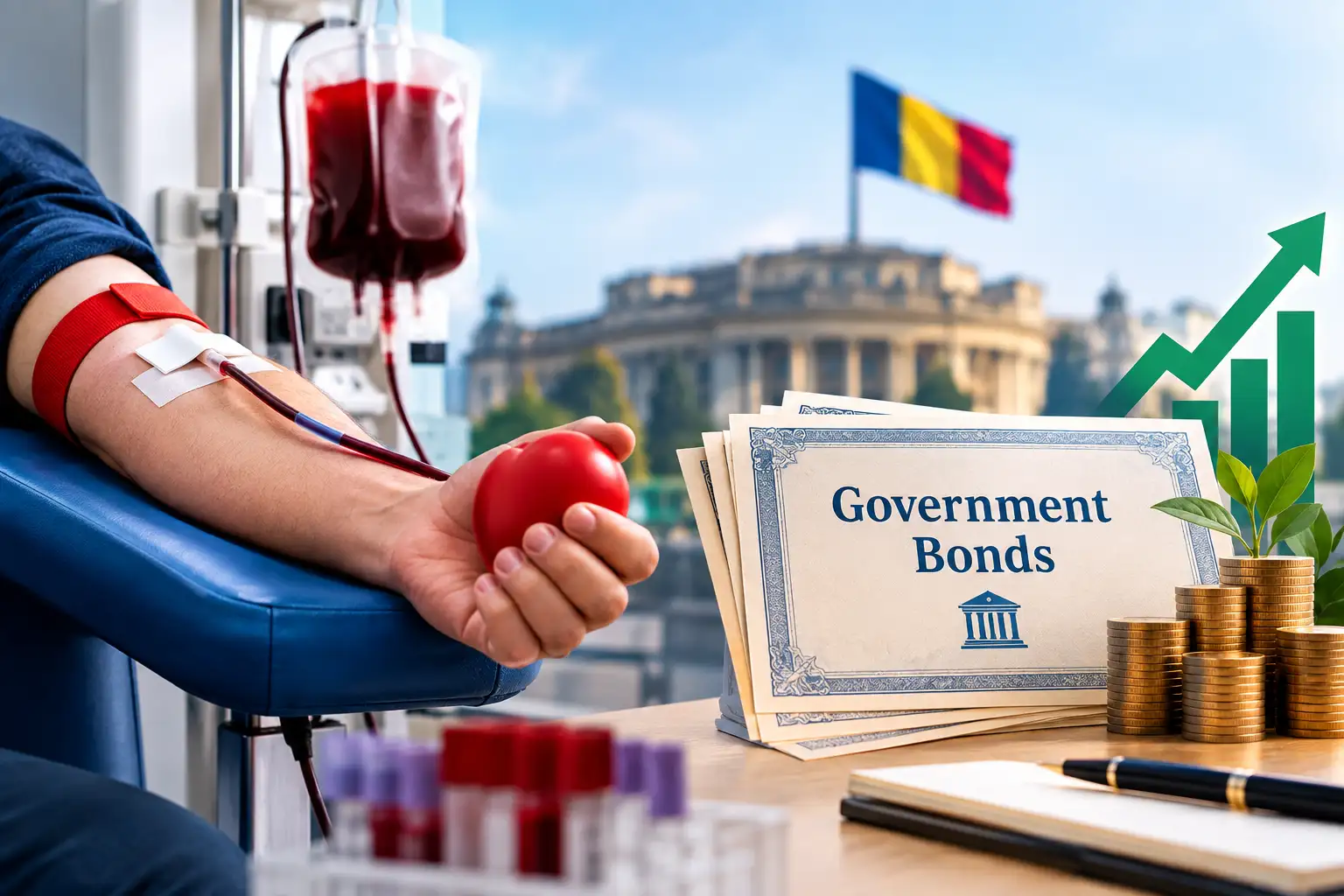
So a few times each year, Nedelea, a 46-year-old project manager, waits patiently in line for hours at a run-down facility in downtown Bucharest for a nurse to prick his arm. Later, he logs onto his brokerage account and uploads a blood-donor’s certificate to retrieve his financial reward: a chance to buy Romanian government bonds offering souped-up interest rates of over 7%. That’s a full percentage point above the going rate available to most retail investors.
“You may lose half of a day for the actual donation,” Nedelea said, “but it’s clearly worth it.”
The blood-for-bonds program is one of the world’s most unusual debt-financing campaigns. For Romania, though, it’s working — managing to both ease the country’s chronic blood shortage and secure much-needed cash to help cover its substantial budget deficit. It’s raised roughly 2.8 billion lei ($604 million) since the start of 2025, from tens of thousands of individual investors.
The country is part of a global push by policymakers to convince everyday citizens to help fund public spending. From Italy to Japan to Brazil, officials are experimenting with novel ways to entice plumbers and mechanics and teachers to buy bonds. With government debt having soared across much of the world in recent years, the urgency has grown. In Romania today, the retail investor program, when including the blood-for-bonds swap, provides close to a fifth of the government’s entire borrowing needs.
“Every little bit helps,” said Moritz Kraemer, chief economist at German lender Landesbank Baden-Wuerttemberg, and former chief ratings officer at S&P Global. “Governments are trying to mop up any credit that they can get.”
Part of the attraction has to do with how retail investors behave. For the most part, they tend to buy and hold, unlike hedge funds and foreign institutions that can race for the exit during times of turmoil. At the same time, higher interest rates have made the bonds more attractive to ordinary savers.
Households held 11% of government debt in 2024 across countries tracked by the Organization for Economic Cooperation and Development, over twice the share in 2021. Six countries issued new securities aimed at retail investors in the year through October 2025 and six more planned to follow.
In Japan, bond sales are booming as individuals reach for the highest yields in decades. It sold a record ¥5.14 trillion ($33 billion) in bonds to retail investors from April to September, an 84% surge from a year ago.
The country has been hawking bonds to mom-and-pop investors for decades and uses cartoon characters, like one called Kokusai-sensei, or the Government Bond Teacher, to drive sales. A new marketing campaign kicked off in August, pitching the investments as “a plus for everyone.” Officials are also considering whether to allow bonds in tax-exempt accounts, and they might cut inheritance taxes on such holdings.
Yet winning over households comes at a price, especially if treasurers have to offer tax breaks or higher yields to lure buyers. Skeptics argue that, in most countries, the amounts invested are too small to make much of a dent in deficits. Governments must also consider that successful bond programs will drain money from consumer savings accounts, creating risks to banks, and in some cases, financial stability.
“It doesn’t seem to me that it’s worth it,” said Sunil Krishnan, head of multi-asset at Aviva Investors. “It’s no longer a cheap source of debt.”
Back in Romania, which had the biggest budget deficit in the European Union last year, Treasury Chief Stefan Nanu contends the social benefits justify the extra cost of blood bonds. The program, which started in 2023 as a campaign with a popular rock radio station, has zero marketing costs and gets free TV advertising, he added.
“Our purpose is not to make some people rich, it’s to support blood donation,” Nanu said in an interview.
Laviniu Beze, head of a Romanian association of retail traders, is one of those answering the call. He donates four times a year to load up on bonds, which now make up 40% of his portfolio.
“I have trading in my blood,” he said. “As an investor, even if you are getting one percentage point more, of course you have to use it.”