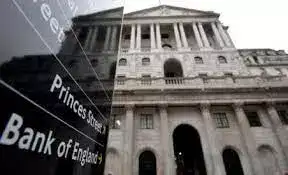
The Bank of England (BoE) is widely expected to leave interest rates unchanged on Thursday as policymakers assess the inflationary impact of the prolonged closure of the Strait of Hormuz and the broader economic consequences of geopolitical tensions, according to Reuters.
The central bank is expected to maintain its benchmark interest rate at 3.75%, extending the pause that has been in place since December. The decision comes as officials weigh elevated energy-related inflation risks against signs of slowing domestic price pressures and a weakening labour market.
Geopolitical tensions complicate policy outlook
The BoE's policy decision comes against the backdrop of the Iran conflict, which has disrupted global energy markets by keeping the Strait of Hormuz closed for the past five months. Although oil prices briefly surged above $100 per barrel last week, futures have since retreated and remain close to the lower end of the BoE's earlier projections.
Governor Andrew Bailey has previously indicated that the central bank's March decision to shelve expectations of further rate cuts due to the conflict is likely to help contain inflation over time.
The BoE's stance contrasts with that of the European Central Bank, which raised interest rates in June to address persistent inflationary pressures.
Last month, the BoE lowered its forecast for peak inflation this year to just above 3.25%, down from its April projection of 3.6% to 3.7% under two of its three energy price scenarios.
The outlook has improved despite higher natural gas prices, with softer oil futures easing concerns over sustained energy-driven inflation.
Inflation slowed to a 15-month low of 2.6% in June, helped in part by Britain's regulated household energy pricing system. Private-sector wage growth also eased to 2.9%, its weakest pace since 2020, reinforcing expectations that underlying price pressures are moderating.
Markets expect no immediate policy change
Economists surveyed by Reuters expect the BoE's nine-member Monetary Policy Committee (MPC) to vote 7-2 in favour of keeping interest rates unchanged.
Chief Economist Huw Pill and external MPC member Megan Greene are expected to again support a rate increase, while Deputy Governor Clare Lombardelli and external policymaker Catherine Mann are viewed as the most likely members who could shift toward a more hawkish stance.
However, the majority of policymakers are expected to conclude that current borrowing costs remain sufficiently restrictive to gradually bring inflation back toward the BoE's 2% target.
Investors eye future rate path
While economists largely expect no policy changes through the remainder of the year, financial markets have become more cautious.
Interest rate futures on Wednesday indicated investors are pricing in a quarter-percentage-point rate increase by November, followed by another increase by March 2027, reflecting lingering concerns over inflation.
Some economists, however, remain unconvinced that further tightening will be necessary. Reuters reported that UBS economist Anna Titareva expects the next policy move to be rate cuts in February and April 2027, citing easing inflation and the impact of the government's decision to scrap the household electricity tax, which is expected to trim inflation modestly.
Focus on bond sales and market impact
Beyond interest rates, investors will also watch for the BoE's assessment of its quantitative tightening programme.
The central bank slowed the pace of bond sales in 2025, reducing annual gilt holdings by £70 billion instead of the previous £100 billion. Market participants surveyed by the BoE expect another reduction in the pace of balance sheet runoff to £50 billion when policymakers review the programme in September.
Governor Bailey is scheduled to hold a press conference after the policy announcement, where markets will closely scrutinise the BoE's updated economic forecasts, policy guidance and views on inflation, growth and financial market conditions.