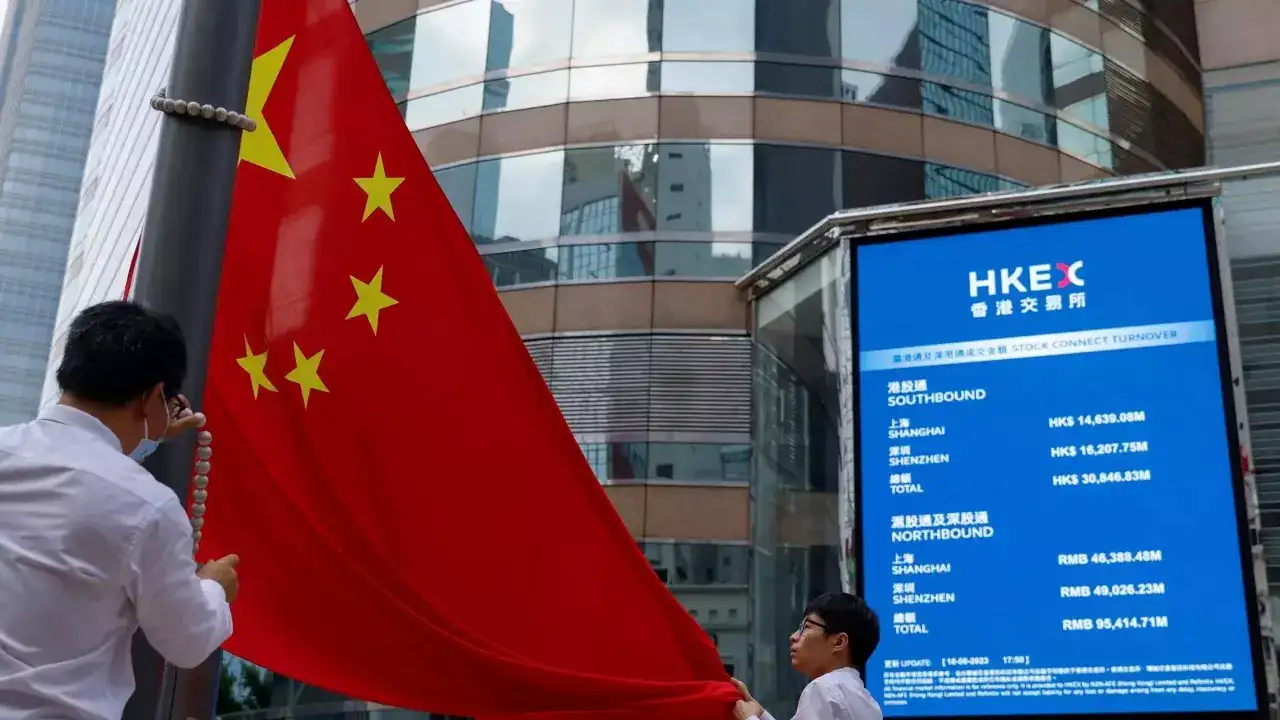
China and Hong Kong stocks declined on Thursday as investors assessed the impact of a more hawkish U.S. Federal Reserve stance, with rate-sensitive sectors such as gold, non-ferrous metals and property stocks coming under pressure, Reuters reported.
China’s blue-chip CSI300 index and the Shanghai Composite index each fell 0.4% by the lunch break. In Hong Kong, the Hang Seng Index declined 0.8%.
Read more: US Market: Goldman Sachs sees Fed raising rates again in October
The Federal Reserve raised interest rates by 25 basis points on Wednesday, taking its benchmark rate to 3.75%-4.00%, and signalled that another increase could come this year. The move marked the first U.S. rate hike since 2023 and prompted investors to reassess the outlook for global borrowing costs, Reuters reported.
The higher-rate outlook weighed particularly heavily on Chinese commodity-related stocks. CSI gold shares dropped 5%, while non-ferrous metal stocks fell about 3%. In Hong Kong, property companies declined 1.9%.
Read more: US Market: Fed's Warsh points to AI investment, geopolitical risks for higher yields
Hong Kong's monetary authority also raised its base interest rate by 25 basis points to 4.25% on Thursday, following the Federal Reserve's move. Hong Kong's monetary policy closely tracks U.S. rates because the Hong Kong dollar is pegged to the U.S. dollar.
Despite the broader weakness, biotech and semiconductor stocks outperformed in both mainland China and Hong Kong.
Analysts cited by Reuters said they preferred China A-shares over Hong Kong equities for the remainder of the year, partly because mainland markets have greater exposure to artificial intelligence hardware and related supply chains. Hong Kong-listed stocks, meanwhile, have a larger concentration of consumer-facing internet companies, leaving them more exposed to weakness in domestic consumption.
A sustained rebound in Hong Kong equities would require fresh catalysts, including fiscal stimulus or a major breakthrough in artificial intelligence, according to CICC strategist Kevin Liu, as reported by Reuters.
Elsewhere in mainland China, the Shenzhen index was down 0.24%, while the ChiNext Composite index slipped 0.12%. Shanghai's technology-focused STAR50 index declined 0.39%.
The moves reflect growing sensitivity across Asian markets to the prospect of higher-for-longer U.S. interest rates. Reuters reported that the Fed's latest projections pointed to another rate increase this year, while the dollar and U.S. Treasury yields strengthened after the decision.