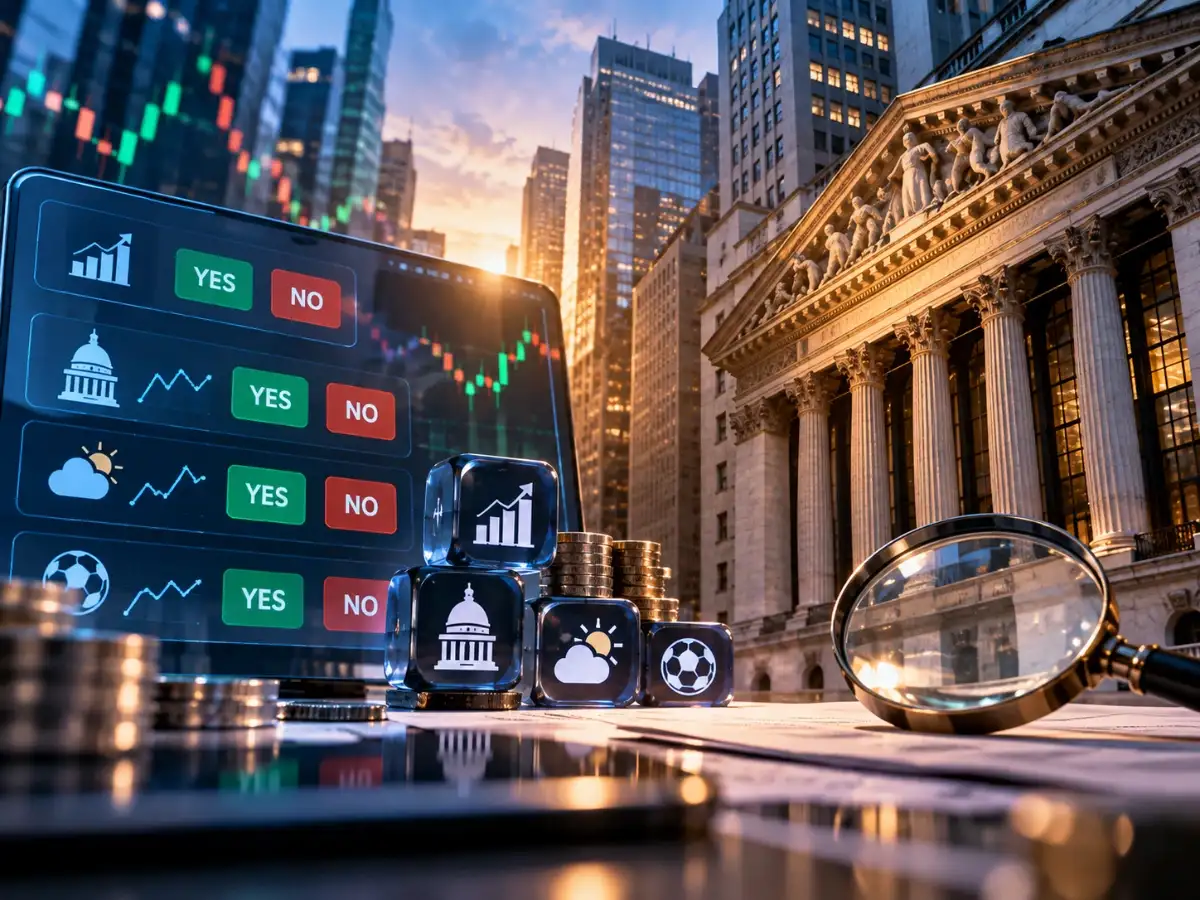
Prediction markets are rapidly expanding beyond sports and politics into traditional financial markets, offering traders new ways to speculate on US stocks, indexes and company events while raising questions over investor protection and regulatory oversight, according to independent data and regulatory experts cited by Reuters.
The industry, led by platforms such as Polymarket and Kalshi, has gained prominence by allowing users to trade contracts tied to a wide range of outcomes. Over the past year, the platforms have increasingly moved into markets linked to corporate performance and stock prices, according to independent research and a Reuters review.
Also Read | Global Market: RoboTechnik slides below IPO price in weak Hong Kong debut
Although these markets remain small compared with the broader US stock market, their growth is creating additional venues for speculation outside many of the investor protections and surveillance mechanisms associated with regulated securities exchanges.
Legal experts cited by Reuters said the rapid expansion of equity-linked prediction markets could eventually have implications for trading in underlying securities and make it more difficult for regulators to monitor potential misconduct.
Nvidia, Alphabet among popular markets
Polymarket International began offering markets on individual stocks last October. Traders have since wagered more than $220 million across about 31,000 equity-linked markets through early September, according to an analysis by blockchain research firm Allium prepared for Reuters.
Almost 60% of the activity involved markets linked to individual stocks, with Nvidia, Alphabet, Apple and Tesla among the most actively traded names, Allium found. The remaining activity was linked to exchange-traded funds and stock indexes.
Participants generally trade contracts based on whether a stock or index will reach a specified level by a particular date. Allium identified one wallet that generated about $175,000 in trading volume through roughly 1,300 Apple-related trades, using positions designed to produce a small profit regardless of which contract outcome ultimately paid.
The companies did not respond to requests for comment, Reuters reported.
Also Read | Global Market: Nikkei falls as oil surge, global bond selloff rattle markets
Kalshi focuses on indexes and corporate events
Kalshi does not currently offer contracts directly tied to individual stocks. However, Reuters found that the platform offers roughly 2,500 markets on a typical day, including contracts linked to stock indexes and corporate key performance indicators, or KPIs.
Those markets can cover events such as product launches and Tesla vehicle deliveries, according to Reuters' review of Kalshi's website and data provided by the company.
Prediction-market operators are increasingly seeking institutional participation as well, promoting event contracts as tools that can provide alternative ways to hedge economic and financial risks.
Unlike traditional stock exchanges, prediction markets can operate around the clock and allow traders to take positions on a variety of outcomes related to a company or market. Legal experts cited by Reuters, however, said these contracts do not necessarily provide investors with the same rights and protections available in conventional securities markets.
Studies have also found that most retail traders lose money in prediction markets, Reuters reported.
Offshore structure raises transparency concerns
Polymarket International's offshore structure has added another layer to the regulatory debate. The platform is largely outside the direct reach of US regulators, potentially making it more difficult for authorities to monitor trading activity and investigate possible misconduct, according to experts cited by Reuters.
Polymarket has said it monitors its markets for misconduct and refers cases to US authorities when appropriate. The company has also said it takes measures to prevent US users from accessing its international platform.
Polymarket's newer US exchange, which is regulated by the Commodity Futures Trading Commission, does not currently offer individual-stock markets but does provide a limited number of KPI contracts.
SEC and CFTC face jurisdiction questions
The expansion of these products has also intensified a debate over which US regulator should oversee them.
The CFTC has argued that prediction markets fall within its jurisdiction because they involve derivative-like contracts. At the same time, there are growing calls for the Securities and Exchange Commission to play a larger role.
Under US law, contracts linked to individual stocks are generally treated as security-based swaps, which fall under SEC oversight and are subject to restrictions that generally limit participation to professional investors.
Some contracts linked to corporate KPIs could potentially fall within the same category, according to legal experts cited by Reuters. Kalshi has disputed that interpretation, while Polymarket has said it is working with regulators to determine how existing definitions of swaps and security-based swaps apply to newer event contracts.
The SEC and CFTC jointly sought public feedback in June on the regulatory treatment of prediction markets and whether one agency should have primary oversight.
Traditional financial firms and consumer groups have argued that the SEC should take the lead because of its experience overseeing securities markets.
The regulatory debate also extends to the potential use of non-public information.
Experts cited by Reuters said corporate KPI contracts could create opportunities for traders with access to confidential company information to profit from upcoming events, potentially raising issues similar to insider trading in conventional stock markets.
Several US lawmakers have also raised concerns about the industry's expansion.
Senator Adam Schiff, a California Democrat, told Reuters that Congress should ensure prediction-market operators cannot avoid securities regulations simply by structuring conventional financial products as prediction contracts.
The growing overlap between prediction markets and traditional finance therefore presents regulators with a developing market-structure challenge, as platforms seek to broaden the types of financial and corporate outcomes that traders can speculate on.