

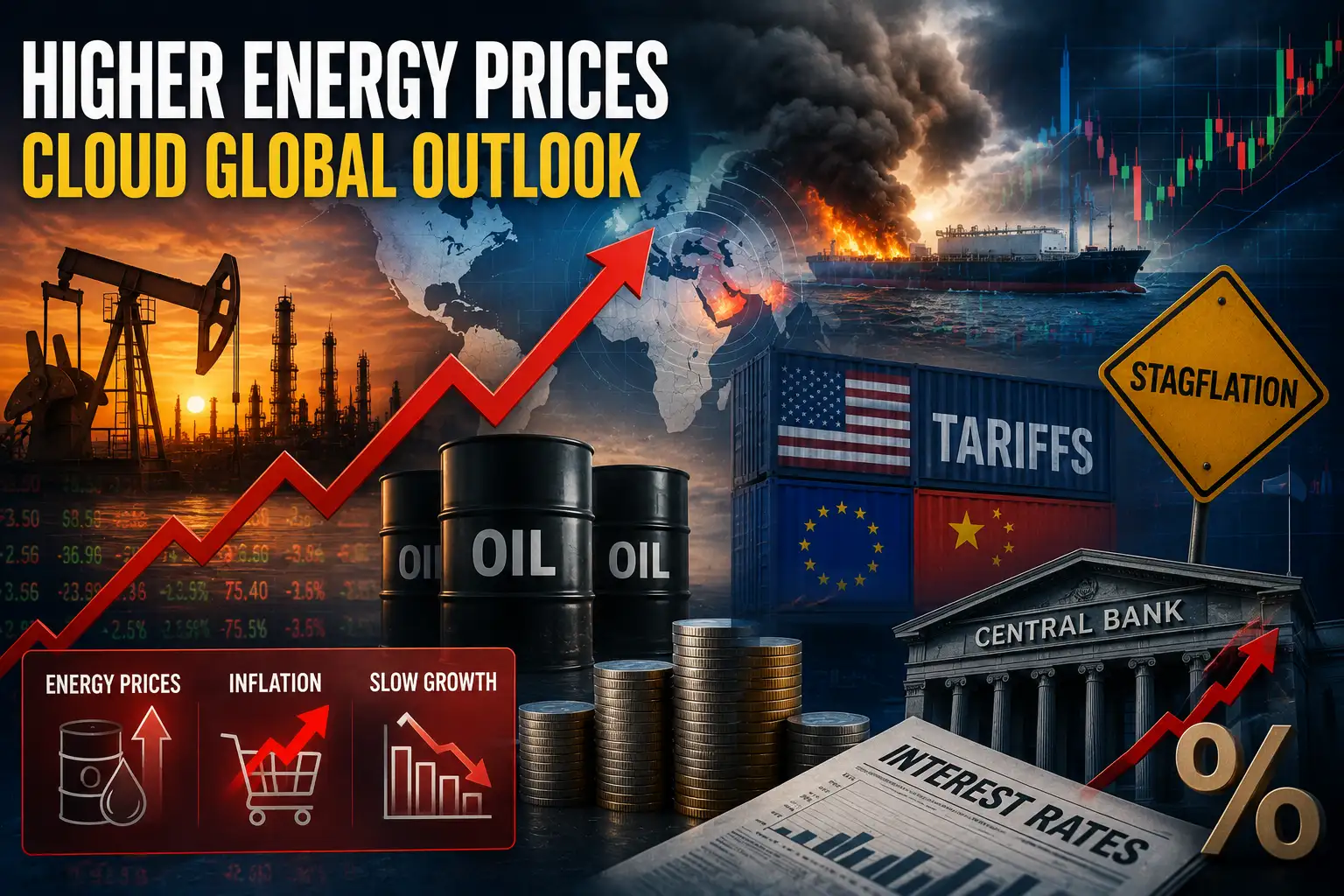
Renewed tensions in the Gulf have reignited fears of stagflation, raising concerns that the global economy could face a prolonged period of weak growth alongside persistent inflation. According to Reuters, hopes that an interim agreement between the United States and Iran would ease inflationary pressures have faded as the conflict has intensified, sending energy prices sharply higher and rattling financial markets.
Oil prices have climbed back to around $100 a barrel, while European natural gas prices are on track for their biggest monthly increase since March. At the same time, government bond yields across major economies have risen to multi-year highs as investors reassess inflation risks.
The uncertainty has been compounded by escalating trade tensions as the U.S. on Friday imposed fresh tariffs of 10% and 12.5% on imports from 60 trading partners, including the European Union and China, a move that could further increase costs for businesses and consumers, Reuters reported.
Energy prices fuel inflation concerns
The latest surge in oil prices has become the primary driver of renewed inflation fears. Brent crude, which had slipped to around $70 a barrel in early July amid optimism over a ceasefire, has rebounded to $100 after Yemen's Houthi rebels said they attacked two Saudi oil tankers in the Red Sea, widening disruptions to global shipping beyond the Strait of Hormuz.
Brent crude has risen nearly 40% during July, marking its strongest monthly performance since March. European benchmark natural gas futures have also climbed to their highest levels since March, reflecting concerns over potential supply disruptions.
Higher energy prices are reviving concerns that inflation could remain elevated for longer than previously expected.
Although U.S. inflation data for June came in below expectations last week, the relief proved short-lived as rising oil prices quickly pushed government bond yields higher in the United States, Germany and Japan.
Market-based measures of inflation expectations have so far moved only modestly, but analysts believe commodity price increases may not yet be fully reflected in asset prices.
Reuters reported that Kpler estimates roughly one-third of global fertiliser shipments pass through the Strait of Hormuz, raising concerns that supply disruptions could also keep food prices elevated, particularly in emerging economies. Weather-related pressures from El Niño are adding to those risks.
The renewed inflation concerns have prompted traders to increase expectations that major central banks may need to tighten monetary policy further.
Markets now expect roughly two additional quarter-point interest rate increases from the European Central Bank before the end of the year, following its June policy move. Although the ECB kept rates unchanged this week, it indicated that further tightening remains possible.
In the United States, expectations for additional Federal Reserve rate hikes eased after softer inflation data but have strengthened again as energy prices surged. Markets now anticipate around two further increases by January, according to Reuters.
Higher borrowing costs present a difficult challenge for policymakers, particularly in energy-importing economies, as tighter monetary policy risks slowing already fragile economic growth while attempting to contain inflation.
Europe appears particularly vulnerable because it depends heavily on imported energy while also confronting the prospect of tighter monetary policy.
Rising energy prices combined with higher interest rates could tighten financial conditions significantly across the region, increasing pressure on businesses and consumers alike.
The euro weakened to a three-week low below $1.14 against the dollar as oil prices approached $100, reflecting investor concerns over the region's economic outlook.
Asia and U.S. also face economic risks
The broader economic impact may already be emerging. Reuters reported that the World Bank's chief economist warned the conflict could reduce global economic growth to as low as 1.3%, down from 2.9% last year.
Asian economies remain especially exposed because they import much of their energy from the Gulf. Countries in South and Southeast Asia are particularly vulnerable to higher fuel costs, while Japan is also facing mounting pressure as its weak yen has pushed import costs to record highs, contributing to domestic inflation.
Although the United States is less vulnerable because it is a net energy exporter, it is not insulated from the effects. U.S. gasoline prices have climbed back above $4 per gallon during the peak summer driving season, while fuel costs for major airlines have increased sharply compared with a year ago.
Higher Treasury yields have also pushed mortgage rates to their highest level since last August, adding further strain on the U.S. housing market.