
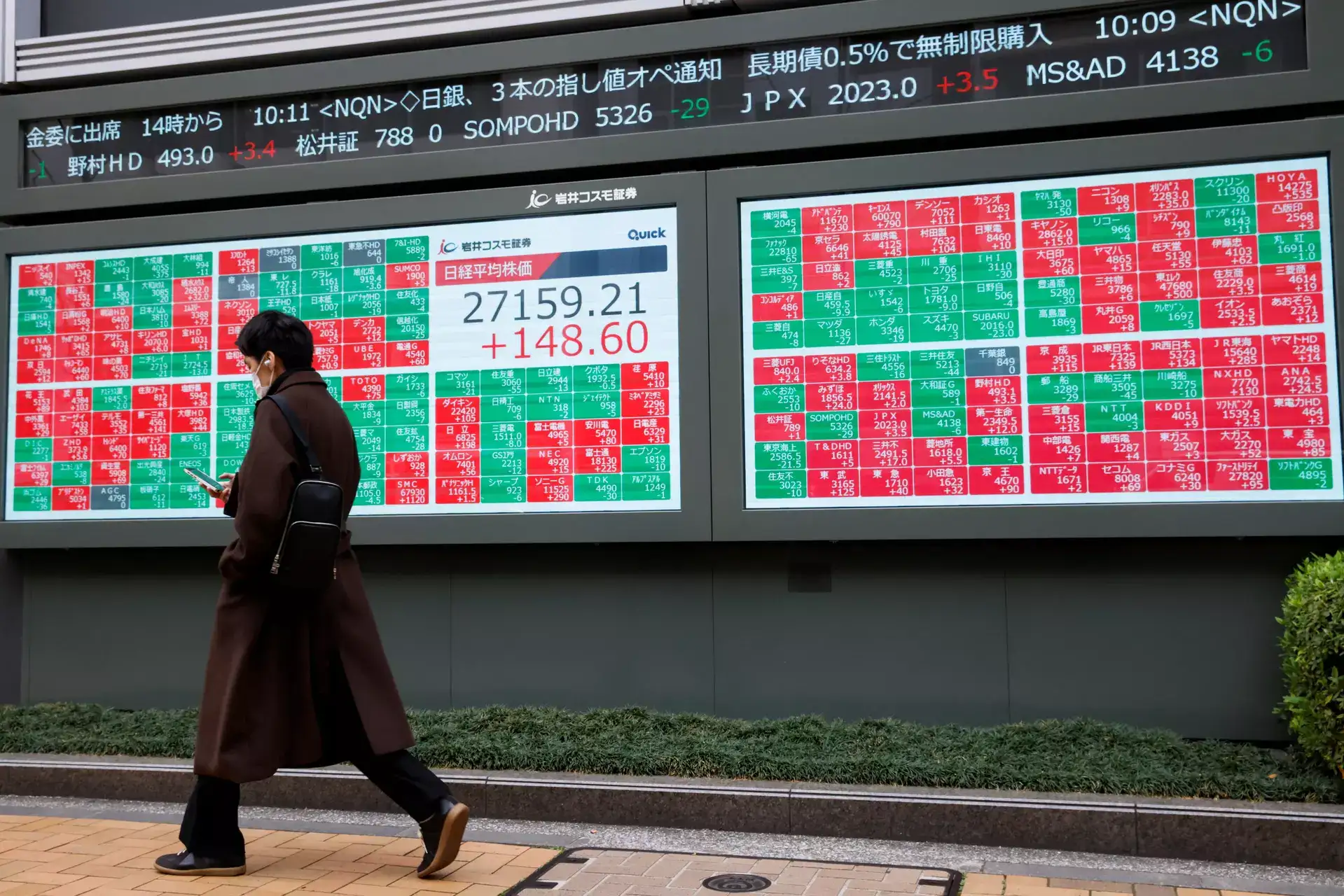
Japan's Nikkei share average retreated on Wednesday as renewed Middle East tensions prompted investors to rotate out of high-flying technology stocks sensitive to energy prices.
The benchmark Nikkei 225 Index sank 1.89% to close at 64,179.27, reversing course from a 2.1% surge in the prior session. The broader Topix slid 1.25% to 3,847.60. The United States launched strikes against Iran on Tuesday in retaliation for the downing of a military helicopter, deepening doubts over a potential peace deal. Price pressures from the Gulf crisis caused Japanese wholesale inflation to quicken to the fastest pace in three years, adding upward pressure on domestic bond yields, data showed on Wednesday.
"Declines are centred on AI- and semiconductor-related shares, as heightened tensions in the Middle East and upward pressure on domestic interest rates prompted investors to focus more on relative valuations," said Wataru Akiyama, an equities strategist at Nomura Securities. "As a result, the Topix's decline is relatively limited compared with the (tech-heavy) Nikkei." There were 99 advancers on the Nikkei index against 126 decliners.
The largest losers were all tech-related stocks, including Taiyo Yuden, down 12.9%, followed by Furukawa Electric , 11.7% lower, and Sumitomo Electric, which lost 11.7%. Nintendo was a standout among decliners, dropping 6.76% after the video game giant's presentation of upcoming titles disappointed investors.
The largest gainers on the Nikkei were developer Mitsubishi Estate, up 5.2%, followed by Tokyo Disneyland operator Oriental Land, 4.3% higher, and Screen Holdings , which gained 4.2%.