
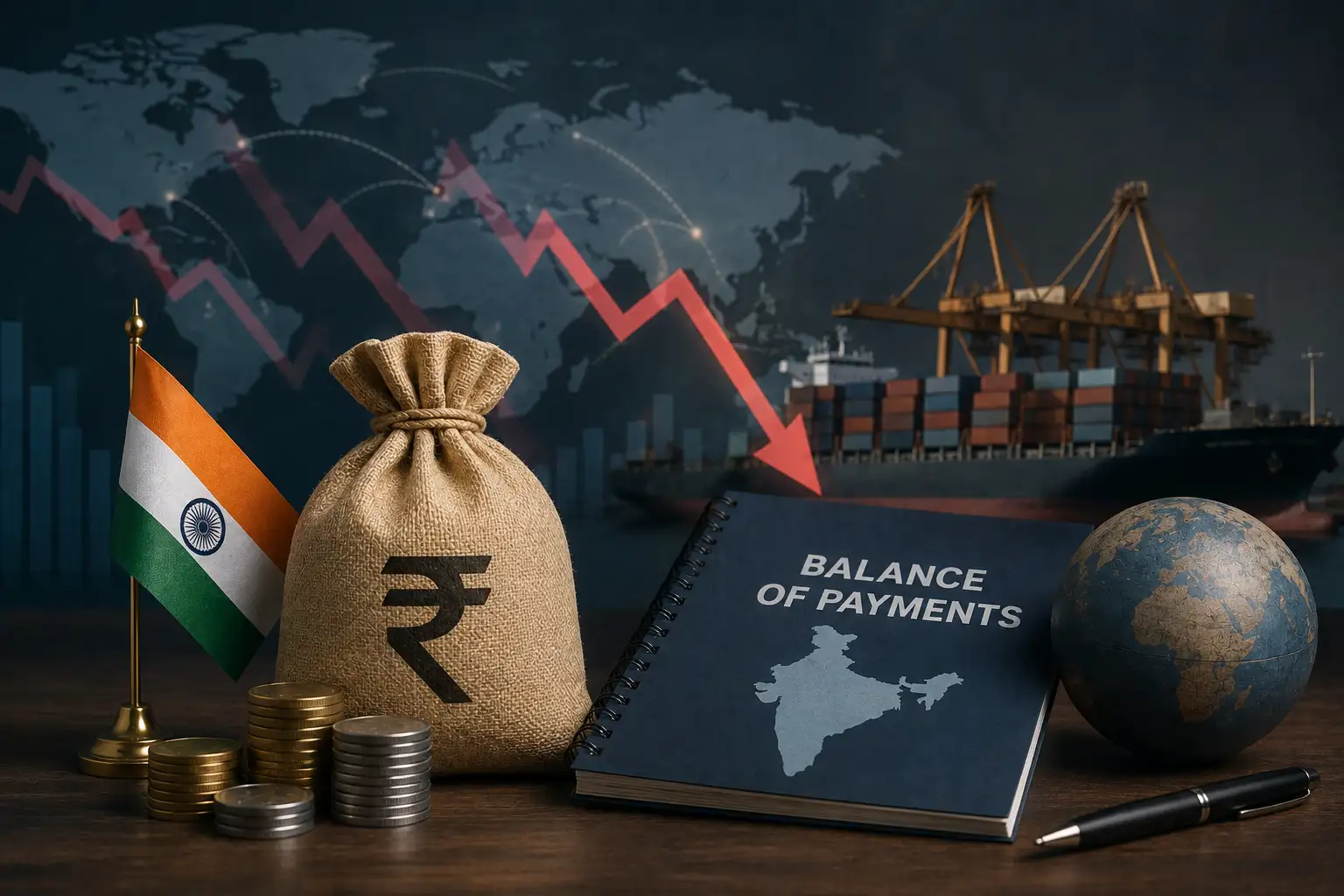
India's balance of payments (BoP) account has slipped into a deficit of $8.1 billion in the first quarter from $4.5 billion surplus in the year-ago period, largely on account of dollar outflows in the capital account as overseas portfolio investors offloaded their investment from local markets in a risk-off strategy amid geopolitical turmoil.
The country's current account deficit (CAD) widened in the first quarter to $3.1 billion from $2.9 billion in the year-ago period while the capital account turned into a deficit of $5 billion from a $7.4 billion surplus, data published by the Reserve Bank of India (RBI) Friday showed.
The merchandise trade deficit widened to $85.7 billion in the first quarter from $68.9 billion, largely due to a higher fuel bill.
The country's crude oil import bill rose 26% year-on-year to $49 billion in the first quarter of FY27 even as crude import volumes fell 18% following the disruption in supplies through Strait of Hormuz.
India, the third-largest crude oil importer globally, depends on foreign shipments for over 90% of its domestic fuel consumption.
Even a higher surplus from the services sector and remittances and gifts from abroad could not offset the impact of the higher fuel bill.
The net services surplus stood at $52.2 billion against $47.9 billion in the same period last year.
The net transfer, which includes remittances, foreign aids and pension and gifts, stood at $41.4 billion as compared with $30.9 billion over the same period.
On the capital account side, the net foreign direct investment grew to $7.8 billion in the period under review from $4.8 billion a year prior.
However, a net $9.6 billion outflow during the quarter on account of the withdrawal of investments by foreign portfolio investors (FPI) from the local markets turned the balance of payments math unfavourably.