Jio Platforms’ Rs 30,200 crore initial public offering (IPO) is attracting a grey market premium of Rs 221, implying a potential listing gain of nearly 20% over the upper end of its price band. The strong demand ahead of the issue has also been accompanied by subscription recommendations from brokerages, which cite the company’s market leadership, pricing power and multiple avenues for growth.
The IPO is priced at Rs 1,065-1,119 per share and will open on October 21, closing on October 23. At the upper end of the price band, the grey market premium points to an indicative listing price of Rs 1,340 per share.
The issue comprises 27 crore shares and is entirely a fresh issue and would be India’s largest public offer. Jio Platforms intends to use Rs 27,500 crore of the proceeds to repay or prepay borrowings. At the upper price band, the company’s post-issue market capitalisation is estimated at Rs 10.30 lakh crore.
What are brokerages saying?
Emkay Global has recommended subscribing to the IPO, highlighting Jio’s leading position in India’s telecom market and its growing footprint across broadband, enterprise connectivity and digital services.
Through Reliance Jio Infocomm, Jio Platforms operates the country’s largest telecom network. As of June 2026, it had 533.3 million customers, accounting for 50% of wireless broadband subscribers and 42.6% of fixed broadband subscribers. Its network carries around 60% of India’s wireless data traffic. According to Emkay, Jio also has the largest 5G customer base outside China.
The company’s financial performance has been supported by growth in both revenue and profitability. Between FY24 and FY26, revenue grew at a compound annual growth rate of 15.8%, while EBITDA and profit after tax increased at annualised rates of 16.2% and 18.4%, respectively. Average revenue per user (ARPU) rose from Rs 181.7 in FY24 to Rs 214 in FY26, alongside the addition of 42.6 million subscribers.
Emkay expects Jio’s future growth to come from a broader range of businesses beyond mobile connectivity. The company plans to consolidate its position in mobility through greater 5G adoption and the migration of customers from 2G to 4G and 5G. Home broadband is another key growth area, while its relationships with enterprises and small businesses are expected to expand through managed services. Jio also plans to offer its proprietary technology stack to telecom operators overseas.
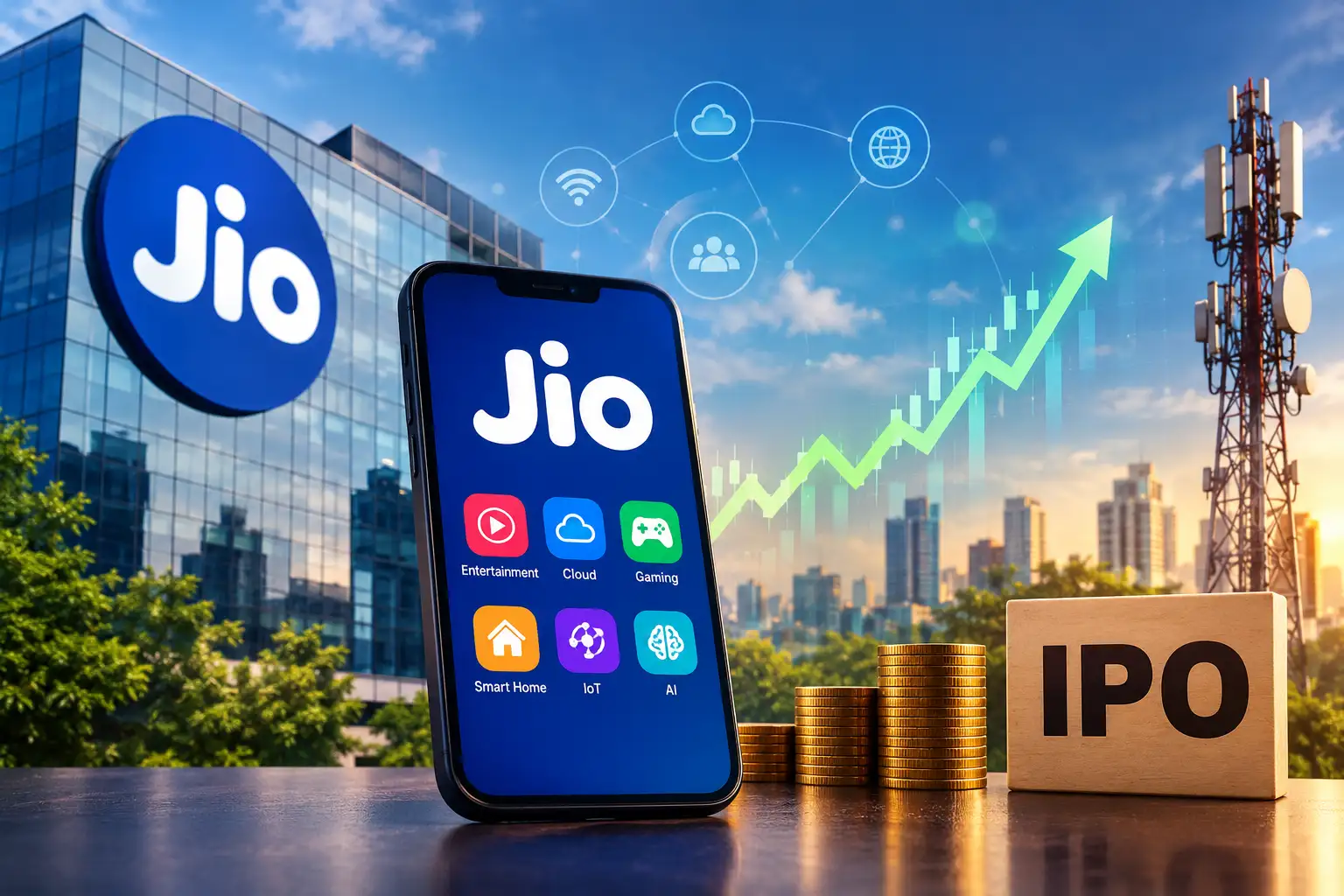
Its digital-services portfolio spans entertainment, cloud, gaming, smart-home solutions, the Internet of Things, communication and artificial intelligence-enabled platforms. These include MyJio, JioTV+, JioSaavn, JioGames, JioAICloud, JioPC and JioBrain. For enterprise customers, the company offers internet leased lines, MPLS, VPN, CPaaS, managed Wi-Fi, private 5G, SD-WAN, cloud, cybersecurity and managed network services.
Technology development is another part of Jio’s strategy. The company has built an integrated technology stack covering network infrastructure, device engineering, software, operating systems and digital applications. In the first quarter of FY27, it had 12,477 employees working on digital product and technology development, accounting for around 45% of its workforce. Its investments include research into 6G, cloud-native platforms, network automation and new digital services.
Jio Platforms and its subsidiaries had filed 7,220 patent applications as of the first quarter of FY27. Of these, 2,655 were filed in India and 4,565 overseas.
Jio was the first operator in India to launch a standalone 5G network. Its 5G customer base stood at 284.9 million in the first quarter of FY27, making it the third-largest globally, according to the IPO note. The company also has India’s largest spectrum bank, comprising 26,800.8 MHz with an average remaining life of 16 years. Its holdings include nationwide 5G spectrum in the 700 MHz, 3,300 MHz and 26 GHz bands.
The company’s cash generation and profitability have also improved. Jio Platforms reported operating cash flow of Rs 77,556 crore and free cash flow of Rs 43,301 crore in FY26. EBITDA increased from Rs 54,341 crore in FY24 to Rs 73,382 crore in FY26, while profit after tax rose from Rs 21,422 crore to Rs 30,064 crore. Its EBITDA margin edged up from 49.6% in FY24 to 50% in FY26.
Emkay expects cash generation to improve further as the 5G investment cycle approaches its end. The IPO note also states that repayment of borrowings by Reliance Jio Infocomm should reduce leverage and finance costs, support cash flows and provide greater financial flexibility for future investments.
On valuation, Emkay places Jio Platforms at 31.7-33.3 times FY26 earnings and 15-15.6 times FY26 EBITDA at the upper end of the IPO price band. SBI Securities estimates a post-issue FY26 price-to-earnings multiple of 34.4 times at the same price and values the company at Rs 20,117 per subscriber on an enterprise value basis.
These valuations reflect Jio’s scale, earnings growth, technology capabilities and potential to monetise its businesses over the long term, according to the brokerage. However, Emkay has identified several risks, including spectrum costs, regulatory changes, competitive pressure on ARPU, subscriber churn, dependence on Reliance Group entities, concentration among passive-infrastructure and equipment vendors, leverage and foreign-exchange exposure.
What is SBI Securities saying?
SBI Securities has also highlighted the company’s continuing capital expenditure needs, reliance on infrastructure providers, cybersecurity and privacy risks, dependence on spectrum licences and the possibility of network disruptions.
Disclaimer: This article has been written by Veer Sharma, who is not a SEBI-registered Research Analyst or an Investment Adviser. Veer Sharma and his/her ‘relative(s)’ (as defined under Section 2(77) of the Companies Act, 2013) do not hold any financial interest in the companies mentioned in this article as of the date of publication. The views/recommendations mentioned in this article, wherever applicable, are those of the respective SEBI-registered Research Analyst/brokerage and have been reproduced/reported with due attribution. They should not be construed as the views or recommendations of The Economic Times Digital or the journalist. Readers are advised to consider the original research report and make their investment decisions based on their own assessment. Brokerage disclaimers here.