

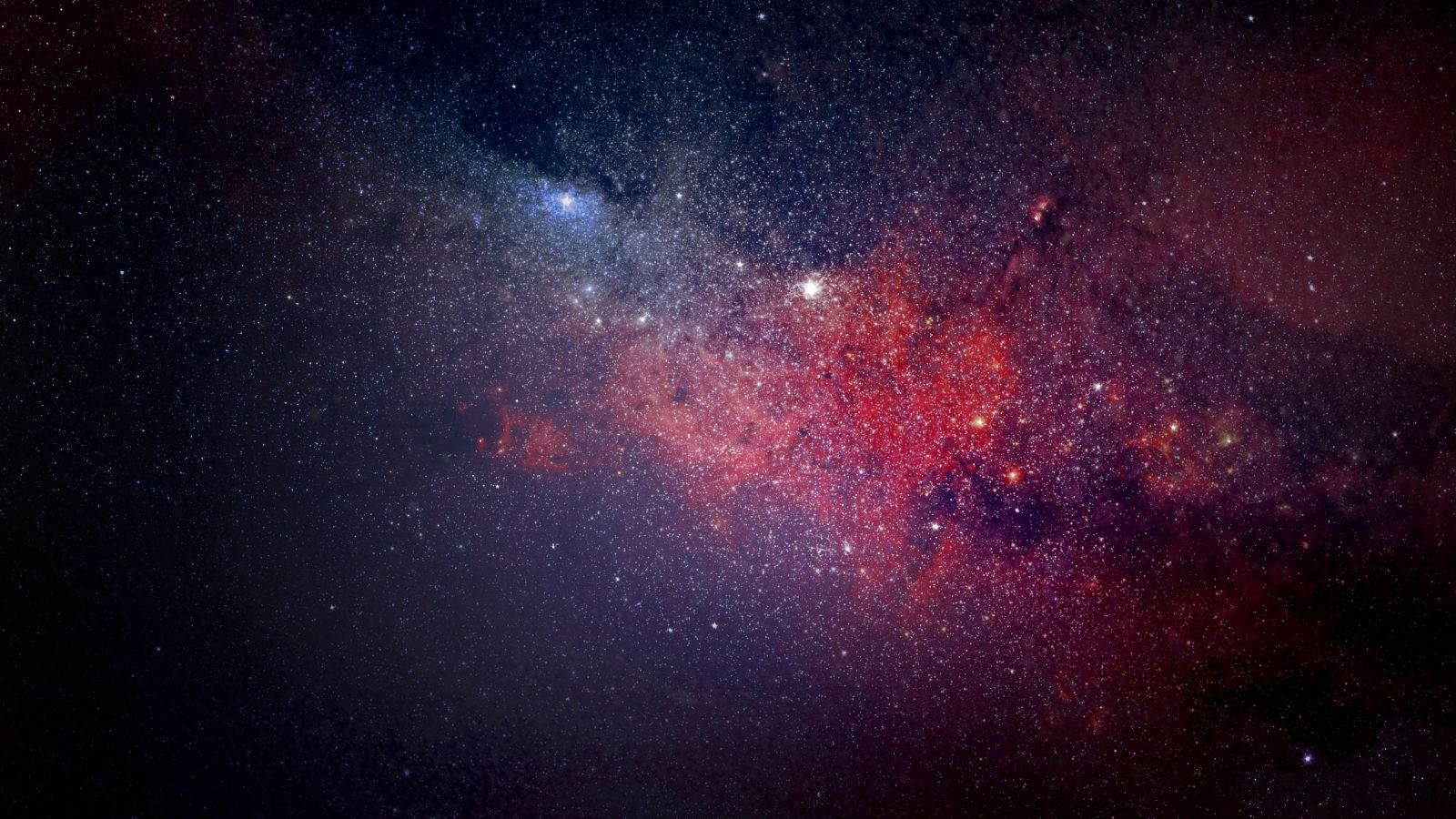
Post Content New cosmology studies suggest large-scale cosmic structures may influence how the universe expands. (Image for representation: Magnific)
A new series of studies has raised fresh questions about one of modern cosmology’s most important assumptions: that the universe behaves uniformly on the largest scales.
Researchers analysing data from exploding stars and massive galaxy surveys have found tentative evidence suggesting the universe may not be as evenly structured as scientists have believed for nearly a century.
If confirmed, the findings could challenge the Friedmann-Lemaître-Robertson-Walker (FLRW) model, the mathematical framework that underpins the standard model of cosmology.
The research, published in three papers on the preprint server arXiv, has not yet been peer-reviewed. However, the work is already drawing attention because it directly tests whether the geometry and expansion of the universe behave consistently across vast cosmic distances.
Modern cosmology assumes that, when viewed at extremely large scales, the universe is homogeneous and isotropic, meaning matter is spread evenly and the cosmos appears roughly the same in every direction. This principle forms the foundation of the Lambda Cold Dark Matter model, which scientists use to explain the expansion and evolution of the universe.
Also read | Can SpaceX and Blue Origin get their moon landers ready for Nasa’s 2028 Artemis mission?
But the actual universe is far messier, filled with galaxy clusters, cosmic voids, and enormous filament-like structures often described as a “cosmic web.” The new studies suggest these structures may subtly influence how space itself expands.
The researchers used observational data from the Pantheon+ supernova catalogue and the Dark Energy Spectroscopic Instrument (DESI), which is creating one of the largest 3D maps of the universe ever assembled. They also analysed baryon acoustic oscillation data, which tracks ancient density patterns left behind shortly after the Big Bang.
Story continues below this ad
Using advanced mathematical consistency tests and machine-learning techniques known as symbolic regression, the team reconstructed the universe’s expansion history without relying entirely on standard cosmological assumptions.
Also Read: Astronomers identify 27 potential twin-sun planets similar to Star Wars’ Tatooine
The results revealed small but notable deviations from predictions made by the FLRW model, with statistical significance ranging between 2 and 4 sigma. While this falls short of the 5-sigma threshold usually required for scientific discoveries, researchers say the findings are intriguing enough to warrant further investigation.
One possibility is that light travelling through large empty regions of space may distort measurements of cosmic density, making the universe appear emptier than it truly is. Another explanation involves “cosmological backreaction”, where large-scale cosmic structures may influence the average expansion of space-time itself.
If future observations confirm these deviations, the findings could force scientists to rethink existing theories about dark energy, gravity, and the overall structure of the cosmos.
© IE Online Media Services Pvt Ltd
