

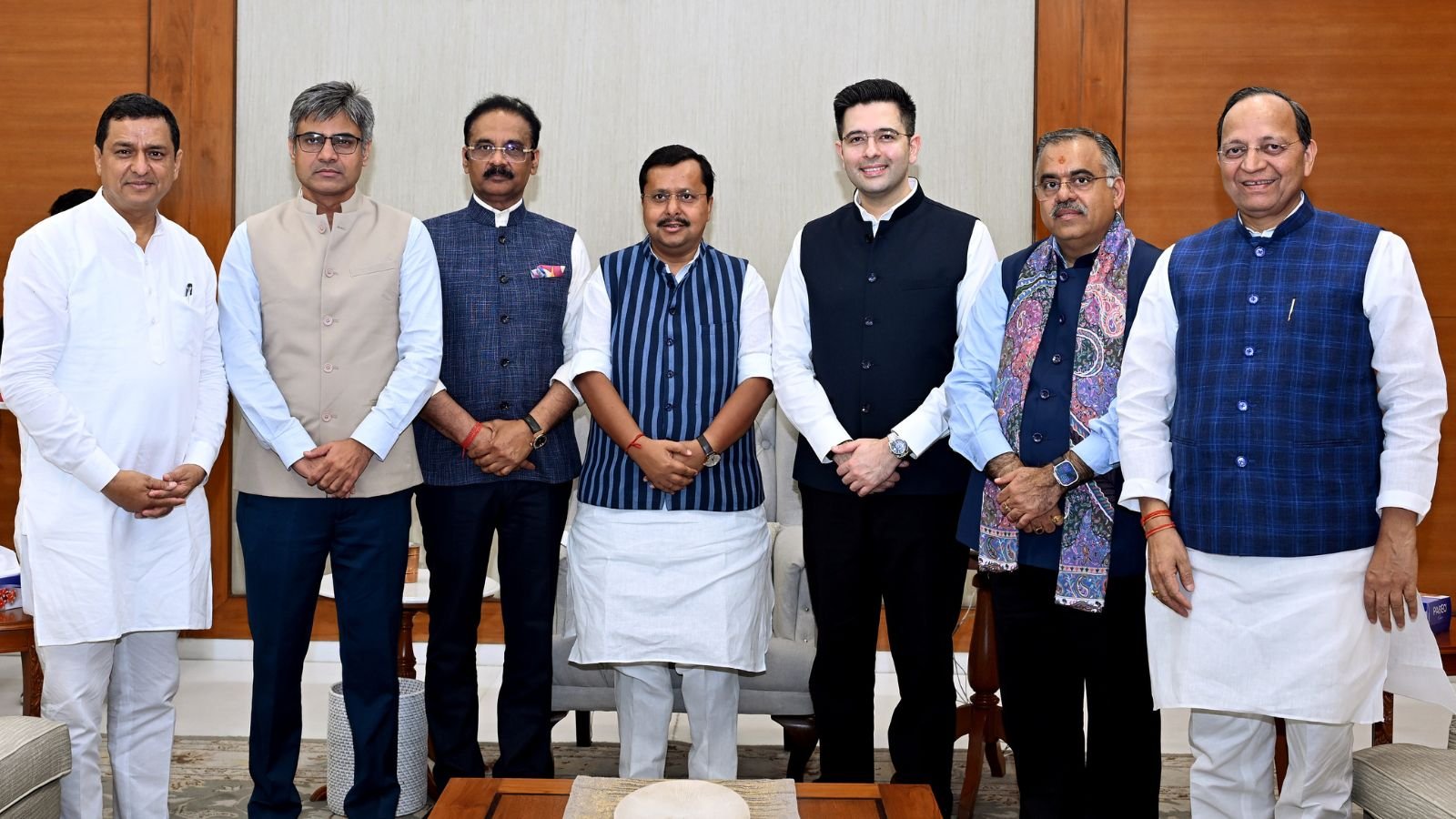
The latest Rajya Sabha party position, published on Monday morning, shows a sharp shift in numbers, with the Aam Aadmi Party’s strength reduced to three MPs and the Bharatiya Janata Party’s tally rising to 113, indicating Upper House Chairman C P Radhakrishnan’s acceptance of the merger of seven AAP members with the BJP.
Earlier, the AAP had 10 members in the Upper House, while the BJP had 106.
The NDA’s tally in Rajya Sabha is now 148: BJP 113, TDP 2, JD (U) 4, Shiv Sena 2, RLD 1, JD (S) 1, AGP 1, NCP 4, AIADMK 5, RPI (Athawale) 1, Rashtriya Lok Morcha (Upendra Kushwaha’s party) 1, and United People’s Party (Liberal) 2, apart from 7 nominated members who haven’t yet joined the BJP, Independent Rajya Sabha MP Kartikeya Sharma, and one each from the MNF, NPP, and PMK.
Also Read | Raghav Chadha could not have defected or split AAP — if his Bill had passed
Five nominated members who joined the BJP have already been counted in the saffron party’s tally of 113. The present strength of Rajya Sabha is 245.
Rajya Sabha tally of parties
According to the updated party position, three days after the rebel AAP contingent’s announcement to this effect, Ashok Kumar Mittal, Raghav Chahda, Harbhajan Singh, Sandeep Kumar Pathak, Vikramjit Singh Sahney, Swati Maliwal, and Rajinder Gupta became members 107 to 113 of the BJP’s roster in the Upper House.
BJP national president Nitin Nabin, a former Bihar legislator who was elevated to Rajya Sabha and took oath during the three-day Special Session between April 16 and 18, is at 103 in the BJP’s current position in the Council of States.
Former Bihar chief minister and Janata Dal (United) patriarch Nitish Kumar, too, is now on the roster of the Upper House as the first of four JDU MPs of the House. Sanjay Kumar Jha remains the JDU’s floor leader in the House.
Story continues below this ad
On the other hand, the AAP’s tally, which was at 10 prior to the rebellion of the party’s seven MPs last Friday, shrank to three with senior AAP leader Sanjay Singh, and Delhi MP, as the party’s floor leader in addition to his colleague Narain Das Gupta, who is also serving his second term from Delhi like Singh, and Punjab MP Sant Balbir Singh.
Also Read | Will AAP Rajya Sabha MPs face disqualification after joining BJP? Explained
In the pendency of the Chairman’s decision, they would have been considered AAP MPs despite their decision to merge with the BJP. For, paragraph 2 (1) (a) of the 10th Schedule says, “An elected member of a House shall be deemed to belong to the political party, if any, by which he was set up as a candidate for election as such member.”
In June 2019, four of the six members of the Telugu Desam Party (TDP) had decided to merge with the BJP. The number was exactly two-thirds of the party’s strength in Rajya Sabha. Two days later, Rajya Sabha Chairman M Venkaiah Naidu accepted the merger, thus freeing the MPs from the threat of disqualification under the anti-defection law.
10th Schedule
The 91st Constitutional Amendment Act of 2003, passed by Parliament during the tenure of the Vajpayee government, did two things: it said that to avoid disqualification proceedings, at least two-thirds of the members of a party in a House had to switch over to another party, something that would be seen as a merger of the members with that party. In this case, neither those crossing over nor those still part of the original party would face disqualification.
Story continues below this ad
If the numbers were below two-thirds of that party’s strength in the House, the members shifting loyalties would be liable to face disqualification proceedings. Second, the Act laid down that the total number of ministers in a government would not exceed 15 per cent of the total strength of Lok Sabha or a state Assembly, and that the number would not be less than 12 in very small states.
Also Read | Vikramjit Sahney interview: ‘Raghav Chadha, Maliwal, Pathak decided to leave due to their issues with AAP, then approached others’
This Act strengthened the 10th Schedule as it stood after the 52nd Constitutional Amendment Act 1985 – passed by Parliament when Rajiv Gandhi was Prime Minister – which inserted the above Schedule in the Constitution. However, the 10th Schedule at this time recognised a split of one-third of the members of a party in a House as legitimate, meaning something that would not attract disqualification.
As this, too, was misused many times, the 91st constitutional amendment act made switching over more difficult by deleting the one-third reference from the 10th Schedule, and mandating that two-thirds had to switch over for a merger that would save them from disqualification proceedings.
The 10th Schedule was deemed necessary because of large-scale defections in the 1960s and 1970s. The phrase Aaya Ram Gaya Ram had acquired currency in the late 60s to describe the frequent changing of parties.
Story continues below this ad
“A Haryana MLA, Gaya Lal, changed his party thrice within the same day in 1967,” according to PRS Legislative Research.
As per an article by Ritvik Jain published by International Journal for Legal Research and Analysis, “Between the fourth and the fifth general elections in 1967 and 1972, from among the 4,000 odd members of the Lok Sabha and the Legislative Assemblies in the States and the Union Territories, there were nearly 2,000 cases of defection and counter-defection. By the end of March 1971, approximately 50% of the legislators had changed their party affiliations, and several of them did so more than once, some of them as many as five times.”
Flipside
The provisions against defection, aimed at preventing horse-trading, have bound members of the legislature firmly to their party line. For they can face disqualification even for defying the party whip on a matter.
This means that individual members lose agency as representatives of their constituency or state and become completely subservient to the party leadership, leading to the centralisation of political parties.
