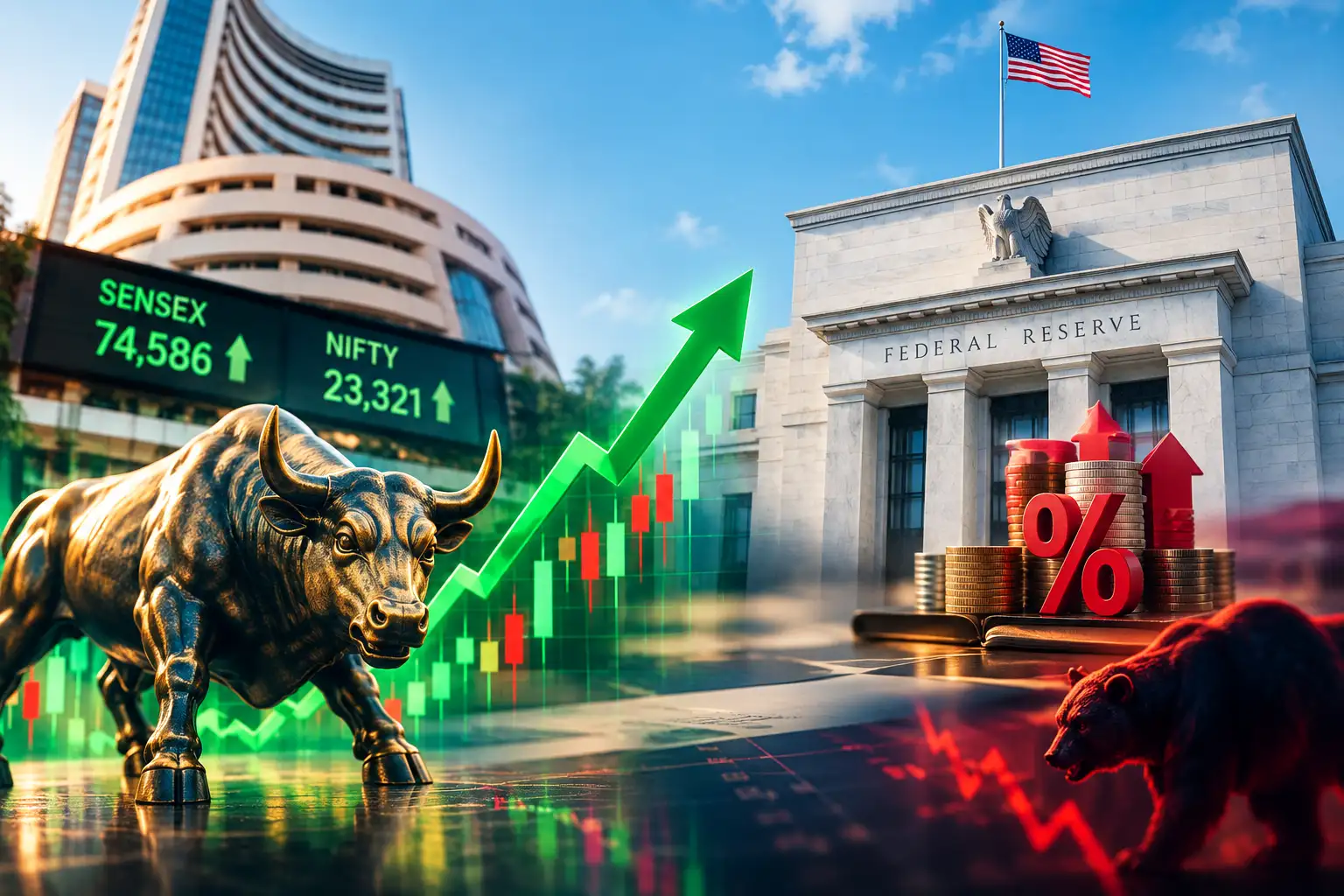
The Indian stock market extended gains on Thursday, with Sensex and Nifty trading higher, bucking worries after the US Federal Reserve’s first rate hike in three years, although analysts advise caution amid multiple headwinds.
Sensex gained around 245 points to trade at 74,586 while Nifty 50 gained more than 104 points to trade at 23,321, as seen at 10.15 am. Broader markets also swung into the green, with Nifty Midcap 100 and Nifty Smallcap 100 rising nearly 1% each.
Zomato and Blinkit parent Eternal saw its shares jump around 3% to lead gains on Sensex. Bajaj Finance shares rose nearly 2%, while those of BEL, ITC and Axis Bank were up over 1% each. Bucking the trend, HDFC Bank, TCS, HCL Tech and Infosys shares fell nearly 1% each.
All sectoral indices except Nifty IT were trading in the green, with Nifty Metal, Nifty Pharma, Nifty PSU Bank, Nifty Auto and few others rising around 1% each. The overall market breadth turned positive, with NSE seeing 2,316 advances against 827 declines, while 105 stocks remained unchanged.
Also read | Explained: What US Fed’s first 25 bps rate hike in 3 years means for Indian stock market
The US Federal Reserve on Wednesday announced its first interest rate hike since 2023, with officials expecting one more increase later this year. The American central bank’s Federal Open Market Committee (FOMC) announced the decision after a two-day meeting, increasing the benchmark interest rate by 25 basis points to a range of 3.75-4%. This comes after consumer inflation stayed at 3.4% in August, same as last month but still much higher than Fed's 2% target. Inflationary pressures were further intensified by soaring energy prices amid renewed tensions in the Middle East.
"There are no immediate signs for inflation to ease, especially given the stalemate in the Middle East. This means the Fed may need to continue to tighten to achieve its target," Tai Hui, APAC chief market strategist at JP Morgan Asset Management, was quoted as saying by Reuters. Traders are now expecting a 50% chance of another Fed hike next month to rein in inflation. A total of three rate increases have been priced in for this tightening cycle.
Why caution is still warranted?
While the Indian stock market trades in the green, caution is still warranted. Today is Sensex’s weekly expiry day, which typically sees sharp volatility towards the end of the session. Additionally, bond yields remain elevated, with the benchmark US 10-year Treasury yield above the crucial 5% mark.
The Indian rupee weakened past the 96-mark against the US dollar today, marking the first time in over a month, driven by a stronger US dollar after the Federal Reserve raised interest rates and signalled further tightening. FIIs have also been selling heavily on Dalal Street.
Also read | PVR Inox buyback: Last chance to participate in multiplex operator's Rs 300 crore buyback. Should you tender shares?
What lies ahead for Dalal Street?
The Fed’s decision to raise rates by 25 bps was completely on expected lines, as there was no justification for a hold in rates in the context of elevated inflation and a resilient economy with only 4.1% unemployment, said V K Vijayakumar, Chief Investment Strategist, Geojit Investments. He added that the hawkish message from Kevin Warsh that “inflation has been too high, and has been for too long” and that “ this committee will deliver price stability” can be construed as reassuring to the markets.
However, high bond yields will continue to weigh on equity markets, according to the analyst. Under normal circumstances, he feels that 5% yield on the 10-year would have triggered a sell-off in equity markets. But this is not happening now since US corporate earnings continue to be good. Warsh’s comment that “new hirings, private sector earnings and business capital investment point in a good direction” reflect a resilient economy and strong corporate sector, the analyst said, noting that this has the potential to act as a counterbalance to the high bond yields, thereby preventing a sell-off in the equity markets.
“The Indian market will continue to struggle. FIIs have been continuous sellers in India during the last six days and this trend is likely to continue. Another concern is the news of the U.S. House of Representatives passing a bill to impose a 100% tariff on countries like India which import oil from Russia. The geopolitical scene and Trump’s policies are getting murkier,” Vijayakumar warned.