

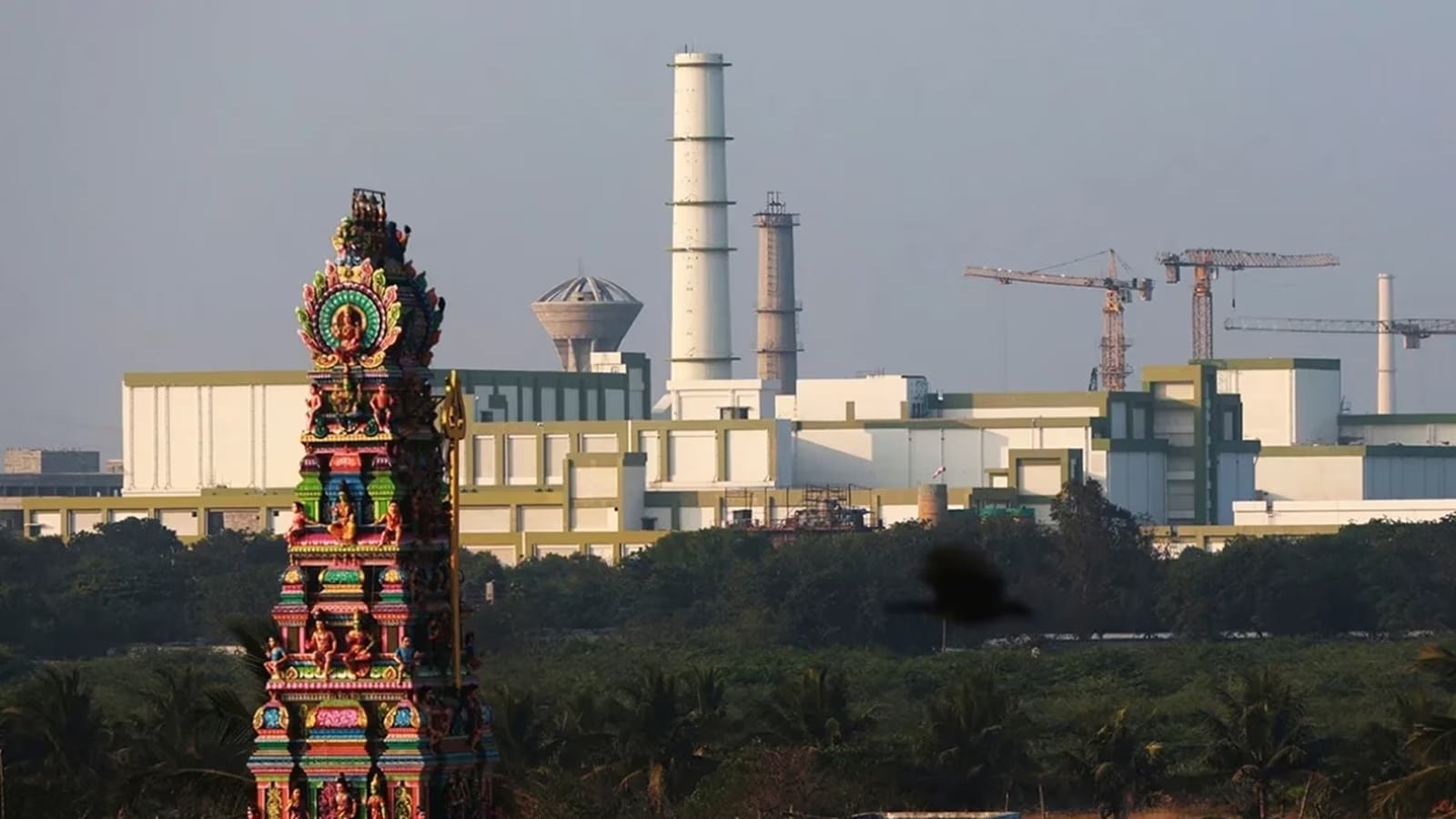
Member (Finance), Department of Atomic Energy Seema Jain said that achieving the target of 100 gigawatt (GW) of nuclear power capacity by 2047 would require investments of at least Rs 20 lakh crore, assuming a baseline cost of Rs 22 crore per megawatt (MW). (Source: File)
The dilution of the liability clause under the proposed SHANTI Act is expected to boost Foreign Direct Investment (FDI) in India’s nuclear power sector as it opens up to private participation.
Speaking at a high-level workshop on the Act, Seema Jain, Member (Finance), Department of Atomic Energy (DAE), said the Atomic Energy Commission has approved an FDI policy, which has now been sent for inter-ministerial consultation.
Jain said that achieving the target of 100 gigawatt (GW) of nuclear power capacity by 2047 would require investments of at least Rs 20 lakh crore, assuming a baseline cost of Rs 22 crore per megawatt (MW).
“Now that kind of financing will require all sorts of innovative measures to happen so that you know that kind of money and the financial space is made available for this sector,” she said, adding that initiatives related to banking and FDI are in the pipeline.
The inaugural session of the workshop was also attended by Ghanshyam Prasad, Chairperson of the Central Electricity Authority (CEA); Gurdeep Singh, CMD of NTPC; and Praveen Gupta, Member (E&C), CEA.
As India has mastered Pressurised Heavy Water Reactor (PHWR) technology and achieved criticality in Fast Breeder Reactor (FBR) technology, Jain said the next challenge is the indigenisation of Light Water Reactor (LWR) technology, which dominates the global nuclear fleet.
“….the next challenge for us would be to indigenize that (LWR) technology, not just the design part but also the fuel processing and the other associated elements, the components, the equipment and all of those things so that India emerges as a very, very reliable partner, not just domestically for the Indian industries but also for exporting this technology in the neighborhood,” Jain said.
Story continues below this ad
Nuclear tariff concerns
Delivering the keynote address, CEA Chairperson Ghanshyam Prasad said nuclear power remains the only viable alternative to coal for baseload generation, given its ability to provide stable and clean energy.
However, he flagged concerns over higher tariffs for new nuclear power plants compared to older ones.
“…the tariffs of the old nuclear power plants are right now ranging from 272 to 387 paisa per unit. Which is a very good tariff price. This reminds me of the hydro segment which at the time when you build it, It looks to be higher. But over a period of time you find that it is one of the cheapest sources,” he said.
He said the challenge is going to come from the new plants which are coming up as the tariff of these plants range somewhere around 5.50 to 6.50 paisa per unit. “We will have to take steps to reduce this tariff by way of some measures,” he added.
Story continues below this ad
Prasad also highlighted the need to shorten approval timelines for nuclear projects. At present, the entire process — including regulatory clearances and implementation — takes around 13 years. He stressed the need to reduce this to about 8–9 years.
