
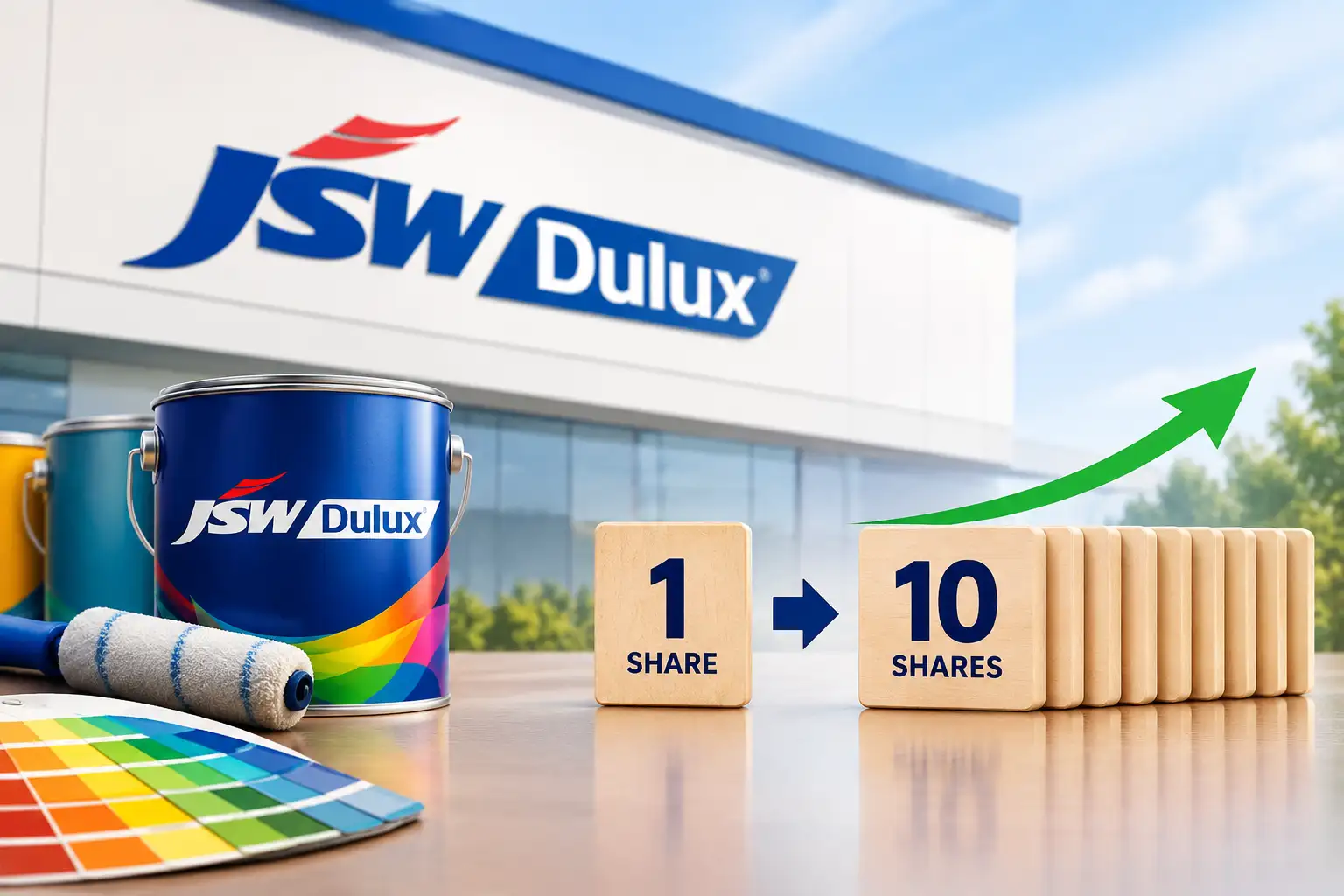
JSW Dulux has fixed October 22 (Thursday) as the record date for its 1:10 stock split, making today the last day for interested investors to buy the paint-maker’s shares to be eligible for the corporate action.
As per Sebi's T+1 settlement norm, investors need to buy a company's shares at least one trading day before the record date to ensure the shares are credited to their demat accounts in time and they become eligible for the corporate action. Accordingly, today is the last opportunity for investors to buy JSW Dulux’s shares to be eligible for the stock split.
Also read | Hindustan Zinc Q2 Results: Net profit skyrockets 142% YoY to Rs 6,412 crore, revenue soars 77%
What JSW Dulux’s 1:10 stock split means for shareholders?
While the number of outstanding shares increases during a stock split, the company’s overall market capitalisation remains unchanged. A lower share price can make the stock more accessible to retail investors, potentially improving participation and trading volumes. A 1:10 stock split means that every share held on the record date would be split into ten shares, while the total value remains the same.
Let’s take an investor who holds 10 shares of JSW Dulux worth Rs 100 each for example. The total value of her shareholding in the company stands at Rs 1,000. After the stock split takes effect, her 10 shares will be split into 100 shares worth Rs 10 each, keeping the total value of her stock holding the same at Rs 1,000.
JSW Paints, a part of the JSW Group, acquired a 60.76% stake in Akzo Nobel India pursuant to the Share Purchase Agreement between JSW Paints Ltd and Imperial Chemicals Industries Ltd and Akzo Nobel Coatings International BV in December last year.
Subsequently renamed to JSW Dulux, the shares of the company have dropped over 4% in 2026 so far and 10% in one year, with the stock overall gaining 24% in three years and 38% in five years.
Also read | UltraTech Cement Q2 Results: Net profit jumps 21% YoY to Rs 1,494 crore; revenue up 19%
Disclaimer: This article has been written by Debaroti Adhikary, who is not a SEBI-registered Research Analyst or an Investment Adviser. Debaroti Adhikary and his/her ‘relative(s)’ (as defined under Section 2(77) of the Companies Act, 2013) do not hold any financial interest in the companies mentioned in this article as of the date of publication. The views/recommendations mentioned in this article, wherever applicable, are those of the respective SEBI-registered Research Analyst/brokerage and have been reproduced/reported with due attribution. They should not be construed as the views or recommendations of The Economic Times Digital or the journalist. Readers are advised to consider the original research report and make their investment decisions based on their own assessment. Brokerage disclaimers here.