

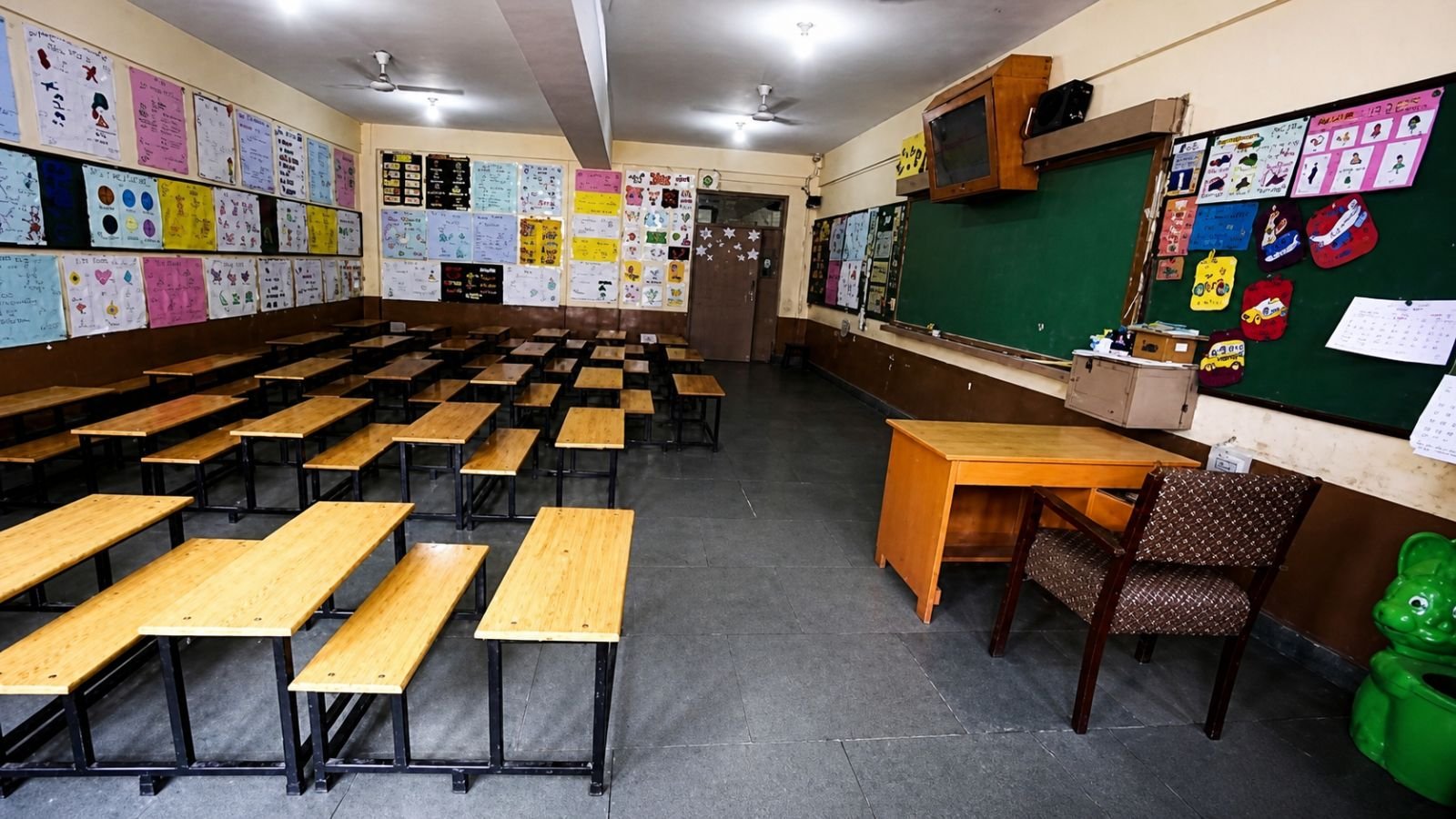
At the Bemina, Srinagar, office of the Jammu and Kashmir Board of School Education, a file is kept inside a locker. They call it File 104, which is essentially a watchlist of schools flagged by intelligence agencies. If a school finds its way in, government registration is off the table, without any formal response or a public notice.
One of the schools in the spotlight in recent days is Islamia High School in Baramulla, one of the 58 self-financed schools linked directly or indirectly to the Falah-e-Aam Trust (FAT) which the government has announced it will take over, as it sees them as “under patronage of the Trust or falling within its ideological orbit”.
The FAT is the educational affiliate of the banned Jamaat-e-Islami (JeI), J&K.
Following the government order, the administrative control of all 58 schools has been given to principals of nearby government schools, including Islamia High School.
Also Read | Rare sight: Hurriyat’s Mirwaiz shares stage with mainstream politicians in Kashmir
Registered as an independent institute with the state board since 1992, Islamia High School has around 1,500 students on its rolls, 700 of them girls.
Spread over 13 kanals of land, it boasts among its alumni several senior police officers and doctors, with its most-famous student in recent times being rising cricket pacer Aqib Nabi. In Class 10 results this year, it had a pass percentage of 95%, with five students scoring 490 marks out of 500.
Islamia High School’s administrative control is now with Government High School, Buglowbagh, which, after the clubbing of seven more schools with it, has 170 students on its rolls.
Story continues below this ad
A former student of Islamia High School says this is “ironical”. “An administration that struggles to manage even 200 students has been given control of more than 1,500 students.”
The takeover of the 58 schools last week completed an exercise that began in 2022, when the administrative control of the 22 original schools of FAT was taken over by the government, citing a 1990 crackdown on the trust. In August 2025, the government took over another 150 such schools.
“The takeover has effectively stripped us of our autonomy,” says the principal of a formerly FAT school. “Our accounts are sealed and about every expense, whether the salary of teachers or other routine costs, we have to get the approval of the principal of the administrative school.”
However, the principal of a FAT school that was taken over last year says nothing much has changed for them on the ground. “Everything is the way it was. We have the same students, same teachers, we do the recruitment the way we used to do earlier… The difference is that students of Classes 9 and 10 are registered with the government school (that has administrative control over the FAT school now), and appear for exams under them.”
Story continues below this ad
Incidentally, the order of the Secretary, School Education, announcing the takeover of 200 FAT schools in August last year, had led to disagreement with the Omar Abdullah government. While the order said deputy commissioners would take over the management of the schools, Education Minister Sakeena Itoo claimed that the order – issued in “the interest of students” – had been “modified without her knowledge”.
According to her, the elected government had decided that these schools would be looked after by principals of nearby government schools. Eventually, an agreement had been reached on handing over the running of the schools to principals of neighbouring government schools.
The Jamaat-e-Islami started with 22 schools in 1967, at a time when Kashmir’s educational landscape was largely dominated by government-run institutions, apart from a handful of missionary schools in the private sphere. Across the semi-urban and rural areas of the Valley, viable educational options were even fewer. It went on to also open schools in Muslim-dominated areas of Jammu region.
In 1975, the JeI, J&K, was banned by the Sheikh Abdullah-led National Conference government. It approached the CM over the fate of the schools, and it was he who offered a solution, a former member of the outfit says. “The CM said you should run these schools under a Trust instead of the Jamaat to keep them functional.”
Story continues below this ad
The JeI had set up the Falah-e-Aam (Welfare for All) Trust for social outreach three years earlier, and it was seen as the best option.
Even as the JeI ban was lifted two years later, schools run by FAT emerged over time as a popular, affordable alternative to government schools, with the biggest draw being the early adoption of English as a medium of instruction, especially in core subjects like Mathematics and Science, following the syllabus prescribed by the state board. Besides these, the schools taught Islamic Studies and Arabic.
Over the years, the state board offered recognition to these schools based on recommendations of the deputy commissioners concerned, acting on intelligence agencies’ input.
As militancy rose in the Valley in the 1990s, the JeI was banned again. This time, the crackdown was extended to FAT, with the 22 schools directly linked to it ordered shut. However, the trust later got relief for them.
Story continues below this ad
For three decades after that, till 2019, the schools functioned without major disruption, with the FAT network expanding to reach a student base of over 80,000 – nearly half of them girls – and employing around 5,000 teachers.
In 2019, ahead of the abrogation of J&K special status, the JeI was banned one more time, with police and magistrates issuing notices to schools run by the Trust.
The authorities had to step in to clarify that these schools would not be closed down, attributing the confusion to officers misinterpreting the JeI ban.
