

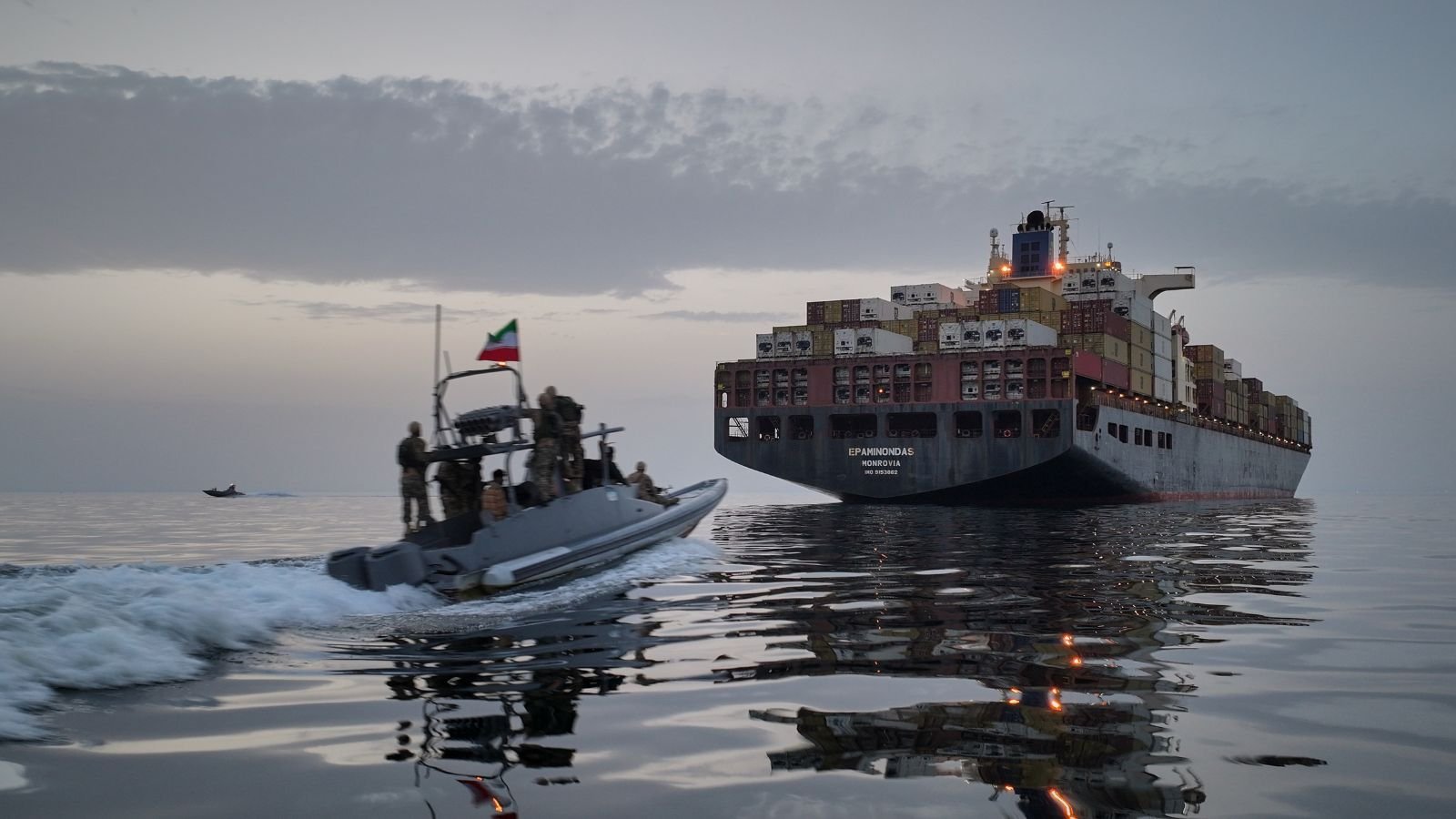
In this photo released by Tasnim News Agency, a Revolutionary Guard Navy (IRGC) speedboat approaches the cargo ship Epaminondas during what state media described as the seizure of one of two vessels accused of violations in the Strait of Hormuz. (AP Photo)
A foreign-flagged merchant vessel with 17 Indian seafarers on board was among a group of ships sailing near the Strait of Hormuz when the Iranian coast guard fired warning shots as it moved to intercept them on Saturday (April 25), a senior government official said Monday, adding that all Indian seafarers on the ship are safe.
Shipping Minister Director Mandeep Singh Randhawa identified the vessel as Togo-flagged chemical tanker Chiron 7. The incident occurred in waters near Oman’s Shinas port, which is to the southeast of the Strait of Hormuz.
The incident serves as yet another example of the heightened tensions around the Strait of Hormuz, with Iran as well as the US running their own blockades around the critical waterway. Earlier last week, Iran fired upon three foreign-flagged vessels, two of which cumulatively had 22 Indian seafarers on board. Earlier on April 18, two India-flagged vessels were also fired upon by the Iranian navy.
“An incident related to the Togo-flagged chemical tanker MT Chiron on April 25 has been reported. It has some Indian seafarers also on board. This incident occurred around the Shinas outer port limit in Oman. This ship, along with a few others, was sailing in the area and the Iranian coast guard asked for the ships to be intercepted, and some warning shots were fired by them. All Indian seafarers are safe. The Ministry is in regular touch with the Ministry of External Affairs, Indian missions, and maritime stakeholders,” Randhawa said at the government’s inter-ministerial news briefing on the West Asia crisis.
Ship tracking data shows that Chiron 7 has not switched on its location transponder for nearly 10 days now. Last week, it was trying to exit the Persian Gulf, which is to the east of the Strait of Hormuz. As Shinas is on the other side of the Strait, the tanker would have crossed the maritime chokepoint. Further details about the ship’s current location and status were not immediately available.
According to global shipping databases, Chiron 7 is owned and managed by a Honduras-based shipping firm.
On being asked about the status of the 22 Indian seafarers that were on foreign-flagged container ships that came under Iranian fire last week, Randhawa said that they are safe, without elaborating further.
Story continues below this ad
Also Read | Iran attacks ships in Strait of Hormuz: 3 signals this sends about the war
There were 21 seafarers on Panama-flagged container ship Euphoria, which was stranded to the east of the Strait after coming under fire from Iran’s Islamic Revolutionary Guard Corps (IRGC) navy last Wednesday. Euphoria was not seized by the Iranian forces. There was one Indian seafarer on another ship—Liberia-flagged Epaminondas—that was seized by the IRGC. Another vessel—Panama-flagged MSC Francesca—that was fired upon and seized by the IRGC didn’t have any Indian seafarers on board.
The attacks, which heightened tensions in the Strait of Hormuz area, appeared to be in retaliation of US forces seizing a few Iranian oil tankers that were attempting to slip through its blockade of Iran’s ports. In fact, US forces seized one more Iran-linked tanker on Thursday in the Indian Ocean. The US has also claimed that its forces in the region forced the diversion of numerous ships attempting to either leave or enter Iranian ports. Iran has condemned the US blockade, calling it “armed piracy” and a breach of the ceasefire between Washington and Tehran.
Wednesday’s firing by Iran on merchant vessels also followed the incident of Iranian gunboats firing at two India-flagged ships on Saturday as they tried to exit the fraught waters of the Strait of Hormuz. The vessels—oil tanker Sanmar Herald and bulk carrier Jag Arnav—turned back into the Persian Gulf after coming under fire.
Just a day earlier, Iran had announced that the Strait of Hormuz was completely open for commercial shipping, but by Saturday afternoon, the IRGC announced that the Strait was closed for all vessels. Iran said that the reversal was due to the US refusing to end the blockade of Iranian ports even as a fragile ceasefire was in place. The sudden U-turn by Iran on the status of the Strait led to confusion among ships that had lined up to cross the maritime chokepoint, which could have played a role in the incident of firing upon Indian ships.
Story continues below this ad
Scores of commercial vessels with thousands of seafarers have been stuck in the Persian Gulf since the West Asia war began on February 28 as vessel movements through the Strait of Hormuz ground to a halt after warnings from Iran; a few ships had also come under attack. The Strait of Hormuz is among the world’s most critical chokepoints for energy supplies, and accounts for a fifth of global oil and liquefied natural gas (LNG) flows. For Iran, its ability to disrupt global trade and energy flows by effectively closing the Strait has proven to be its most potent weapon and bargaining chip in the West Asia war.
Over the past few weeks, only a few ships a day have been able to cross the waterway, that too in coordination with the Iranian forces. So far, 10 India-flagged vessels have crossed the Strait safely due to diplomatic efforts by New Delhi. The government continues to be in talks with Iran to ensure safe passage of the 14 Indian vessels that are still stranded in the Persian Gulf. Even with the fragile ceasefire between the US and Iran in place, vessel movements through the Strait hardly picked up as confusion over the status of navigation through the critical waterway persisted.
