

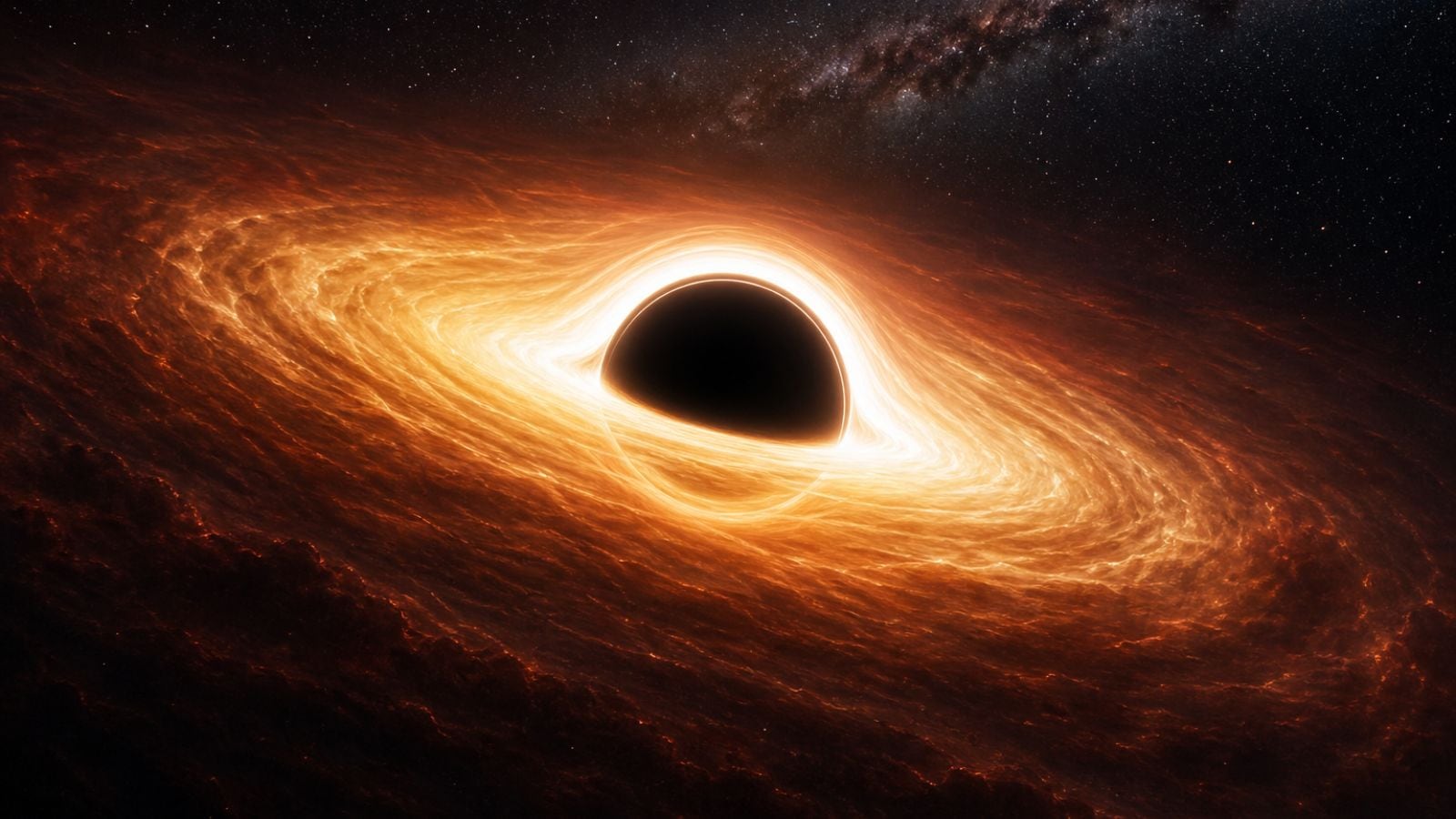
Post Content New research suggests decaying dark matter may be the “secret ingredient” behind the early existence of supermassive black holes discovered by the James Webb Space Telescope. (AI-generated image for representation:OpenAI)
The James Webb Space Telescope (JWST) has revealed a growing number of supermassive black holes in the early universe, appearing much earlier than many existing formation models had predicted.
These supermassive black holes – objects with masses of millions to billions of suns – have been observed as early as around 500 million years after the Big Bang. A research team from the University of California, Riverside, led by Yash Aggarwal, has proposed that decaying dark matter could have played a role in their rapid formation.
However, a key challenge remains: scientists are still working to fully understand how such massive black holes formed so quickly, as their early appearance poses a significant challenge to current models of black hole formation.
How are black holes made?
One widely studied pathway suggests black holes form from the remnants of massive stars – stars that are born, evolve, collapse under their own gravity, and can grow further by merging with other black holes or by pulling in surrounding matter. However, this process alone can be too slow to explain how some supermassive black holes grew so large so early in the universe, according to current models.
Also Read | Project Hail Mary: The science is a stretch, but the story carries the film
“The first galaxies are essentially balls of pristine hydrogen gas whose chemistry is incredibly sensitive to atomic-scale energy injection,” said Flip Tanedo, a colleague of Yash Aggarwal. “These are the properties that we want for a dark matter detector -the signature of these ‘detectors’ might be the supermassive black holes that we see today.”
Because of this, scientists are exploring additional mechanisms that could speed up black hole formation in the early universe. One such idea is that dark matter, particularly if it decays and releases small amounts of energy, may have helped accelerate the process under certain conditions.
What is dark matter?
Dark matter has long been one of science’s most frustrating mysteries because it leaves no trace we can easily follow. According to Space.com, Dark matter makes up about 85 per cent of all matter in our universe.
Story continues below this ad
Dark matter is not the opposite of normal matter, but it does not get affected by electromagnetic forces and light, which means it lacks any electrons. This makes all dark matter invisible, as it cannot be interacted with at present with any matter created, since everything is created by atoms. This makes it extremely difficult to observe directly, as it can only be studied through its gravitational effects.
This fact, coupled with the idea that dark matter may have a role in the early existence of the supermassive black holes, has put scientists in a pickle. So, the researchers have found a different approach – instead of directly searching for the dark matter, we will look at everything it has left behind.
Formation of these supermassive black holes
According to the study, as dark matter particles slowly decayed in the early universe, they may have released small amounts of energy that changed the chemistry of the first gas clouds. Instead of that massive gas breaking down into stars – the usual route to black hole formation- some of these clouds may have collapsed directly into massive black hole seeds, effectively speeding up and skipping billions of years of cosmic biography.
Also Read | China picks 2 Pakistani candidates for Tiangong space programme
What makes this idea exciting is how little energy was needed to trigger the change. According to Space.com, the team calculated that the equivalent of a “billion trillionth of the energy of a single AA battery” injected into primordial hydrogen was enough to reshape the entire evolutionary path of an early galaxy.
Story continues below this ad
“Our study suggests that decaying dark matter could profoundly reshape the evolution of the first stars and galaxies, with widespread effects across the universe,” Aggarwal said in a statement. “With the JWST now revealing more supermassive black holes in the early universe, this mechanism may help bridge the gap between theory and observation.”
(This article has been curated by Nityanjali Bulsu, who is an intern with The Indian Express)
© IE Online Media Services Pvt Ltd
