

Post Content
Globalstar, a satellite firm known for powering Apple’s Emergency SOS feature that enables its devices to send texts from isolated areas, has been bought by Amazon, marking the tech giant’s latest effort to bolster its nascent Leo satellite internet business as it looks to go head-to-head with Elon Musk’s Starlink.
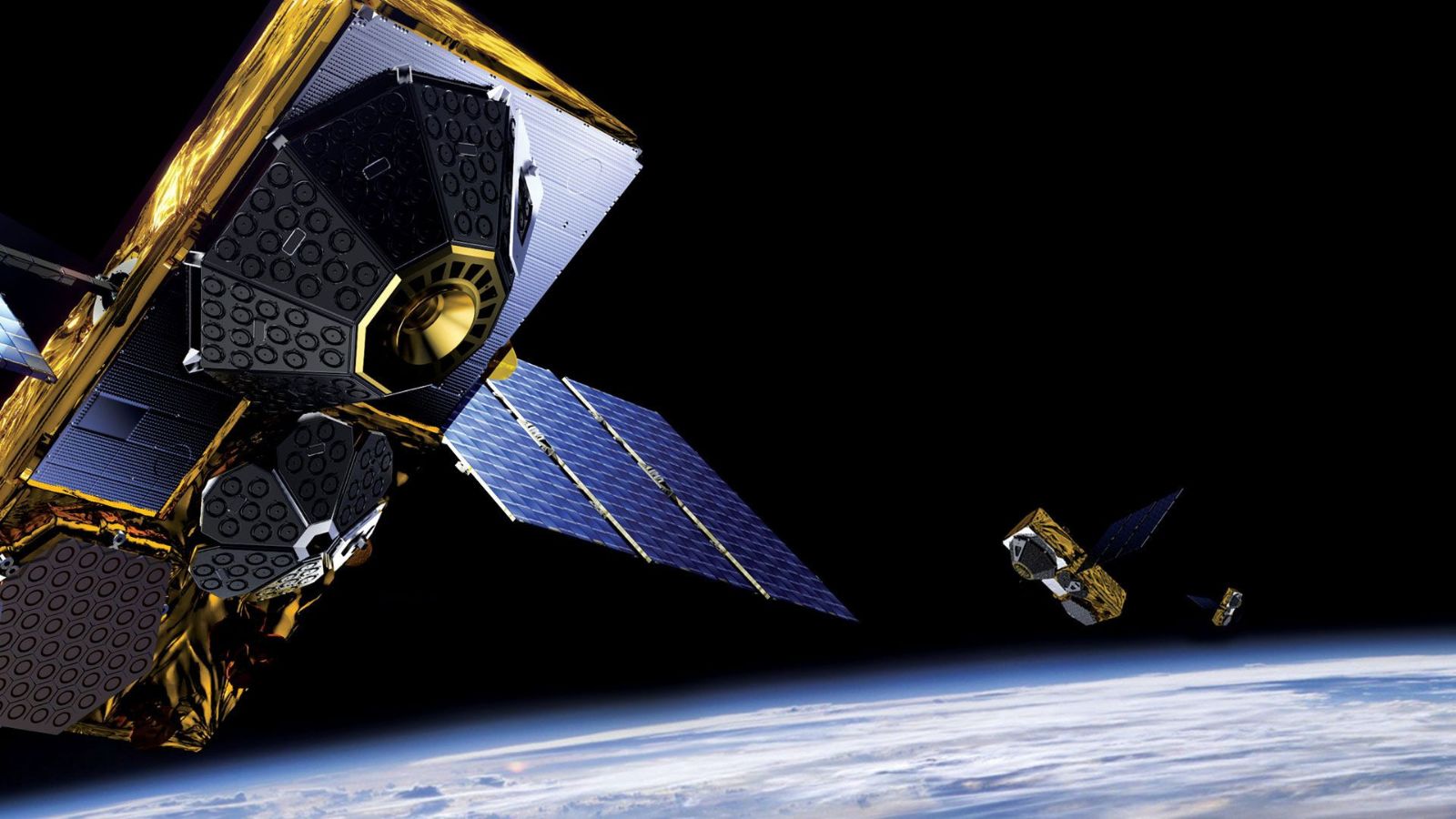
Amazon said on Tuesday, April 14, that it will be acquiring Globalstar in a deal worth about $11.57 billion. The e-commerce major will assume control of Globalstar’s existing satellite operations, infrastructure, and other assets as part of the acquisition. This means that Globalstar’s low earth orbit satellite network, comprising roughly 24 satellites, will operate alongside Amazon’s own fleet of more than 200 satellites.
Notably, the transaction gives Amazon access to Globalstar’s spectrum licenses with global authorisations, paving the way for the company’s direct-to-device (D2D) satellite service, which is slated to begin in 2028.
“By combining Globalstar’s proven expertise and strong foundation with Amazon’s customer-obsession and innovation, customers can expect faster, more reliable service in more places — keeping them connected to the people and things that matter most,” Panos Panay, Amazon’s senior vice president of devices and services, said in a statement.
Apple, which took a 20 per cent stake in Globalstar in 2024 through a $1.5 billion investment, may emerge as a key beneficiary of the Amazon deal. The acquisition brings financial stability to Globalstar and may help improve its performance relative to rivals like Starlink, while allowing Apple to retain access without having to own or operate the network itself.
Both Amazon and Apple have confirmed that existing services will continue, with a new agreement ensuring satellite connectivity for current and future iPhone and Apple Watch features, including Emergency SOS and messaging in no-network zones.
What is D2D satellite service and how does it work?
Extending conventional cellular coverage through terrestrial mobile towers is often unviable in remote regions, open seas, vast forests, or rugged mountains. This is where D2D satellite connectivity comes in.
Story continues below this ad
D2D satellite networks differ from conventional mobile networks which rely on terrestrial Base Transceiver Stations (BTSs) that aggregate mobile signals, process them, and route them to their destinations. Satellites perform similar functions as BTSs while orbiting the Earth.
Generally, satellites can be placed either in geostationary orbit (over 36,000 kilometres above Earth’s surface) or low earth orbit (between 160-2,000 kilometres). LEO satellites are better suited for mobile connectivity than GEO satellites as they move closer to the Earth and provide lower latency, though they typically require large constellations of satellites to ensure continuous coverage.
Also Read | What is satellite spectrum, why most countries prefer not to hold auctions
LEO satellites are equipped with transmitter and receiver antennae pointed toward the Earth, they send multiple beams in lower frequency bands (sub-GHz, L-band, and S-band, between 1 and 2.5 GHz) to cover designated areas or ‘footprints’, similar to how additional mobile towers are constructed on the ground to improve coverage.
When a smartphone is unable to latch onto a nearby cellular tower due to poor signal, the device will connect to an LEO satellite passing overhead, and the satellite will then relay the signal – either directly or through inter-satellite links – to the nearby on-ground mobile tower, completing the connection.
Story continues below this ad
What is the size of the D2D satellite market? How is spectrum assigned?
Investments toward D2D satellite capacity will go up to $6-$8 billion, with over 1,000 D2D-capable satellites expected to be launched into orbit by the end of the year, according to Deloitte Global’s ‘TMT Predictions 2026’ report. Of this amount, 85-90 per cent of spending will fund new satellite deployments while the remaining 10-15 per cent will be dedicated to replacing existing satellites.
Meanwhile, end-user spending on LEO satellite communications services is expected to reach $14.8 billion globally in 2026, an increase of 24.5 per cent from 2025, according to Gartner analysts.
Most satcom players rely on partnerships or acquisitions to leverage established mobile infrastructure and spectrum, and bridge the gap between satellite and terrestrial networks. “The critical question is which terrestrial networks are providing the necessary radio spectrum for the satellite companies,” Bill Ray, Chief of Research at Gartner (UK), told The Indian Express.
In the past, satcom companies and telcos in India have clashed over how spectrum for satellite-based communication services should be assigned. When asked if D2D services could open a new front of conflict between tech companies and telcos, Ray said, “Given the necessary cooperation with local operators (to get radio spectrum) the potential for conflict is minimised.”
Story continues below this ad
“Though I’d note that Elon Musk’s assertion that Starlink will become an MVNO [Mobile Virtual Network Operator] should be a cause for concern amongst branded network operators considering who to make a deal with,” he added.
Who are the key D2D satellite service providers?
Starlink began offering its D2D service called Starlink Mobile in a few countries such as the United States, Canada, and Australia earlier this year, by partnering with a growing number of mobile carriers, including T-Mobile.
In March 2026, Japanese telecom company KDDI announced the launch of the “world’s first international roaming connection” via Starlink Mobile. In 2025, Starlink acquired multiple spectrum licences, including 50 MHz of wireless spectrum and mobile satellite service spectrum, from EchoStar in order to expand its Starlink Mobile network.
AST SpaceMobile, another satellite firm, is looking to launch its own D2D service later this year with six satellites currently in LEO. Unlike Starlink and Amazon, AST SpaceMobile is reportedly borrowing spectrum for its service from mobile carrier partners such as Verizon, AT&T, and Vodafone.
Story continues below this ad
Also Read | India frames rules for Starlink, others: local manufacturing, data localisation, security cooperation
To avoid the costs of deploying a satellite constellation, California-based Skylo is looking to offer D2D services using existing geostationary satellites combined with its cloud-based platform while inking global roaming agreements with mobile operators.
State-owned Bharat Sanchar Nigam Limited (BSNL) launched its D2D satellite service in India in 2024, partnering with Viasat, a US-based satellite communication company. Trials conducted by BSNL showed that it was able to send and receive text messages via a geostationary L-band satellite.
What are the challenges facing D2D satellite service providers?
While Starlink and Lynk Global have both launched commercial D2D satellite services, AST SpaceMobile could be the one to watch as it was formed by a consortium of terrestrial operators and has some technical advantages. In addition, AST SpaceMobile’s first customer is expected to be FirstNet, the US first responder network, underscoring the critical emergency-use potential of D2D satellite services.
However, operators will have to prioritise traffic in emergency situations as satellite networks cannot provide the same level of capacity that terrestrial towers do. “So, in the event of a major disaster, the satellite will work in providing coverage, but only with limited capacity. Network operators will have to decide which customers they should prioritise,” Ray said.
Story continues below this ad
Other challenges remain. D2D satellite connectivity works best outdoors with a clear view of the sky, offers limited speeds, and can drain battery as devices are harder to connect. It is also not fully resilient against large-scale disasters and network disruptions because connectivity still depends on terrestrial gateways.
Regulatory bottlenecks persist, not just around spectrum policies but also at the device level that could potentially slow the rollout of D2D services.
In response to the Amazon-Globalstar deal, US Federal Communications Commission (FCC) Chairman Brendan Carr said that the regulator will have to review the acquisition.
“Ultimately, we’ll have to take a look at the paperwork and see, but it’s, you know, consistent with the long-term vision that we have to make sure that the US leads in this next-gen era of direct-to-cell technologies,” Carr was quoted as saying by CNBC.
Story continues below this ad
“We’re ultimately not the arbiter of what technology succeeds or not. We shouldn’t be the constraint either, so we’ve directed the staff to move quickly on all of these different applications,” he added, signalling a more open stance aimed at boosting the US space economy.
