

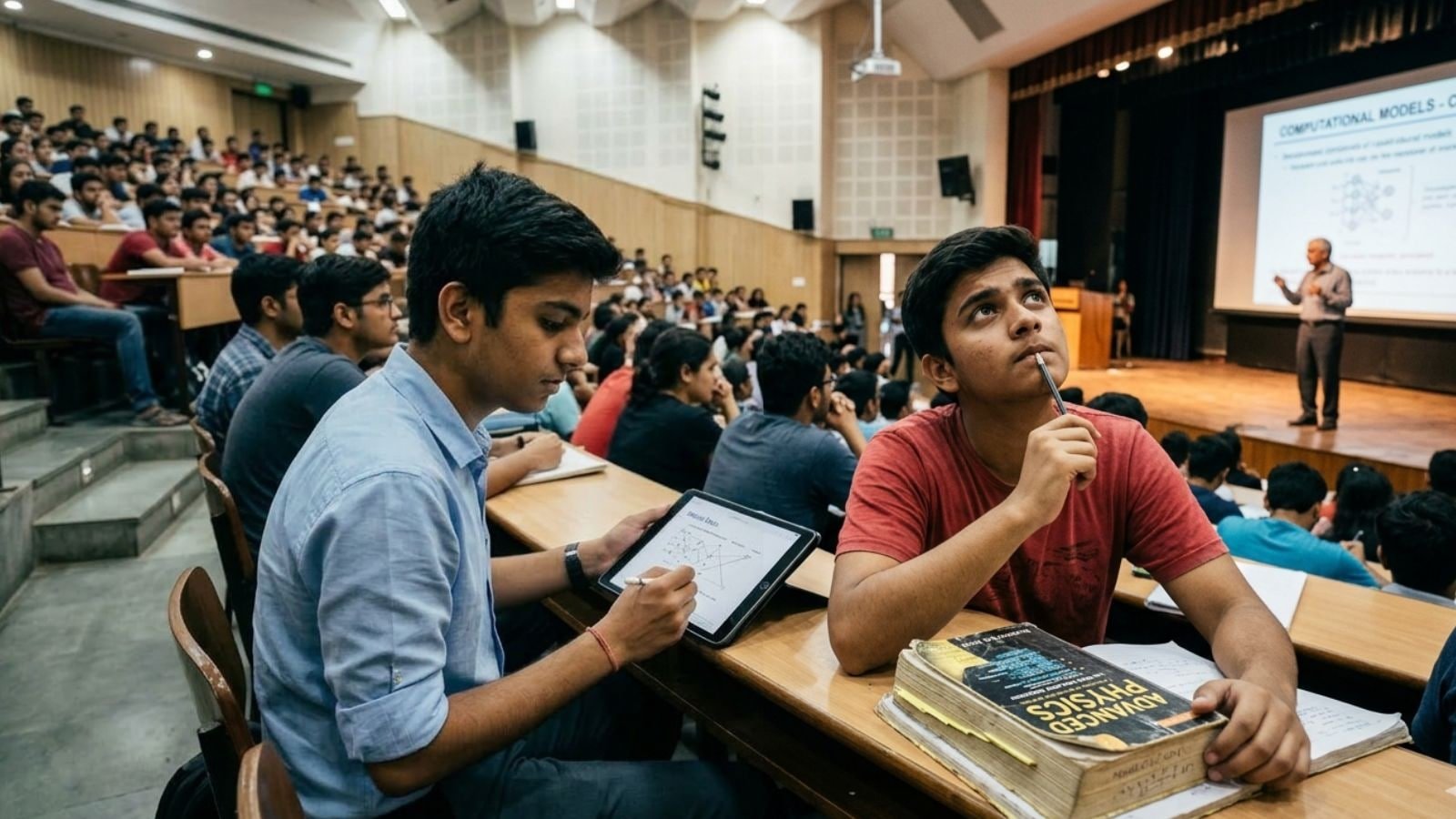
While the basics of JEE preparation may not have changed much over the past decade, the tools around it are evolving. What if a JEE aspirant could instantly identify the chapters where they are losing marks? Or which physics question did they take too long to solve during a mock test? For students preparing for one of India’s most competitive exams, AI-powered tools are gradually changing how they practise, revise, and analyse their performance.
At the centre of preparing for a national-level entrance test like the Joint Entrance Examination (JEE) remains the classic trifecta of physics, chemistry, and mathematics. Candidates must practise hundreds of problems and manage their time carefully. But the tools supporting this preparation are evolving. Artificial Intelligence-driven platforms, mock test analytics, and personalised feedback are slowly entering coaching centres and mock-test sessions.
For many aspirants, the first interaction with AI happens through doubt-solving or concept-explainer tools. Students increasingly turn to chatbots or AI assistants when they struggle with a question late at night or want a quick breakdown of a complex concept. But the bigger transformation is happening in performance analysis and personalised preparation.
AI helps identify weak
Consider mock tests. These tests have always been central to JEE preparation. But AI is now helping convert mock test data into detailed insights. Instead of simply telling a student their score, new systems can identify weak chapters – down to a topic, measure accuracy levels, and even track how long a student spent on each question.
Coaching institutes assert such tools can also help bridge a long-standing classroom challenge. A single instructor often teaches dozens of students in one batch. Tracking the learning gap of each student can be difficult.
According to Ajay Kumar Sharma, national academic director, Aakash Educational Services, technology is gradually helping address this issue. “There has always been a challenge in a classroom where around 40 students attend one session. AI can help identify weak areas and give additional guidance so that each student gets more targeted support,” he said.
Sharma notes that while AI-based insights are already being introduced in some areas, the systems are still evolving. In several cases, identifying weak topics and recommending additional practice still involves manual intervention by teachers. “We are providing guidance on weak areas and concepts, but it is not yet fully automated. We are working towards improving these systems further,” he explained.
Story continues below this ad
Another area where AI is gaining ground is exam analytics. Digital mock testing platforms can now track a student’s performance in far greater detail than traditional paper tests.
Those who are users of the ‘Arihant Edge’ app and participate in the weekly mock tests for JEE aspirants find a hyper-personalised analysis of their attempts. According to Harsh Kapasi, COO of Arihant Academy, the platform uses AI-based analytics to help students understand their preparation more clearly.
“Students get their marks immediately after the exam along with topic-level performance analysis,” Kapasi said. “The system shows which concepts in physics, chemistry, or maths need more practice, how much time a student spent on each question, and where accuracy was lower.”
Read | Preparing for JEE during boards? Focus on balance, experts advise
Such a detailed analysis was not possible earlier. In traditional offline tests, which were the norm even two-three years back, students filled OMR sheets and received only their scores and answer keys. Now digital testing allows deeper insights into performance patterns.
Story continues below this ad
Another sign of how AI is entering the preparation ecosystem can be seen in tools launched by technology companies themselves.
How Google, ChatGPT are changing the game
Earlier this year, Google announced the introduction of AI-powered capabilities within Google Gemini that allow students to practise and understand complex quantitative concepts. The tool can generate practice questions, explain solutions step-by-step, and break down difficult physics or mathematics problems. Such features are increasingly being used by students preparing for competitive engineering entrances like JEE to quickly test concepts or understand alternate approaches to solving problems.
Similarly, ChatGPT recently announced updates aimed at helping learners better understand mathematics and science concepts. The platform can now work through complex equations with improved accuracy, explain step-by-step reasoning, and provide clearer conceptual breakdowns for STEM subjects. According to OpenAI, in early testing, high school and college-age students reported that the interactive format helped them better understand how variables relate to one another, while educators noted that such tools could help students grasp how concepts work rather than simply memorising formulas.
Kapasi explains that the data can even reveal problem-solving behaviour. “We can see if a student spent too much time on a question that should ideally take less time. We can also identify chapters where multiple mistakes occurred and recommend targeted revision or additional tests.”
Story continues below this ad
These insights are not just for students. Coaching institutes can also use the data to design more focused interventions. For instance, students who struggle in a particular subject can receive additional question sets or mock tests based on those topics.
Read | JEE Advanced 2026 exam on May 17 | Important dates
AI is not replacing teachers
Meanwhile, educators stress that AI is not replacing teachers or study material. Kapasi says the learning content itself continues to be created by subject experts. “Our notes and academic material are developed in-house. AI mainly helps us analyse performance and guide students on where they need to focus more.”
For aspirants, however, such detailed analysis can sometimes feel intense. When every mistake, hesitation, and time delay is captured in data, the feedback can appear overwhelming.
Rohan Verma, a Class 12 student preparing for JEE, says the insights can initially seem intimidating. “The report shows exactly where you made mistakes and which chapters need more work. At first, it feels like a very close examination of your preparation,” he said.
Story continues below this ad
But he adds that the detailed feedback eventually helps him refine his study plan. “It actually reduces confusion. If I know I’m losing marks in a specific topic like integration or wave optics, I can focus my revision there instead of guessing what I should study next.”
Another aspirant, Aditya, sees the detailed analytics as a way to manage time better. “Sometimes you think you know a chapter well, but the report shows you spent too long solving certain questions. That helps you realise you need more practice to improve speed,” he said. “It’s detailed, but it helps you prepare smarter rather than making you anxious.”
However, some students also caution that AI tools must be used carefully during preparation. Adarsh Sharma, another JEE aspirant, says the reliability of explanations remains an important concern. “The biggest challenge is the accuracy and reliability of what is being explained. JEE preparation requires very precise conceptual clarity, and even small inaccuracies can create confusion for us as we appear for the exam,” he said.
“At the same time, for quick conceptual clarification or minor doubts, AI tools can be helpful because they provide instant explanations and multiple solution approaches. But discussing doubts with peers or teachers often leads to deeper conceptual discussions and alternative ways of thinking, which are ultimately valuable in exams like JEE Advanced that test analytical ability, while demanding time management.”
Story continues below this ad
Read | JEE Main Topper Tips | ‘Choosing consistency over cramming helped me crack JEE, get CSE at IIT-Bombay’
Parents, too, are gradually becoming more comfortable with digital learning systems. Many platforms now allow parents to track their child’s performance through dedicated dashboards showing scores, chapter-wise progress, and improvement trends.
Educators believe that as these systems evolve, AI will become a stronger support tool for personalised learning. But they also caution that technology cannot replace the fundamentals of preparation.
Are toppers from other national-level exams also benefiting from AI?
Interestingly, although AI may be reshaping preparation strategies with dedicated tools, many toppers have not fully embraced it yet. Over the past few years, indianexpress.com spoke to toppers across multiple competitive exams, ranging from engineering and medical entrances to professional course exams and civil service exams.
Most JEE Main or JEE Advanced and NEET UG toppers continued to rely almost entirely on the traditional formula: self-study, NCERT textbooks, previous-year questions and coaching mock tests. Several, including Devdutta Majhi (JEE Advanced 2025, AIR 16, and female topper) and Tathagat Awatar (NEET UG 2024, AIR 1), did not mention using AI tools or generative apps in their preparation.
Story continues below this ad
However, the story was slightly different for some professional exam toppers. For instance, Raj Krishna Jha (UPSC Civil Services Exam 2024, AIR 8) said he used ChatGPT particularly to practise essay writing and get structured feedback on around 40–50 drafts during his UPSC preparation. Similarly, Anirudh Garg (ICAI CA Final 2026, AIR 2) used it selectively to clarify difficult concepts when textbooks fell short, while Aniruddha Chakrabarti (WBJEE 2025, Rank 1) turned to AI tools for a few tricky topics during his preparation.
As it stands, conceptual understanding, regular practice, and disciplined study habits remain the key to succeeding in a pan-India exam like JEE. AI can point out weaknesses and guide revision, but the effort to understand and learn difficult concepts lies with the student.
