

Post Content
What is the best location for a smart device that gathers signals from your body and helps you make adjustments to improve your quality of life? A ring on your finger stays put and stays out of the way — quietly gathering data for at least a week before it needs to be recharged. This is where Finnish smart ring maker Oura is confident about its advantage over the competition, with a no-nonsense approach to living fitter and healthier.
The Oura Ring works best when you use the sizing kit to find the right fit. This matters: a loose ring will not collect data accurately. I got the right size, and the fit ensured it stayed on at all times — easy to forget about after the first day.
The app is central to the experience. It walks you through setup easily and sends alerts to remind you to charge the ring using the proprietary dock that comes in the box. Compared to other wearables, I find smart rings far less intrusive — there is no screen demanding your attention or making you self-conscious. The sensors inside work continuously and silently. You only notice them in the dark, when the sensor lights briefly shine through.
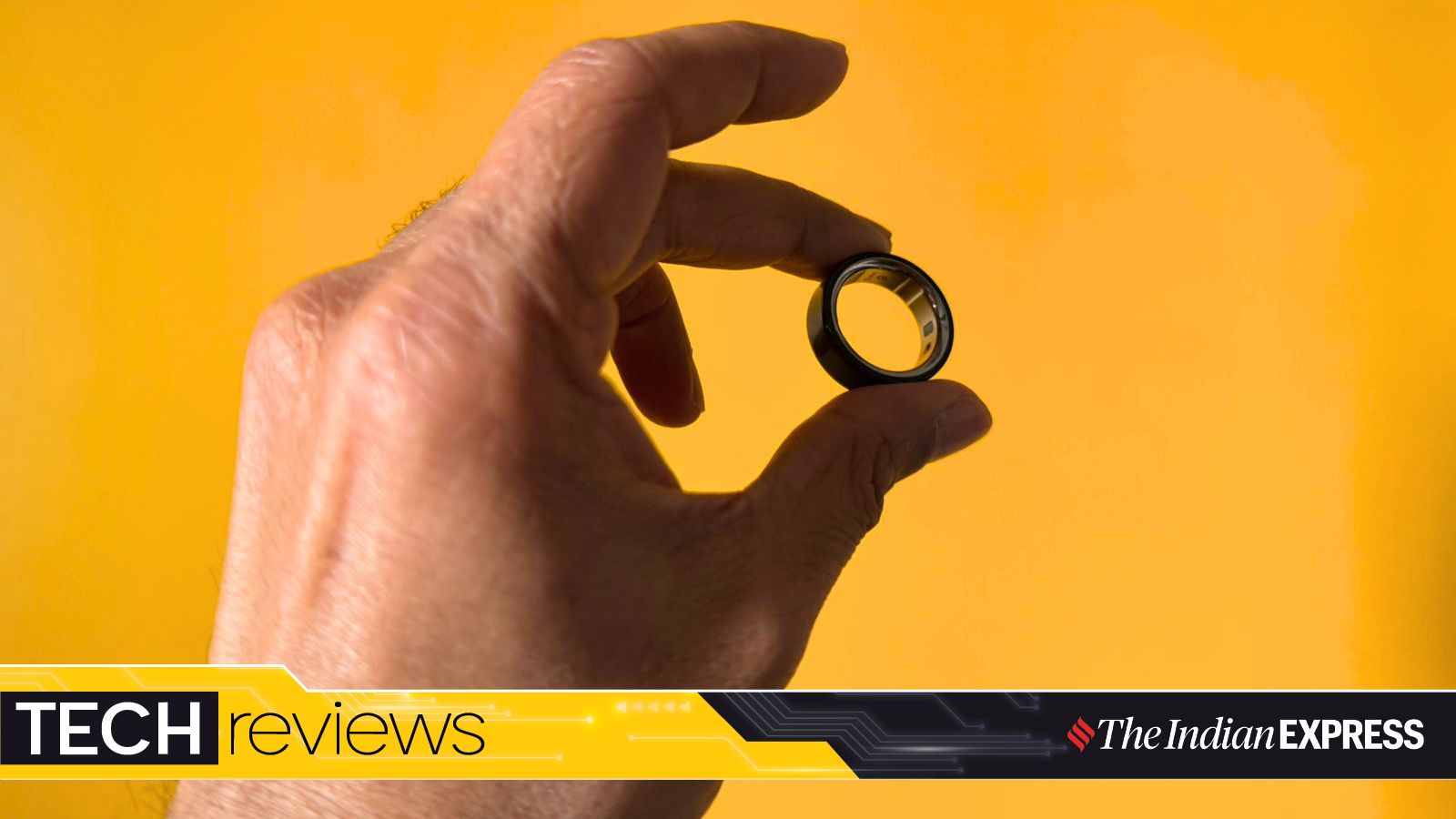
Worn like a regular ring, the device stays comfortable throughout the day and night, enabling continuous, unobtrusive health tracking. (Image: Nandagopal Rajan/The Indian Express)
It takes about five days of continuous use for some data points to populate, which is fine — you know the data has context rather than just being a snapshot. The app focuses on key metrics: readiness, sleep, activity, heart rate, and stress, each with a one-tap entry point to a deeper dive. It scores you out of 100 across all of them. Seeing that I had an 89/100 for fitness felt more meaningful than knowing I had burnt 400 kcal the previous day. The app synthesises your scores across different dimensions into an overall readiness score — a morning read on how recharged you are to take on the day. I found it remarkably accurate.
Also Read | I swapped my Apple Watch for the Polar Loop for 3 weeks: Here is why the “Boost Score” changed my routine
This past weekend, for instance, I was caught up with work that cut into my sleep and came with its share of stressful moments. The next morning my readiness score had dipped, my heart rate was elevated above baseline, and the app flagged several stress peaks. I struggled through the day, desperate to lie down by afternoon. I slept through the two-hour flight back from Mumbai, got home, and had a full night’s rest. The next morning, my readiness score had recovered — backed by 7 hours and 34 minutes of sleep at 90% efficiency, meaning I had barely stirred through the night.
Over two weeks with the ring, I have worked out that I function best on around 7.5 hours of sleep — which, interestingly, is exactly what my doctor recommends, though I usually fall short by an hour. The one lifestyle shift the ring has already triggered: I now make a deliberate effort to sleep past seven hours at least on weekends.
With roughly a week of battery life, the Oura Ring only needs an occasional top-up on its compact charging dock. (Image: Nandagopal Rajan/TheIndian Express)
On the fitness side, it tracks steps and calories, but what I found more useful was the data on time spent being active. The bigger problem for most of us today is not exertion – it is that we get so absorbed in work, or in whatever is playing on television, that we simply stop moving. Our grandparents never had this problem. Watching this metric has made me more mindful of getting up and moving every few minutes, and I find myself hitting my step targets daily without any dedicated extra effort.
Story continues below this ad
On a quick trip to London, I clocked over 23,000 steps — a number both the Oura Ring and my Apple Watch agreed on. The ring also accounts for training separately and does not require you to manually start a session. If it detects activity worth tagging, it nudges you to label it.
For most of the review period, nothing was showing up on the stress cards. Then I realised that stress accumulates rather than spikes — it builds as things pile up beyond your routine, and the body starts registering it a day later, showing up in elevated heart rate and disrupted sleep. That was a genuine insight. I had always assumed stress correlated more directly with the event itself. The lesson: unfinished tasks and missed deadlines will eventually show up in your vitals. The app also suggests quick breathing exercises to help you wind down.
The Oura app presents sleep, stress, and activity insights through clear scores and trends, turning raw data into meaningful daily guidance. (Image: Nandagopal Rajan/The Indian Express)
There is a lot more data in the app, with most of the detail sitting one layer behind the main dashboard — though you can customise what gets front-row visibility. There is also an AI advisor that builds a personalised understanding of you over time. I set up three check-ins a day and used them to ask specific questions. At one point, I asked whether the advisor had detected signs of sleep apnea during the review period. It said no — welcome news, given that I have been diagnosed with mild sleep apnea. It did, however, flag my sleep patterns as inconsistent. You can have similar conversations about anything from making your evening walks more effective to managing stress.
A caveat: much of the data depth and AI advice sits behind a monthly subscription that costs Rs 599 in India. Some may find that steep, but it is worth considering alongside the Rs 28,900 you are already spending on the ring. There is a ceramic variant available at a higher price, but the black ring I tested felt perfectly premium. The fact is that this is a premium device, costing as much as an Apple Watch, just for the hardware.
Story continues below this ad
Also Read | I wore the New Ray-Ban Meta Glasses 2 for two weeks: Here is why they might finally replace your smartphone
Battery life is roughly a week, after which you need to dock it for about an hour. If you wear other rings – on the same hand or the other – there will be the occasional clash when washing your hands or going about other small tasks. Worth keeping in mind if you are not used to wearing rings.
The Oura Ring stands out for its ease of use and the quality of its data. The app does the harder job well: it translates numbers into actionable nudges that can lead to real behavioural change. That, ultimately, is what separates a great health device from a data collector — and the Oura Ring gets it right.
