

Post Content
John Roese, Global Chief Technology Officer (CTO) and Chief AI Officer at Dell Technologies, has cautioned against regulating specific artificial intelligence models or technologies because they may become obsolete by the time rules are made, rendering the regulations meaningless.
Speaking to indianexpress.com at Dell’s annual event in Las Vegas, US, Roese said that governments’ artificial intelligence strategy should have a long-term vision instead of regulating a specific technology. “AI moves fast, government doesn’t. No government really moves at the speed of the technology industry,” he said.
“In the early days, a lot of the AI strategies were very technology-focused and specific. And the ability to regulate the actual technology of AI is almost impossible because by the time you write the regulation and roll it out, all the technology has changed,” he explained.
Roese cites the example of early AI regulations in Europe, which were introduced before Retrieval-Augmented Generation (RAG) existed, when AI models could only learn from data directly trained into them. This meant companies would have had to hand over sensitive enterprise data to AI providers such as OpenAI or Anthropic, something no one would accept. RAG changed this by enabling generic AI models trained on public knowledge to securely connect to private enterprise data with controls in place, making earlier regulations quickly outdated.
“Some of them tried to define privacy and control policies on the assumption that you just had a single model with no external data and that everything changed. I think people learned that lesson. My guidance to ministers, along with being higher level, is stay away from the actual specific technology. It changes too fast,” he said.
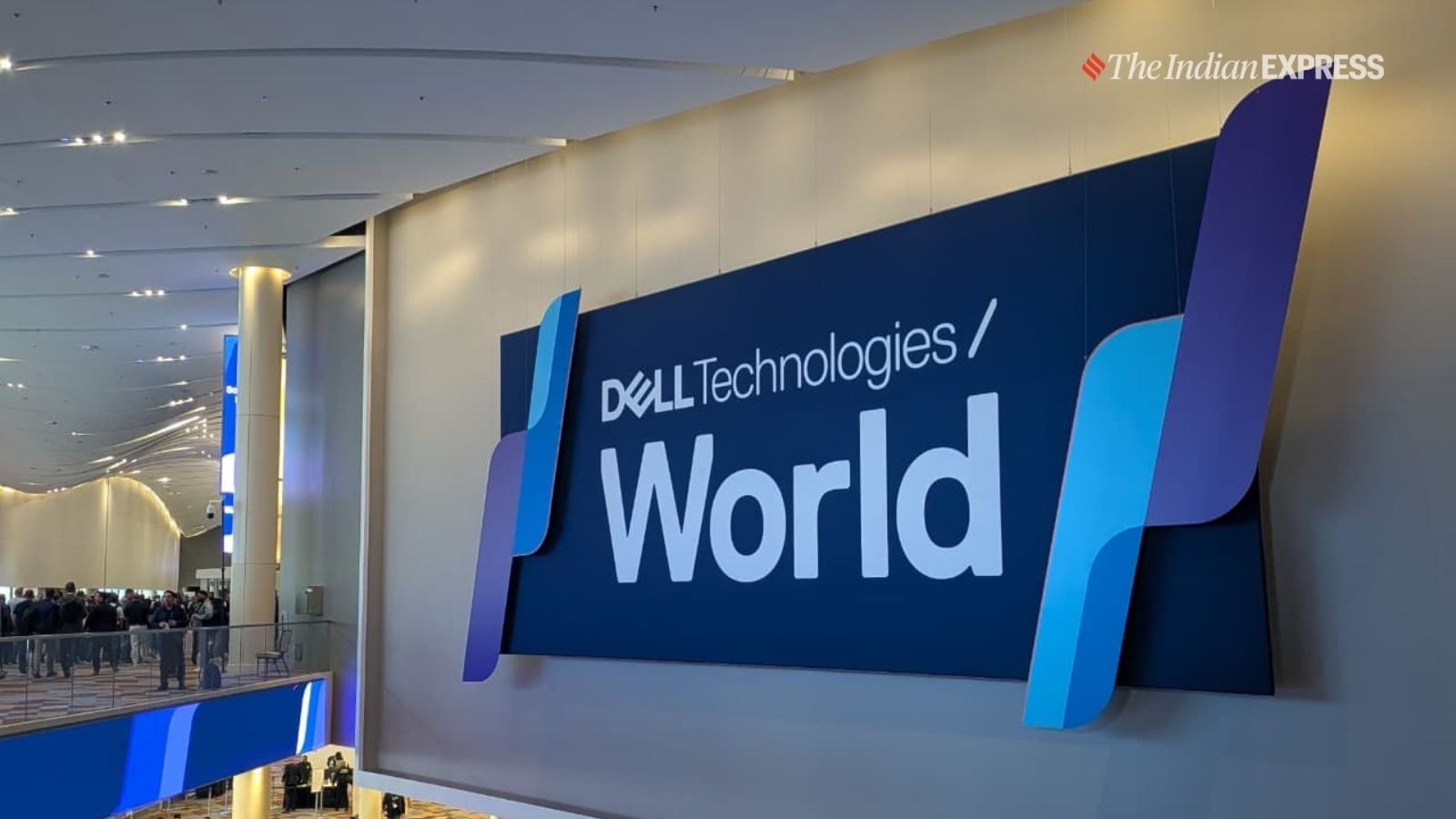
Dell Technologies CTO and Chief AI Officer John Roese speaks during the company’s annual event in Las Vegas, where he discussed AI regulation, sovereign AI, and hybrid infrastructure strategies. (Image: The Indian Express/ Anuj Bhatia)
Roese said he has recommended agentic AI to several governments. “If an agent is working on behalf of the government, the identity should be delivered from the government to the agent, not by a third party. If the government is the identity provider for every agent, it has a kill switch, the ability to track it, and control over it,” he added.
Taking the example of the United Kingdom’s AI regulatory framework, which he believes is built on a long-term vision, he said, “They did not specify the compute itself, but rather estimated that they would need 20 times more computing capacity to serve the country during the AI era than they have today. That may sound abstract, but it is actually a very good goal because it essentially says, ‘I don’t know how I will do it, but I know I must have a lot more compute available within this timeframe.”
Story continues below this ad
Roese agrees that the quality of AI policy has improved over the past two years, but says compliance complexity remains a challenge, especially for a global company as large as Dell, which is exposed to every major market in the world.
“We have over a thousand jurisdictions around the world with AI policies that we are expected to comply with. They don’t talk to each other, and they don’t rationalise,” he said.
Roese has a message for policymakers. “I am totally okay with regulation. I think that while having discussions and developing policies, policymakers should ask statisticians and mathematicians to calculate the global cost of implementing those regulations and present that back to them. That way, policymakers can decide: Is the cost too high? Could it be done in a more efficient way?” he said.
Story continues below this ad
Policymakers from around the world are taking a special interest in artificial intelligence, hoping to turn their countries into AI superpowers. While experts have highlighted serious challenges for governments—including the massive funding required for AI infrastructure projects and complex questions surrounding data security—one of the biggest concerns is that some governments are moving to regulate frontier AI models. This signals a move to tighten scrutiny over developers of advanced AI systems, requiring AI firms to share advanced models with the government before release, amid growing concerns over cybersecurity and national security risks.
Dell Technologies highlighted the growing importance of sovereign AI, hybrid infrastructure, and long-term national AI strategies during its annual event in Las Vegas. (Image: The Indian Express/ Anuj Bhatia)
Roese said there is a need for a national AI framework, which the United States is working towards, and for reducing state-level regulations. That may also work for a country like India, he suggested.
At a time when major countries are building their own sovereign AI platforms and are prepared to invest in creating AI infrastructure and ecosystems, the focus has also been on harnessing the technology to drive their own growth.
‘If a government wants to build AI at the hardware level, there is absolutely no difference in capability that they could deploy themselves versus what the most advanced hyperscaler model company in the world is using. They are the same products. We sell them to anybody,” Roese said.
Story continues below this ad
Roese supports hybrid AI as a long-term architectural reality for most large enterprises, or for anyone investing in AI infrastructure. He said that while “cloud-first” implied putting everything into a public cloud, there is no evidence of any large-scale company actually moving everything into a single cloud. “If it were such a great strategy, how come nobody has ever achieved it?” he questioned.
“Enterprises are complex, costs are complex, and people inevitably like the idea of choice and a distributed architecture. With AI, it has to be hybrid because you need to be able to reach out into the real world rather than just aggregate everything. That’s good news for Dell, and I think for countries like India and France, and others that want to execute a sovereign strategy.”
India, like other countries, is building its own domestic AI ecosystem and cashing in on well-established AI hubs in Bengaluru, Hyderabad, and Mumbai. It also has a large tech workforce and has attracted some big infrastructure investments from the likes of Google, Nvidia, and Amazon in recent months.
Story continues below this ad
“I think the Indian government is quite literate in the technology. This is not a government that is following blindly. They have deep technical expertise, and even the most senior people in government seem to be very well educated about this technology, which is to be expected. I think there are all the normal challenges that they have to work through, such as energy and job displacement. These are all complex issues,” Roese said when asked about India and where it stands in the AI race.
