

Post Content
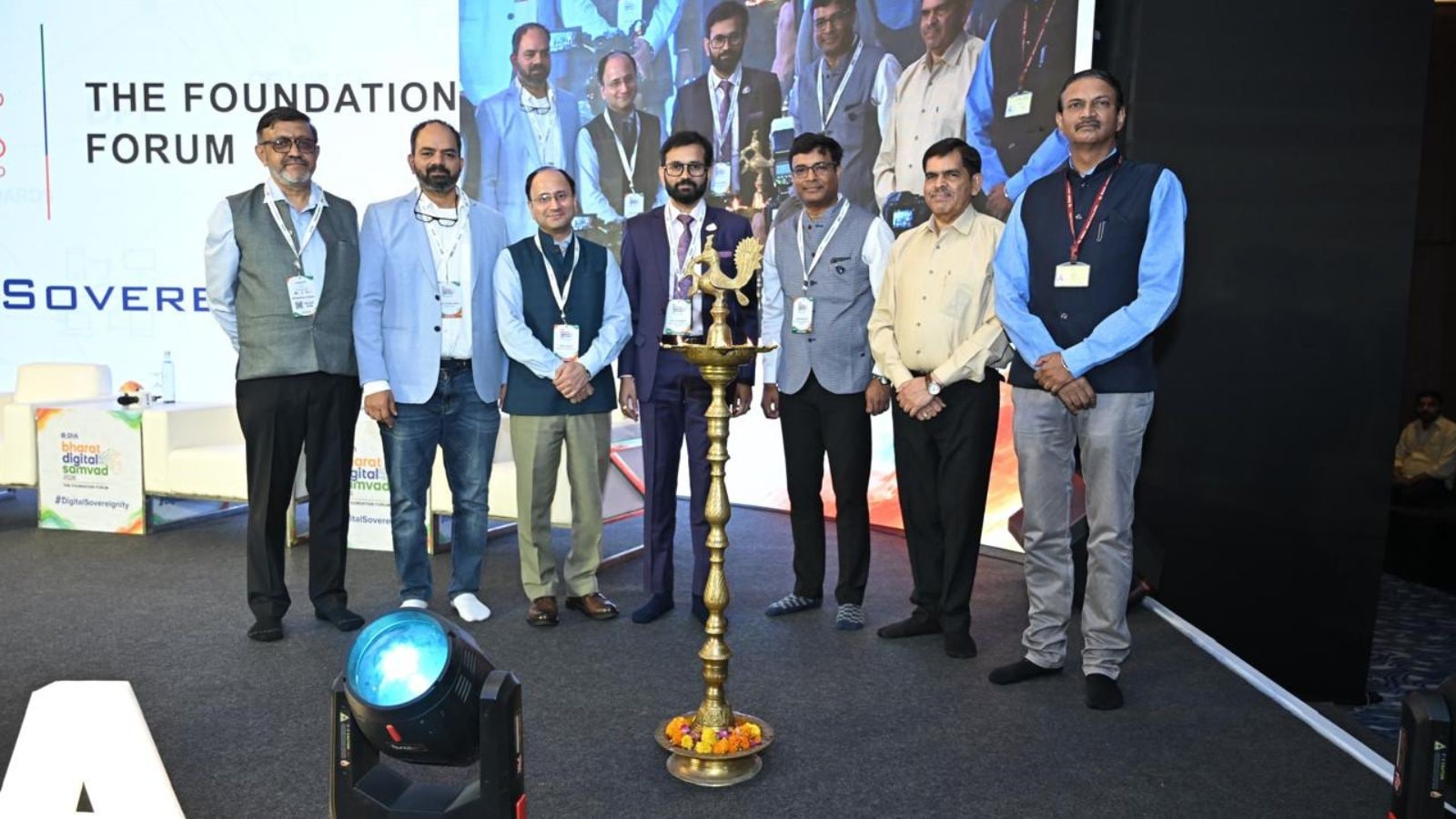
India cannot be a ‘guinea pig’ for foreign AI companies and must reduce its dependence on digital infrastructure controlled by Big Tech, current and former government officials as well as various tech industry stakeholders said at a national digital sovereignty forum called the Bharat Digital Samvad in New Delhi on Wednesday, May 20.
The event was organised by Bharath Digital Infrastructure Association (BDIA), a not-for-profit industry body focused on advancing India’s sovereign digital infrastructure agenda and shaping stronger collaboration between industry, policymakers, academia, and strategic institutions.
The forum featured three policy discussions focused on India’s sovereign compute and digital infrastructure ambitions, reducing dependence on foreign-controlled tech ecosystems, and strengthening trusted cloud, governance, and market access frameworks for Indian technology firms.
One of the key concerns raised during these discussions was the risk of foreign-controlled digital infrastructure being vulnerable to potential ‘kill switch’ mechanisms.
“If you are running services on a cloud connected platform, the sad part is that one fine day anybody can feel upset and switch it off. This is the lay of the land which we are facing […] We need to have our own solutions. We need to think very carefully about what sovereignty means. It means that we should be having the capability to control,” Amit Shukla, a senior diplomat currently working as joint secretary for Cyber Diplomacy and E-Governance in the Ministry of External Affairs, said during a panel discussion.
It comes at a time when the government is looking to require companies in critical sectors such as energy, telecom, and banking to use Made-in-India sovereign cloud systems, The Indian Express previously reported in April 2026.
The consideration was reportedly prompted by an incident last year, where Microsoft suddenly blocked oil refiner Nayara Energy from its IT services. This is said to have raised concerns in New Delhi’s policy circles around the dependence Indian companies have on crucial digital infrastructure services offered by foreign companies, and the need for them to build resilience against potential disruptions in the future.
Story continues below this ad
“You cannot shut down something remotely like what happened with Nayara. You cannot have a kill switch mechanism or you cannot have this sort of a shutdown because somebody decides that this is not going to happen going forward. It cannot be an arbitrary call,” Dr Sandeep K Shukla, Director, IIIT Hyderabad, said at Wednesday’s event.
Another panellist argued that even when Big Tech companies host servers physically within India, ultimate control over those systems often remains overseas, including in jurisdictions such as the US.
Also Read | Centre keen firms in critical sectors use ‘Made in India’ cloud systems
In the context of the global AI arms race, Amit Shukla pointed to a dilemma facing Indian companies building AI solutions, where relying on proprietary models running on foreign cloud infrastructure means that access could be potentially withdrawn any time.
While open-weight models allow developers to host it on their own, Shukla opined that the open-source approach to AI is not going to be sustainable in coming years. “It does not make sense for people to spend billions of dollars and continue doing that and then it is for all of us to see how long it is going to continue. The general understanding is that the development of open source models will plateau very soon. So if your solutions are dependent on that one, you are headed towards a place in time where it is going to plateau,” he said.
Story continues below this ad
This particular panel discussion was moderated by Dr Pavan Duggal, senior advocate, Supreme Court of India, who said that India has become the guinea pig of big tech because we are not able to keep up with the pace of frontier AI. India, as one of the world’s largest future AI markets, must leverage its scale strategically, Duggal added.
Likening it to the British Empire once exporting raw cotton from India and selling it back to the country as finished textiles, Sandeep Shukla said, “Now they are going to train models which are India-specific and sell it back to Indians.”
“Every day, every citizen using AI is giving their data, including medical and various other kinds of sensitive information,to their AI systems […] and the data is going to servers that are not in our control. I think that we have to wake up and understand that we do not have friends around the world,” he further said.
The discussions also highlighted the need for policy-backed support to accelerate India’s domestic AI, cloud, semiconductor, cybersecurity, and digital infrastructure ecosystem through sovereign cloud certification standards, sovereign workload classification frameworks, indigenous digital product standards, and long-term digital governance models.
Story continues below this ad
Also Read | SAP launches Sovereign Cloud in India to enable local data storage, boost AI development
Industry leaders further emphasised the importance of advancing domestic innovation, indigenous IP creation, and nationally aligned frameworks such as Bharat Cloud Certification (BCC), Trusted Indian Digital Product (TIDP), and Digital Sovereignty Maturity Models (DSMM) to strengthen India’s path towards technological self-reliance and digital sovereignty.
As part of the event’s outcomes, BDIA announced that it plans to submit a comprehensive policy recommendation framework to the government in order to accelerate India’s sovereign digital infrastructure ecosystem.
Speaking at the event, Piyush Somani, president, BDIA, said, “India stands at a defining moment in its digital journey. While the country has emerged as a global leader in digital adoption, the next phase of growth must focus on building sovereign and trusted digital infrastructure that is designed, governed, and scaled from within India.”
“As technologies such as AI, cloud, and cybersecurity become foundational to economic growth and national resilience, it is critical for India to strengthen its domestic capabilities and reduce strategic dependencies across key digital infrastructure layers,” Somani added.
