

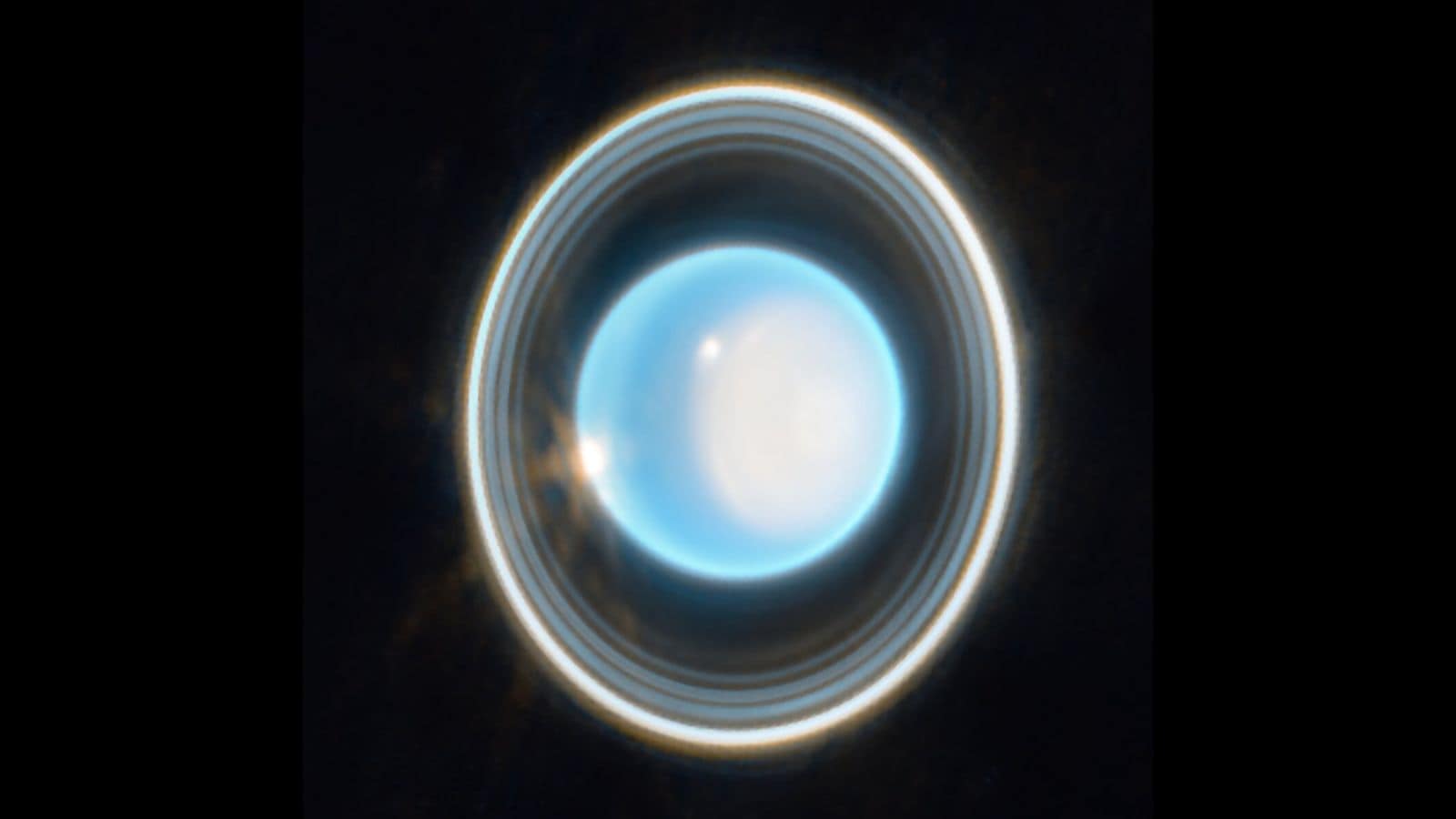
Post Content New research highlights stark differences between Uranus’s μ- and ν-rings. The μ-ring appears blue, suggesting it is made up of extremely fine icy particles, likely sourced from Mab, one of the planet’s inner moons(Image: ESA)
The ring system of Uranus is proving more complex than once thought, with new research suggesting the possible presence of previously unknown moons.
Using infrared images from the James Webb Space Telescope along with earlier data from the Hubble Space Telescope and the W M Keck Observatory, scientists closely examined Uranus’s outermost μ (mu) and ν (nu) rings.
The findings, published in the Journal of Geophysical Research: Planets, could shed new light on the composition and formation history of these rings.
Unlike the striking rings of Saturn, those of Uranus are not visible to the naked eye. They were only discovered in 1977 during a stellar occultation event, when Uranus passed in front of distant stars and briefly blocked their light. Since then, astronomers have identified 13 rings, though the outer ones remain particularly mysterious.
New research highlights stark differences between Uranus’s μ- and ν-rings. The μ-ring appears blue, suggesting it is made up of extremely fine icy particles, likely sourced from Mab, one of the planet’s inner moons. Scientists say this process is similar to how the E-ring of Saturn forms, fed by icy plumes from its moon, Enceladus.
Also Read | ‘Building blocks of life’ on Mars: NASA’s Curiosity rover finds organic molecules
On the other hand, the ν-ring is reddish, suggesting a dust composition with traces of organic carbon. Scientists believe this material is generated by micrometeorite impacts on small, rocky bodies—possibly undiscovered moonlets—that orbit within Uranus’s inner system.
“By decoding the light from these rings, we can trace both their particle size distribution and composition, which sheds light on their origins, offering new insight into how the Uranian system and planets like it formed and evolved,” said Imke de Pater of the University of California, Berkeley.
Story continues below this ad
These contrasting compositions raise new questions about the nature of Uranus’s moons. In spite of Mab being believed to have an abundant presence of ice, the rest of the moons around it are considered to be dustier and rockier than it. Moreover, the presence of organic-rich material in the ν-ring suggests the existence of other undiscovered moons around it.
Also Read | Can the Giant Magellan Telescope spot habitable worlds? Funding holds the key
It is also possible for the μ-ring to vary in luminosity over time, even though scientists do not know the cause behind this phenomenon. Due to the low luminosity and small sizes of the moons, observing and detecting the rings has proven difficult.
According to researchers, properly understanding the rings surrounding Uranus will require a future spacecraft to complete a new mission.
© IE Online Media Services Pvt Ltd
