

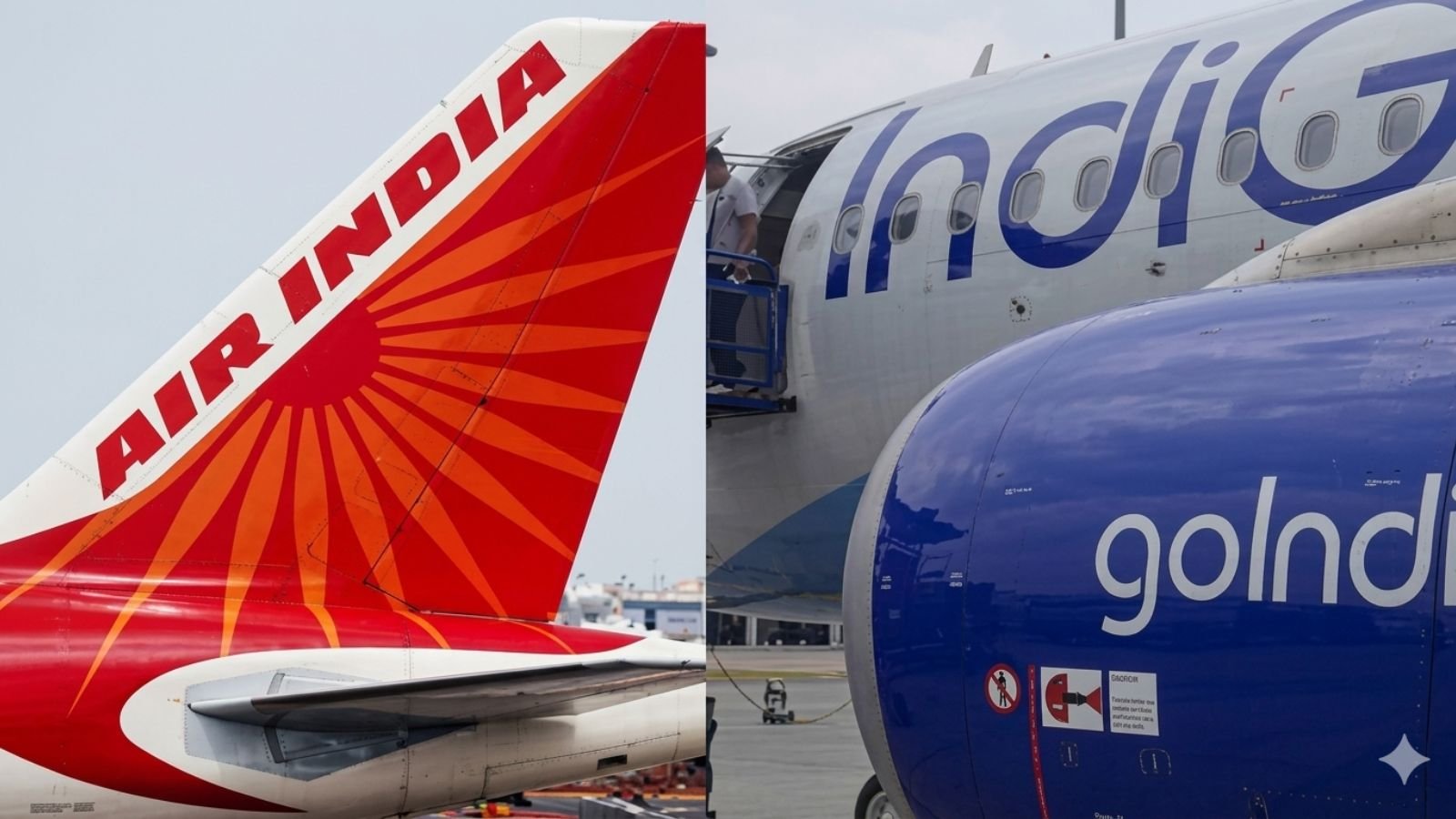
The airlines said the situation has practically made international operations, along with domestic operations, completely unviable and resulted in significant losses for the aviation sector in April. (File Photo/Image enhanced using AI)
An airline body representing Indian carriers IndiGo, Air India, and SpiceJet has sent an SOS to the government, urging changes in the pricing formula for aviation turbine fuel (ATF), or jet fuel, whose prices have shot up in the global market amid the West Asia crisis.
ATF prices in India, which are linked to global prices, are due for their monthly revision early May.
In a letter to the Ministry of Civil Aviation (MoCA), the Federation of Indian Airlines (FIA) wrote that the current “ad hoc” pricing mechanism for ATF is “creating severe imbalance in domestic and international operations and rendering airline networks unviable and unsustainable”.
“The airline industry in India is under extreme stress and are on the verge of closing down or of stopping its operations. The dire condition of the aviation sector has been exacerbated by the West Asia War and the exorbitant increase in the price of ATF,” the FIA wrote in the letter dated April 26, as it sought the jet fuel pricing
formula to be reversed to one with margin bands — with a floor and ceiling — for what refiners can charge, and have the same pricing for domestic as well as international flights of Indian airlines.
Usually, ATF prices account for about 40% of Indian airlines’ operational costs; the price surge has led to a further increase to 55-60%, according to the FIA.
Indian airlines are also suffering due to airspace restrictions in West Asia and the ban on Indian aircraft from entering the Pakistani airspace, as well the rupee depreciation.
Story continues below this ad
The industry body also urged the Centre to temporarily suspend the 11% excise duty on ATF sales for domestic flights, and work towards reduction in value added tax (VAT), which is quite high in a few states that house the biggest Indian airports.
“While the government of India stepped in last month to prevent the collapse of the aviation sector by limiting the increase of ATF to Rs 15 per litre for domestic operations. However, the ATF pricing for international operations was increased by Rs 73 per litre, making… international operations along with domestic operations completely unviable and resulting in significant losses for the aviation sector in April 2026,” the FIA wrote.
In the last price revision on April 1, the price of the fuel for domestic scheduled flights was hiked only partially by the public sector oil marketing companies (OMCs).
For international flights, however, the full price increase was passed on.
Story continues below this ad
The core issue lies in how jet fuel prices are calculated.
ATF prices in India are linked to the Mean of Platts Arab Gulf (MOPAG), a price assessment by S&P Global based on jet fuel prices in West Asia.
In 2022, a “crack band” of $12-22 per barrel was established to cap OMCs’ margins during abnormal price fluctuations. The crack spread is the difference between the price of crude oil and products like ATF derived from it. But this crack band was discontinued in late 2024 mutually by airlines and OMCs. With the global ATF price surge, the airlines want the band to be reintroduced.
The FIA’s argument is that it allows “fair and reasonable margin” for the OMCs, while blunting the impact of surging jet fuel prices on the airlines.
Story continues below this ad
The crack differential which was in the range of $11 to $18 per barrel has surged to $132.59 even though the refining cost for converting crude into jet fuel has not really changed, as per the airlines’ association.
“The current conflict has pushed the (benchmark) Brent crude from $72/bbl (barrel) to $118/bbl and resultant ATF price (MOPAG + Premium)
has moved from $87.24 and touched a high of $ 260.24/bbl (295% increase) and is currently trading at $235.63/bbl,” the FIA said.
