

Venice during the Biennale operates at a near-impossible tempo. Days begin early with the forced patience of long vaporetto (water taxi) queues, and end long after sunset, feet heavy from miles of cobbled streets and the rhythmic ascent of stone bridges.
While few arrive intending to consume 15 or 20 exhibitions in a single day, the city quietly compels it. Time undergoes a strange compression; the urgency to absorb everything, from the national pavilions to the numerous collateral events and the conversations spilling into canal-side bars, creates a frenetic intellectual pressure.
An installation out of the main Biennale areas
| Photo Credit:
Getty Images
An installation by South African artist Senzeni Marasela
| Photo Credit:
AFP
Yet, Venice possesses an ancient alchemy that softens this frenzy. It is the light — aqueous and translucent — that washes over faded facades, sharpening the architectural details of Venetian Gothic archways and marble columns, while muting colour into a sophisticated palette. Even the act of rushing becomes a choreographed movement through beauty.
Against this backdrop, Cameroonian-Swiss curator Koyo Kouoh’s posthumously realised exhibition In Minor Keys unfolds as both memorial and mediation on fracture, displacement and collective unease. (She passed away at 57 last year, at the height of her career, after a cancer diagnosis.) In this sense, given the state of the world we live in, this Biennale feels historic and important.
The late Cameroonian-Swiss curator Koyo Kouoh
| Photo Credit:
Getty Images
“There is no other place like Venice,” British visual artist Rebecca Chesney tells me. “What really stood out for me was seeing so many women artists being represented, and discovering new ones. The use of materials such as ceramics and textiles was so visible and unexpected. I cried in Elegy, an exhibition by artist Gabrielle Goliath, which was meant to be the South African pavilion but wasn’t due to disputes over its inclusion of a Palestinian poet.”
Politicisation of the city
Venice is one of the longest running and most prestigious art biennales in the world. With a 129-year history, it runs for close to 200 days (give or take a few), has over 100 countries participating, and the last edition saw 700,000 tickets sold during its seven-month run. This year, the 61st Venice Biennale (May 9-November 22) opened under an atmosphere of grief and geopolitical tension. In the preview week, the torrential rain and thunderstorms seemed an appropriate accompaniment to the protests over the participation of Russia and Israel, culminating in the unprecedented resignation of the Biennale’s entire prize jury just days before the opening.
The activist group Pussy Riot protest over the readmission of Russia to the Biennale
| Photo Credit:
Simone Padovani
Over 80 artists withdrew from the awards as an act of solidarity, and 25 pavilions, including France, Belgium, Britain and Italy, closed for a day. As Shwetal Patel, the writer and researcher who heads international programmes at the Kochi-Muziris Biennale, points out, “Artists and audiences alike are demanding greater justice especially at international events such as these.”
Protesters during a demonstration called by the Art Not Genocide Alliance demanding the exclusion of Israel and Russia from Venice Biennale
| Photo Credit:
Getty Images
Chaos marks the Venice Biennale after the jury quits over Israeli and Russian participation
Honouring Kouoh
The heartbeat of this year’s Biennale is undoubtedly the vision of the late Kouoh. As the first African woman appointed to curate the central exhibition, she sought to connect the global through the “spirit and sacredness” of marginalised places and people. (Something unwittingly echoed in the protests.) Artists have interpreted the theme, ‘In Minor Keys’, through earth, ceramics, textiles and ancestral memory.
This is felt deeply in the Arsenale and Giardini, from Moroccan artist Amina Saoudi Aït Khay’s beautiful tapestries that refer to her Amazigh heritage and the landscapes of Morocco and Tunisia, to María Magdalena Campos-Pons’ Anatomy of the Magnolia Tree for Koyo Kouoh and Toni Morrison (2026). The Cuban artist’s work is the centrepiece at the Giardini, and features eight panels honouring American novelist Morrison and Kouoh, two titans of Black female intellectualism, surrounded by resin and glass sculptures of the magnolia, the iconic flower of the American South.
Asetta by Amina Agueznay, at the Moroccan Pavilion
| Photo Credit:
AFP
María Magdalena Campos-Pons’ Anatomy of the Magnolia Tree for Koyo Kouoh and Toni Morrison
| Photo Credit:
Getty Images
Masterclasses in the tangible
This edition is strikingly tactile. Favourites among visitors include the intricate beadwork paintings by American artist Big Chief Demond Melancon, depicting the Black Masking culture of New Orleans — elaborate feathered and beaded works that are an expression of community resilience — and the ethereal blue-and-white ikat panels by Himali Singh Soin and David Soin Tappeser. The duo’s sonic-textile installation, presented by RMZ Foundation, draws on the geological connections between the Indian subcontinent and the polar regions, and invites visitors to ask what lies beneath the dominant frequencies of our time. Sound is translated into a handwoven cotton-and-ahimsa silk textile by a master artisan, Gajam Govardhan.
The sonic-textile installation by Himali Singh Soin and David Soin Tappeser
| Photo Credit:
Courtesy @rmz_foundation
Meanwhile, the Moroccan Pavilion’s hand-spun, naturally dyed tapestries provide a masterclass in architectural textile. They allow you to revel in the narrow strips of woven, knotted and stitched artworks that hold stories through patterns and memories of home.
View this post on Instagram
A post shared by VENICE ART BIENNALE (@venice.art.biennale)
The weird and the unexpected
The Biennale is always a study in sensory extremes. For some, the highlight is the whimsical, participatory nature of the Japan Pavilion, where visitors are invited to carry around baby dolls as part of the interactive installation Grass Babies, Moon Babies. It was born out of the nurturing-rearing experience of queer artist Ei ArakawaNash, who became a parent of twins in 2024.
Grass Babies, Moon Babies at the Japanese Pavilion
| Photo Credit:
Getty Images
Visitors are invited to carry around the baby dolls
| Photo Credit:
Getty Images
Others endure the notorious two-hour queue for the Austria Pavilion to witness the provocative spectacle of naked women on jet skis or submerged in a water tank (where urine from the toilet, passed through several filtration systems, top up the water level). Blending dance, theatre and performance, artist Florentina Holzinger uses her long-standing research into water — as both subject and symbol — in Seaworld Venice as a point of departure for an exploration of the human body in a radically changing landscape, in which nature and technology collide.
Visitors at the Austrian Pavilion
For those seeking a more profound immersion, the Polish Pavilion reaches new heights. Inside, two giant screens — one angled precariously from the ceiling — tower over the space. Visitors are invited to lie upon a central stone slab, looking upward as performers (hearing and deaf) dressed in crimson communicate through a haunting, rhythmic blend of song and sign language. Liquid Tongues is a compelling experience, a moment of forced stillness in a city of constant motion.
Liquid Tongues by the Polish artists Bogna Burska and Daniel Kotowski
| Photo Credit:
AFP
View this post on Instagram
A post shared by VENICE ART BIENNALE (@venice.art.biennale)
Navigating the Floating City
If you are staying along the Grand Canal, be prepared for tourists making their way to St. Mark’s Square and the Rialto Bridge. If you want to avoid water taxis, stay within walking distance of the Castello district because that is where the main areas of the exhibition are. My top tip: if you are heading out during peak hours, try to seek entry via the rear — you will avoid lengthy queues.
Il Gesto by French artist JR (Jean Renè), taking inspiration from Italian Renaissence artist Paolo Veronese’s painting Le Nozze di Cana on the facade of Ca’ del Mosto
| Photo Credit:
Getty Images
While you never know what to expect, see or experience at the Venice Biennale, with over 100 artists in group exhibitions alone (which you can see at the Giardini and Arsenale), and thousands more spread across the city in collaterals, there really is a sense of true discovery when you come here.
Also, once you come out of the Biennale, wandering around the city is like being in a maze. But no matter where you end up, you will always be guaranteed homemade pasta, freshly ground coffee and artisanal ice cream.
The Mona Lisa is Drowning, the latest work by street artist TvBoy
| Photo Credit:
Getty Images
A homecoming for India
Of particular significance this year is the India Pavilion, which is back after a seven-year hiatus. Supported by the Ministry of Culture — in partnership with the Nita Mukesh Ambani Cultural Centre and Serendipity Arts — the exhibition, titled Geographies of Distance: Remembering Home, is curated by Paris-based Amin Jaffer. Located at the meandering end of the Arsenale, the pavilion functions as a sensory threshold. Entering through heavy black curtains into a space of deliberate low lighting, the darkness slows the eye, forcing an immediate confrontation with material, scale and and pattern of shadows.
In conversation | What to expect when Kader Attia curates Kochi-Muziris Biennale
At its heart stands Asim Waqif’s colossal bamboo installation. Rising towards the rafters with overwhelming force, it echoes the ubiquitous scaffolding of Indian urban landscapes. “You have hip design studios doing things with bamboo and selling it for huge amounts, but it doesn’t trickle down to the artisans,” says Waqif. “The challenge is to transform what’s left of our connection to pre-industrial technologies into a contemporary context without losing the people behind them”.
It is a work that invites touch and sound; visitors drum against the stalks, breathing in the earthy fragrance of the wood. “I love the sound of the bamboo,” echoes among my artist friends. It feels both monumental and vulnerable, though the visible plastic ties occasionally break the spell of its organic aesthetic.
Asim Waqif’s bamboo installation (left) and Alwar Balasubramaniam’s cracked earthworks
To the right, Sumakshi Singh’s ‘ghostly’ thread-work installations offer a more spectral memory. She has created a trompe l’oeil replica of her ancestral home, capturing everything from decorative flourishes to the minutiae of hinges and bolts. “The fragile architecture of the work inhabits a tension between shelter and exposure, presence and disappearance,” says Singh, noting that the pavilion allowed her to finally realise her work at a truly monumental scale. “It becomes a meditation on what persists within us, even as the outer world dissolves.” It is a profound experience to walk through her thread-drawn doorways, navigating the interplay of shadow and memory.
Permanent Address by Sumakshi Singh at the India Pavilion
| Photo Credit:
AFP
Though the work is fragile (I fear there will be too many hands poking through it), visitors are guided by invigilators to move carefully through the structures and to not touch the artwork — a challenge given how tactile it is and how interactive the bamboo artwork is.
On the opposite flank, Ranjani Shettar’s resin-coated flowers and seed pods hang in a state of suspended animation, hovering between growth and collapse. These contrast with Alwar Balasubramaniam’s cracked earthworks, which, framed upon the walls, elevate the very ground we walk upon into high art. While the papier-mâché houses of Skarma Sonam Tashi on the upper level feel somewhat disconnected from the main floor’s dialogue, the viewing platform allows for a panoramic scan of a pavilion that feels, for the most part, like a cohesive, breathing entity.
Ranjani Shettar’s resin-coated flowers and seed pods
Skarma Sonam Tashi’s Echoes of Home
| Photo Credit:
Andrea Avezzu’
Alwar Balasubramaniam’s cracked earthworks
| Photo Credit:
Andrea Avezzu’
Others to check out
If the India Pavilion is a glorious spectacle, by contrast, on the other side of the island, artist Nalini Malani’s large-scale work of 67 animations (made from 30,000 iPad drawings) across nine projections, is dark and deliberately disturbing. Set inside a cavernous, brick-walled salt warehouse, Of Woman Born, presented by KNMA and curated by Roobina Karode, is an undeniable statement about the position of women in the midst of wars and violence. Sohrab Hura’s Timelines, part of the main exhibition in the Giardini, is a sprawling series of candid snapshots of ordinary lives, unfolding across a series of cardboard boxes.
Nalini Malani’s Of Woman Born
Elsewhere, at the historic Marinaressa Gardens, artist Paresh Maity’s abstract cuboid sculpture, Equilibrium, envisions the universe as a carefully balanced system, drawing upon the four cardinal directions and the four cosmic corners of traditional Indian spatial philosophy. There’s also photographer Dayanita Singh’s tribute to the Italian archives she has photographed over the past decade and her own evolving archive of images made in Italy over the last 25 years, presented at Archivio di Stato.
Photographer Dayanita Singh’s exhibition Archivio at the Archivio di Stato di Venezia
| Photo Credit:
Getty Images
South Asian presence
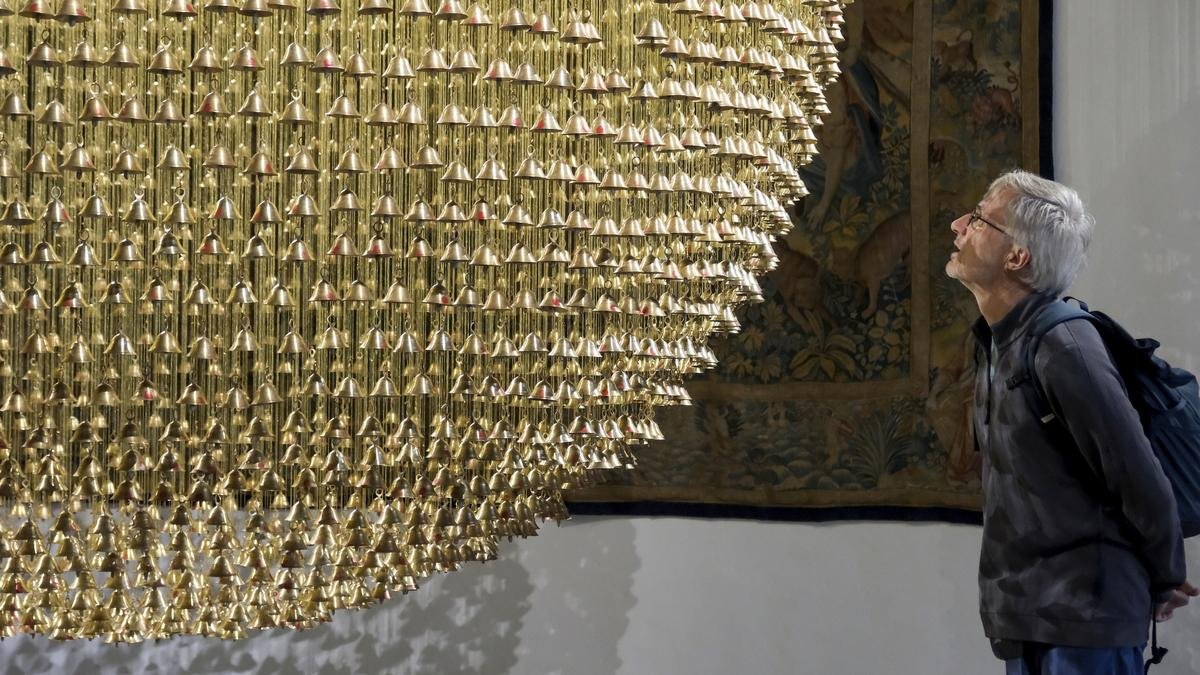
British sculptor Anish Kapoor’s exhibition at Palazzo Manfrin brings together around 100 architectural models of projects, both realised and unrealised. Bangladeshi visual artist Ashfika Rahman’s installation Than Para – No Land Without Us, presented as part of Pinchuk Art Centre’s group exhibition Still Joy at the Ukraine Pavilion. is not to be missed.
Ashfika Rahman’s installation Than Para – No Land Without Us at the collateral event Still Joy – from Ukraine into the World
| Photo Credit:
Giuseppe Cottini
Composed of nearly 5,000 temple bells, each one bears collected thumb prints of displaced people from the Chittagong Hill Tract regions — transforming individual traces into a moving testament of presence, memory, belonging, and the enduring claim to land and identity. There’s also London-based artist Faiza Butt who is channelling Punjab’s textile and craft traditions into bold, experimental forms at the Pakistan Pavilion.
Make the pilgrimage
The Venice Biennale remains an unparalleled intensity. It is the only place where the global zeitgeist is distilled into a few square miles of lagoon-soaked land. Through the vision of Kouoh and the evocative return of pavilions such as India’s, the 61st edition reminds us that art’s greatest power lies in its ability to bring us back to our own sense of being in the world.
The writer is an independent curator of textiles based in the U.K.
Published – May 16, 2026 07:07 am IST
Read Comments
Copy link
Telegram
SEE ALL
Remove
Related stories
Gajendra Singh Shekhawat inaugurates India pavilion at Venice Biennale
Bickram Ghosh at Venice Biennale 2026 with multi-genre Indian music
Related Topics
The Hindu Sunday Magazine
/
arts, culture and entertainment
/
arts (general)
/
culture (general)
/
painting
/
sculpture
/
Italy
/
human interest
