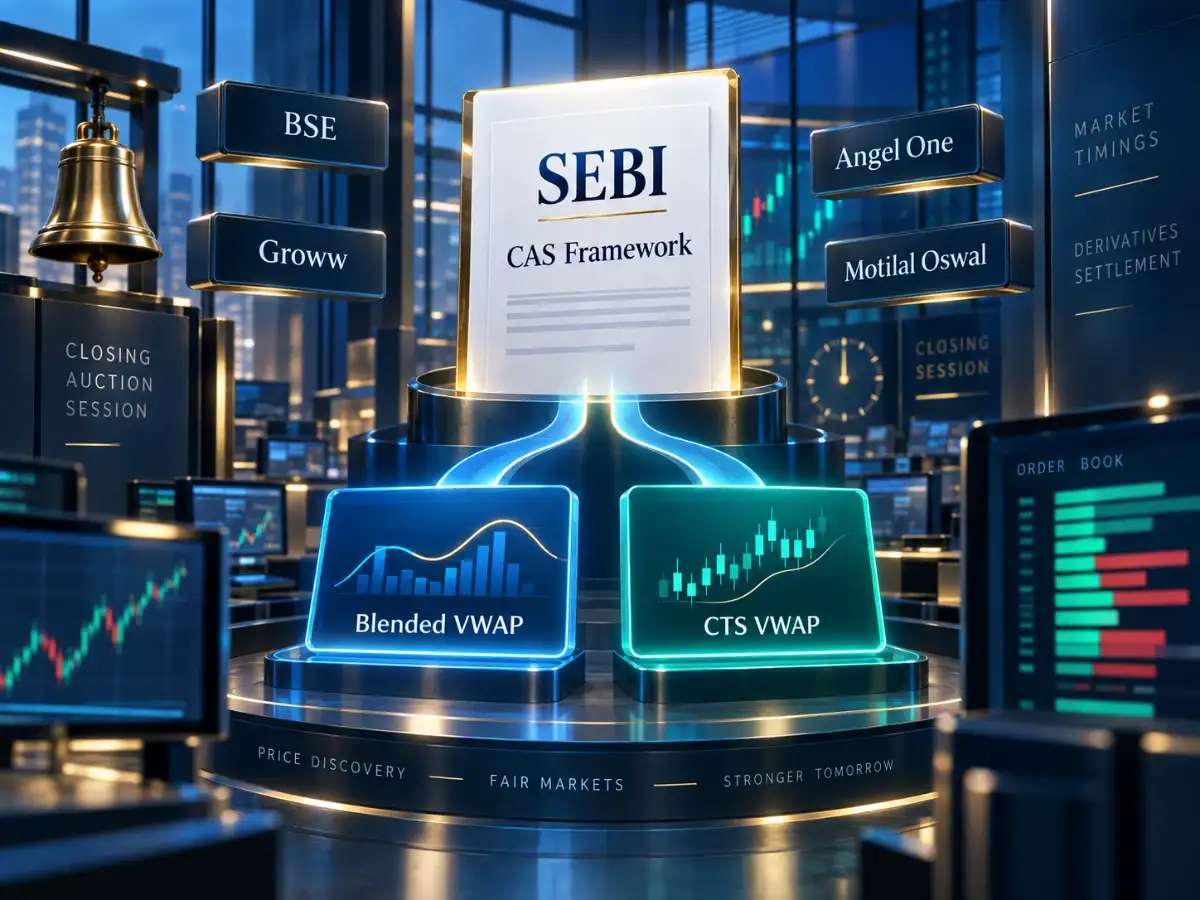
Blended VWAP - Under the first option, the settlement price for both index and stock derivatives would be based on trades executed during the last 30 minutes of CTS and 10 minutes of CAS. SEBI has termed this the "Blended VWAP".
Also read: Sebi proposes new CAS framework, two options for expiry-day settlement
For index derivatives, the contribution of CTS and CAS would be determined by the actual traded value during the respective periods, without assigning any separate or predetermined weight to either period. For stock derivatives, the blended price would be calculated using VWAP across exchanges, taking into account the actual traded value during the last 30 minutes of CTS and the 10 minutes of CAS.
CTS VWAP - Under the second option, the expiry-day settlement price for index and single-stock derivatives would be based only on trades executed during the last 30 minutes of CTS. This would retain the settlement methodology applicable before CAS was introduced, excluding transactions executed during CAS from the settlement calculation during the interim period.
SEBI has proposed that after sufficient experience with CAS, the settlement price could eventually transition to include transactions from both the last 30 minutes of CTS and 10 minutes of CAS, as proposed under the first option. Any such transition would be considered only after at least one year from the start of the revised settlement methodology.
What does it mean for investors?
Jefferies believes the latest proposals from market regulator Sebi to revise the Closing Auction Session (CAS) framework are positive for exchanges and brokers, following the massive volatility triggered by the newly introduced system that spooked investors. However, the international brokerage remains bearish on BSE shares.
Jefferies has retained its ‘Underperform’ rating on Asia’s oldest stock exchange, with a target price of Rs 2,940 per share. The target implies more than 13% downside from BSE’s previous closing price of Rs 3,384.
Read more: CAS here to stay, liquidity will pick up, says Sebi Chief
Its negative view on BSE is based on several factors, including limited growth in the overall options industry over the past two years and a ceiling on market share gains, with expiry-day Sensex and Nifty ADTO now at similar levels. Jefferies also said the RBI’s tightening of bank guarantee norms could reduce premium turnover by up to 10% over the next year. In addition, BSE could potentially see a management transition by June 2027.
Jefferies on Groww share price
Jefferies sees Groww as a better way to play India’s equity story and expects the company to benefit as issues around CAS are resolved. Futures and options account for around 55% of Groww’s revenues, it said.
The brokerage believes Groww has several levers to deliver a 30% PAT CAGR over FY26-29. This is expected to be driven by 18% growth in its broking business, supported by client vintage and market share gains, along with new initiatives such as a margin trading facility and wealth management. Jefferies also expects a 10-percentage-point expansion in margins.
Groww is also set to add US stocks later in FY27. Jefferies estimates this could contribute 5-9% to FY28 earnings.
The brokerage has a ‘Buy’ rating on Groww's parent, Billionbrains Garage Ventures, with a target price of Rs 240 per share. The target indicates nearly 20% upside from the stock’s previous closing price of Rs 200.24 on NSE.
Disclaimer: This article has been written by Veer Sharma, who is not a SEBI-registered Research Analyst or an Investment Adviser. Veer Sharma and his/her ‘relative(s)’ (as defined under Section 2(77) of the Companies Act, 2013) do not hold any financial interest in the companies mentioned in this article as of the date of publication. The views/recommendations mentioned in this article, wherever applicable, are those of the respective SEBI-registered Research Analyst/brokerage and have been reproduced/reported with due attribution. They should not be construed as the views or recommendations of The Economic Times Digital or the journalist. Readers are advised to consider the original research report and make their investment decisions based on their own assessment. Brokerage disclaimershere.