

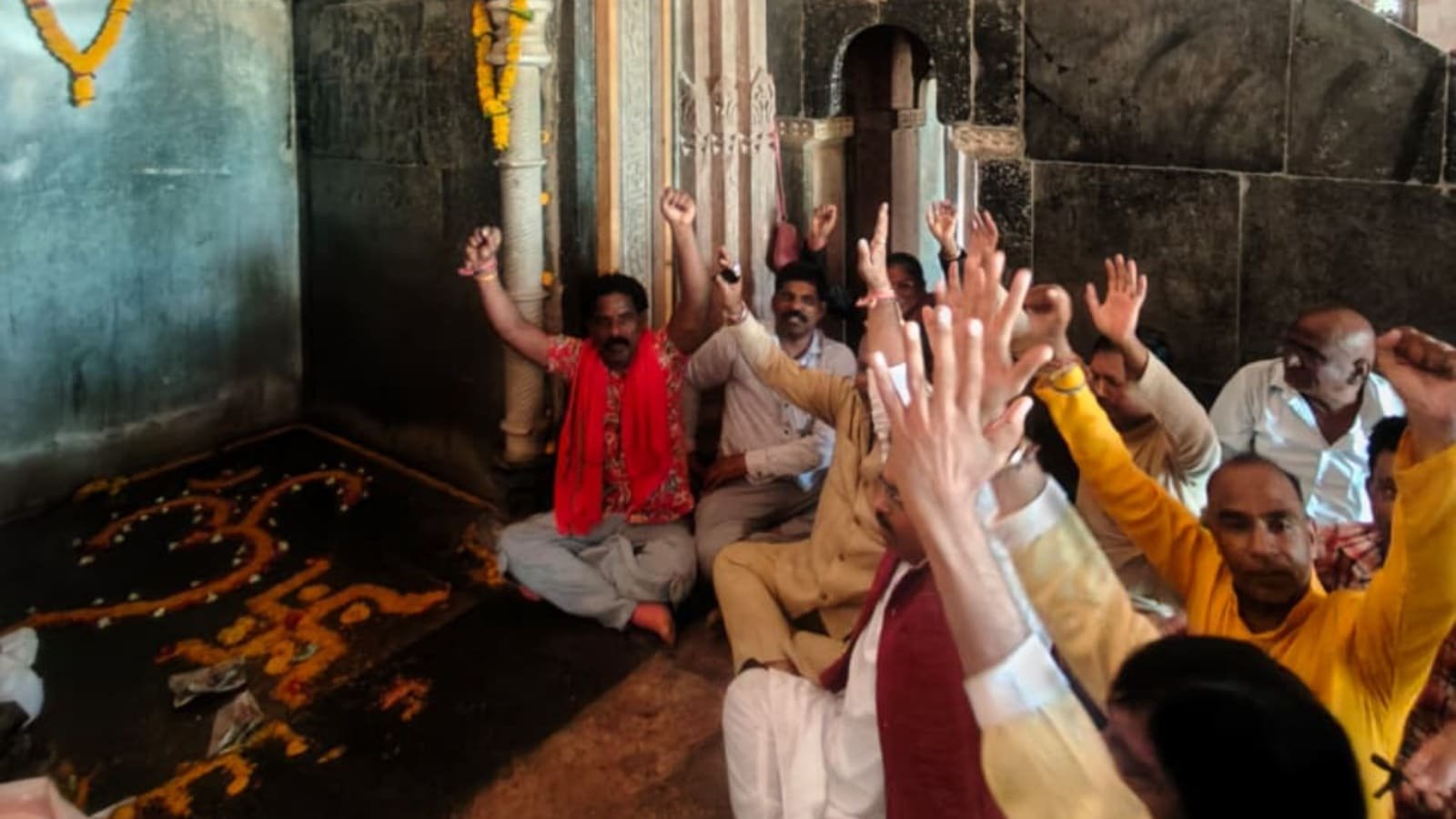
Less than 24 hours after more than 2,000 people gathered at the Bhojshala-Kamal Maula mosque complex here to offer namaz, its transformation into an exclusively Hindu religious place has begun.
On Saturday, marigold garlands hung from the carved stone pillars of the complex as devotees queued barefoot beneath the arches to offer prayers, take photographs and scatter flower petals across the dark stone floor. They recited Hanuman Chalisa and offered prayers to ‘Ma Vagdevi’. In a recessed chamber, flowers were arranged in the symbol of “Om” beneath a garlanded carving mounted against a blackened wall where Hindus believe an idol of Goddess Saraswati once stood.
On Friday, in its order on the long-standing dispute around the medieval complex, the Madhya Pradesh High Court ruled that its religious character was that of Bhojshala, or a temple of Goddess Vagdevi (Saraswati). Under a 2003 arrangement, Hindus had been performing puja at the complex on Tuesdays, while Muslims, who regard it as a masjid, offered namaz at the adjoining dargah on Fridays.
Also Read | Bhojshala is a temple, says Madhya Pradesh High Court on disputed site
In its 242-page verdict, the court made the Archaeological Survey of India (ASI), which has administered the monument since 1952, in-charge of preservation and regulation of access to the complex. It also said that Muslims would no longer be permitted to offer namaz at the site, and directed the state government to consider allotting alternative land in Dhar district for the same.
The Muslim side has said it will challenge the High Court’s order in the Supreme Court. But, on the ground, the order has already started taking effect, with Chief Minister Mohan Yadav rallying behind it.
Bhojshala-Kamal Maula Mosque complex (Image Credit: Deepika Singh)
Kuldeep Tiwari, one of the petitioners in the case, stood near the entrance distributing ladoos to supporters. Referring to the High Court order that also asked the Centre to consider bringing back a Saraswati idol housed at the British Museum in the UK, which is believed to be the one that once stood at the Bhojshala complex, Tiwari said: “We now want the government to bring back the idol and respect the High Court decision.”
Tiwari and other Hindu activists present at the complex are also planning their next campaign already. Pointing towards a staircase, which Hindu groups claim was constructed during the period of Alauddin Khilji, Tiwari said it too should eventually be removed.
Story continues below this ad
Ravi Sikarwar, a senior functionary of an outfit called the Bhoj Utsav Samiti, agreed. “There are various structures made by Muslims which have to go. We fought for 10 years to reclaim our right to worship at the site every day. We will continue to fight to remove all Muslim community structures,” he said.
Bhojshala-Kamal Maula Mosque complex (Image Credit: Deepika Singh)
In contrast, a quiet hangs over a canopy of white tents at the Kamal Maula dargah adjoining the complex. Underneath, Yomuddin Shaikh, a khadim whose family has long been associated with the shrine, took out an old family tree preserved in plastic covers.
“My family has helped conduct the namaz here for centuries,” he says softly. Will he be the last in the line, he wonders. “We don’t know when we will be able to read namaz again. Yesterday, over 2,000 of us offered namaz here one last time.”
Maulana Kamal Welfare Society president Abdul Samad, one of the petitioners from the Muslim side, said it was never about seeking permission to offer namaz. “We have been praying here for hundreds of years and do not need permission,” Samad asserted, adding that the High Court had merely quashed the 2003 ASI arrangement. “We are studying the order and will work with the ASI to understand how namaz can continue. We will offer namaz only here,” he said.
Story continues below this ad
Dhar Shahr Qazi Waqar Siddiqui said there were several Islamic structures within the complex, and they are worried about them. “We have a mehrab, wazukhana, graves… We want the ASI to protect these structures.”
A few kilometres away, in the Muslim-majority lanes of Dhar’s older quarters, most shops were shut Saturday, to guard against any trouble. Men huddled in groups discussed the verdict and the expected Supreme Court challenge, as police vehicles passed by slowly.
“My grandfather and his father before him offered namaz here,” said Riyaz Ahmed, a dry fruits trader. “We should also have the same right. I cannot believe my sons may never be able to offer namaz at this historic site again.”
A town of around 1.5 lakh people, roughly 250 km from Bhopal, Dhar was once known for association with the Malwa Sultanate and the story of Baz Bahadur and Roopmati. However, over the past three decades, the disputed complex in its old commercial quarters has come to define the town’s political and communal life.
Story continues below this ad
The neighbourhood surrounding the complex reflects this reality. Residents recall that two decades ago, the area contained butcher shops, a cattle market, hotels and a cinema hall crowded during fairs and weekends. As communal mobilisation around the complex intensified through the 1990s and early 2000s, many businesses shut down or shifted away.
The old cinema’s ticket counter now functions as a police checkpoint controlling access toward the complex during sensitive periods.
Ashish Goyal, one of the central figures behind the Hindu legal campaign, has spent nearly three decades in the “fight”. A former ABVP member who later became Dhar district convenor of the Hindu Jagran Manch, he welcomes the High Court order as “a big win for Sanatan Dharma”, after a fight of “several decades”.
He says that what gave their campaign a fresh drive was the Supreme Court’s verdict in 2019 awarding the disputed Ayodhya site to the Hindu side. It convinced them that Bhojshala too could be pursued through sustained legal action, Goyal said. They approached the ‘Hindu Front for Justice’ in Lucknow for support, and went about assembling historical records, land documents and royal family accounts. Then, in May 2021, the Hindu Front for Justice approached the High Court seeking exclusive Hindu rights over the complex.
Story continues below this ad
The issue entered the political lexicon in the state around the 2000s, as the BJP, seeking to dislodge the Congress government, adopted it. Uma Bharti raised the issue repeatedly ahead of the 2003 Madhya Pradesh Assembly elections. The Congress, already fighting massive anti-incumbency, lost those polls – and has been out of power since, barring 2018-2020.
In 2022, the Shivraj Singh Chouhan-led government that returned after pulling down the Congress, promised to bring back the Saraswati idol from London. In the recent Lok Sabha elections too, Bhojshala was a big part of campaign speeches across Dhar district.
No one expects the court order to be the end of all that. A senior government official posted at the site, who did not wish to be named, said: “We are all studying the judgment and making arrangements for prayers to begin at the site. Police will be present in large numbers till June to bring normalcy.”
