

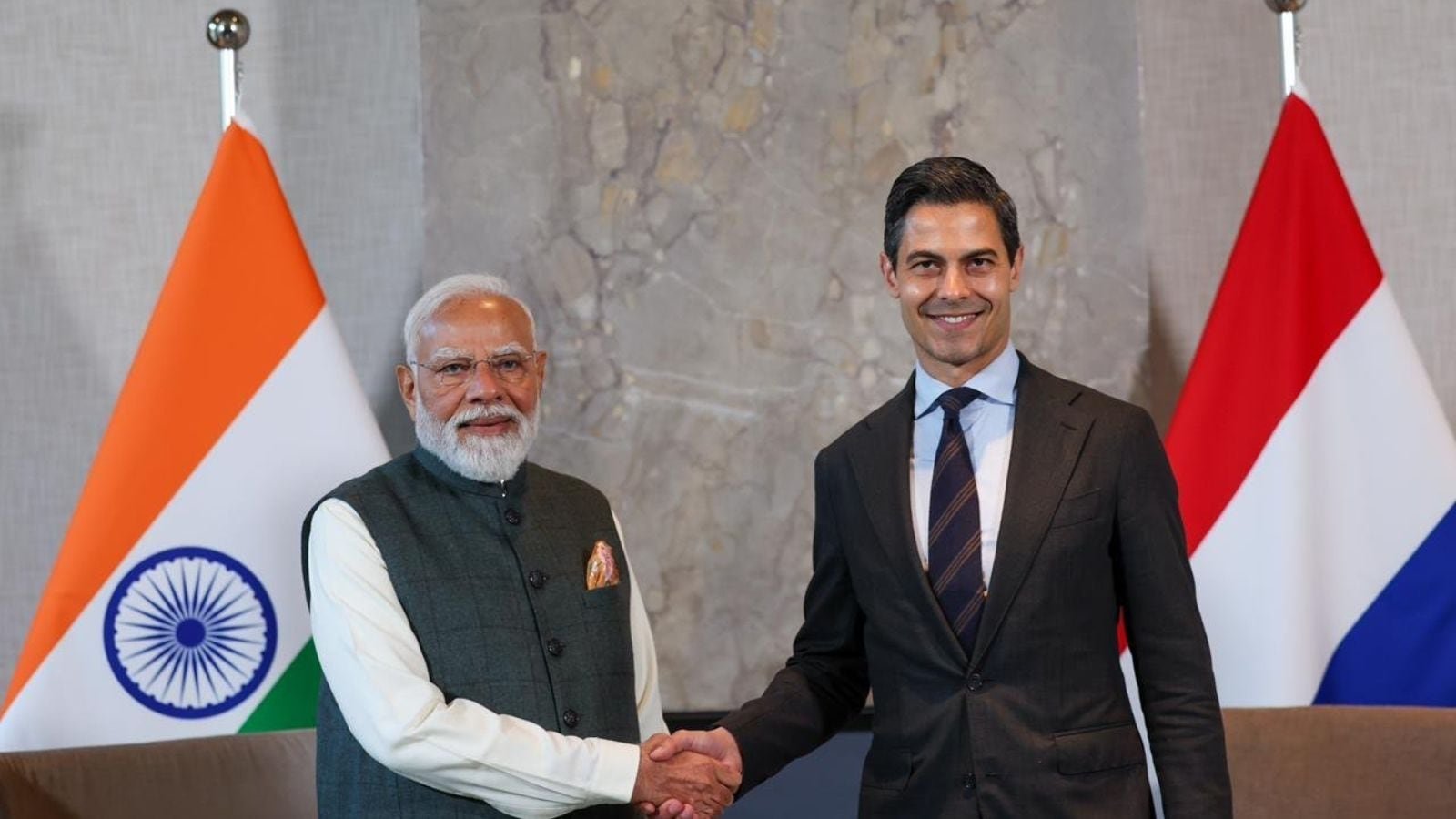
India and the Netherlands have elevated their bilateral ties to a strategic partnership, agreeing on a comprehensive five-year roadmap (2026–30) and signing 17 pacts spanning semiconductors, critical minerals, migration, water management, and renewable energy. The announcements followed talks between Prime Minister Narendra Modi and his Dutch counterpart Rob Jetten on Saturday in The Hague.
Addressing the 39-year-old Dutch Prime Minister, Modi said, “India is the youngest nation in the world and the fastest-growing major economy globally. You represent the new generation of leadership in the Netherlands and Europe. We must combine the Netherlands’ expertise with India’s speed and scale across every sector.”
“Our objective is to elevate cooperation in areas such as innovation, investment, sustainability, and defence to new dimensions. Guided by this shared vision, we are today elevating India-Netherlands relations to the level of a Strategic Partnership.”
Also Read | Amid PM visit, Netherlands returns Chola-era plates after 14-yr diplomatic effort
In a post on X, Jetten said, “The friendship between India and the Netherlands is in full bloom. This is also underscored by the visit of Indian Prime Minister Modi to the Netherlands. It is a bond that is furthermore being elevated to an even higher level by our agreement to establish a Strategic Partnership with each other.”
Jetten added that the partnership is already yielding results, citing a new joint declaration between Dutch chip-toolmaker ASML and Tata Electronics. “This builds on top of the major, historic trade agreement that India and the EU concluded earlier this year. In short, we are making enormous strides forward in our cooperation, and that is truly a win-win situation,” he wrote.
Modi said, “We regard the Netherlands as one of India’s most important partners. The Netherlands is one of India’s top five investors. Our historical, cultural, and people-to-people ties are also deeply rooted. Democratic values, a market economy, and responsible conduct form the bedrock of our shared outlook. Our cooperation in sectors such as water, health, and education is actively improving the lives of our people.”
Major push for semiconductors
The MoU between Tata Electronics and ASML aims to support the semiconductor Fab facility in Dholera, Gujarat. According to the joint statement, the two nations agreed to link the Dutch Semicon Competence Centre with the Indian Semiconductor Mission (ISM) to bolster industries, startups, and suppliers through technology and talent development.
Story continues below this ad
Furthermore, a “brain bridge” in semiconductor research was established through a Memorandum of Cooperation between the Eindhoven University of Technology, the University of Twente, and six premier Indian institutes: IISc Bangalore, IIT Bombay, IIT Delhi, IIT Gandhinagar, IIT Guwahati, and IIT Madras. The initiative will be backed by industry majors NXP, ASML, Tata, and CG Semi.
Turning to global trade and geopolitics, the leaders expressed deep concern over tensions in West Asia and their disruptive impact on global energy supplies. Welcoming the ceasefire announced on April 8, 2026, they called for strict adherence to freedom of navigation through the vital Strait of Hormuz.
“They underscored the importance of de-escalation, dialogue and diplomacy and expressed hope for lasting peace in West Asia / the Middle East. They also called for freedom of navigation and global flow of commerce through the Strait of Hormuz, while opposing any restrictive measures, and reaffirmed their support for ongoing efforts and initiatives in this regard.”
Defence cooperation
On defence cooperation, they agreed to plan a structured Joint Tri-services interaction between the Ministries of Defence and the Directorates of International Military Cooperation to coordinate bilateral military cooperation, including cooperation between Defence Industry and Research Centres, the statement said.
Story continues below this ad
They also agreed to work towards a Defence Industrial Roadmap between the two Ministries of Defence to promote cooperation between the Defence Industry and Research Centre and its respective sectoral organisations, the Society of Indian Defence Manufacturers (SIDM) and the Netherlands Industry for Defence and Security (NIDV). They also agreed to examine the feasibility of institutionalising logistic support to military units/formations during training exercises through the signing of a Mutual Logistic Support Agreement.
Firm stance on terrorism
The joint statement noted that Prime Minister Jetten strongly condemned the April 2025 terrorist attack on civilians in Pahalgam, expressing solidarity with India against cross-border terrorism.
“The two Prime Ministers unequivocally condemned terrorism in all its forms and manifestations. They called for zero-tolerance approach to terrorism and rejected double standards in countering terrorism,” the statement said.
“The two leaders reaffirmed the need to combat terrorism in a comprehensive and sustained manner through both bilateral and multilateral mechanisms, including in the UN and the FATF. They further called for concerted action against all terrorists and terrorist groups, including groups proscribed by the United Nations Security Council (UNSC) 1267 Sanctions Committee and their proxies, affiliates, sponsors, backers and financiers,” it said.
Story continues below this ad
“Both sides also called upon all countries to continue to work towards eliminating terrorist safe havens and infrastructure as well as to disrupt terrorist networks and their financing and bring perpetrators of terrorism to justice swiftly, in accordance with international law. Prime Minister Jetten expressed support for India’s endeavours to establish a UN Comprehensive Convention on International Terrorism (CCIT),” it added.
Both leaders noted with concern the growing threats from the use of new and emerging technologies for terrorist purposes, such as unmanned aircraft systems, the use of virtual assets by terrorists, and terrorist entities and the misuse of information and communication technologies for radicalisation, it said.
Recognising a shared commitment to combat terrorism and strengthen the framework for global cooperation in this regard, both leaders emphasised the importance of upholding international standards on anti-money laundering and combating the financing of terrorism by all countries.
On security cooperation, they agreed to strengthen bilateral cyber dialogue engagements and efforts to counter cyber threats and cybercrime through capacity building and knowledge exchange. They will also continue to work together to conclude a Mutual Legal Assistance Treaty and a new Extradition Treaty.
Story continues below this ad
Migration and economic ties
On the migration pact, the statement said they agreed to strengthen cooperation to prevent and combat irregular migration and trafficking in human beings, and to encourage the fair mobility of highly skilled professionals. “This approach is guided by international standards that ensure migrant workers are treated with dignity and respect, including fair mobility, transparent visa processes, and the protection of workers’ rights,” it said.
Describing the Netherlands–India economic partnership as a model of cooperation, they emphasised the “immense potential for further growth particularly in light of opportunities arising from the India-EU Free Trade Agreement. The Netherlands continues to remain one of India’s major trade and investment partners, reflecting the depth and resilience of the bilateral economic ties”.
To further facilitate trade and investment, the Prime Ministers welcomed the signing of the Agreement on Mutual Administrative Assistance in Customs Matters, enabling the exchange of information between the customs authorities of the countries and thus contributing to enhanced customs enforcement and the facilitation of legitimate trade between India and the Netherlands.
The leaders also reaffirmed their commitment to further advancing bilateral trade and investment through, amongst others, the India–Netherlands Joint Trade and Investment Committee and the Fast Track Mechanism. They agreed to focus on enhancing investment facilitation and strengthening innovation ecosystems to support sustainable growth, job creation and resilient value chains.
