
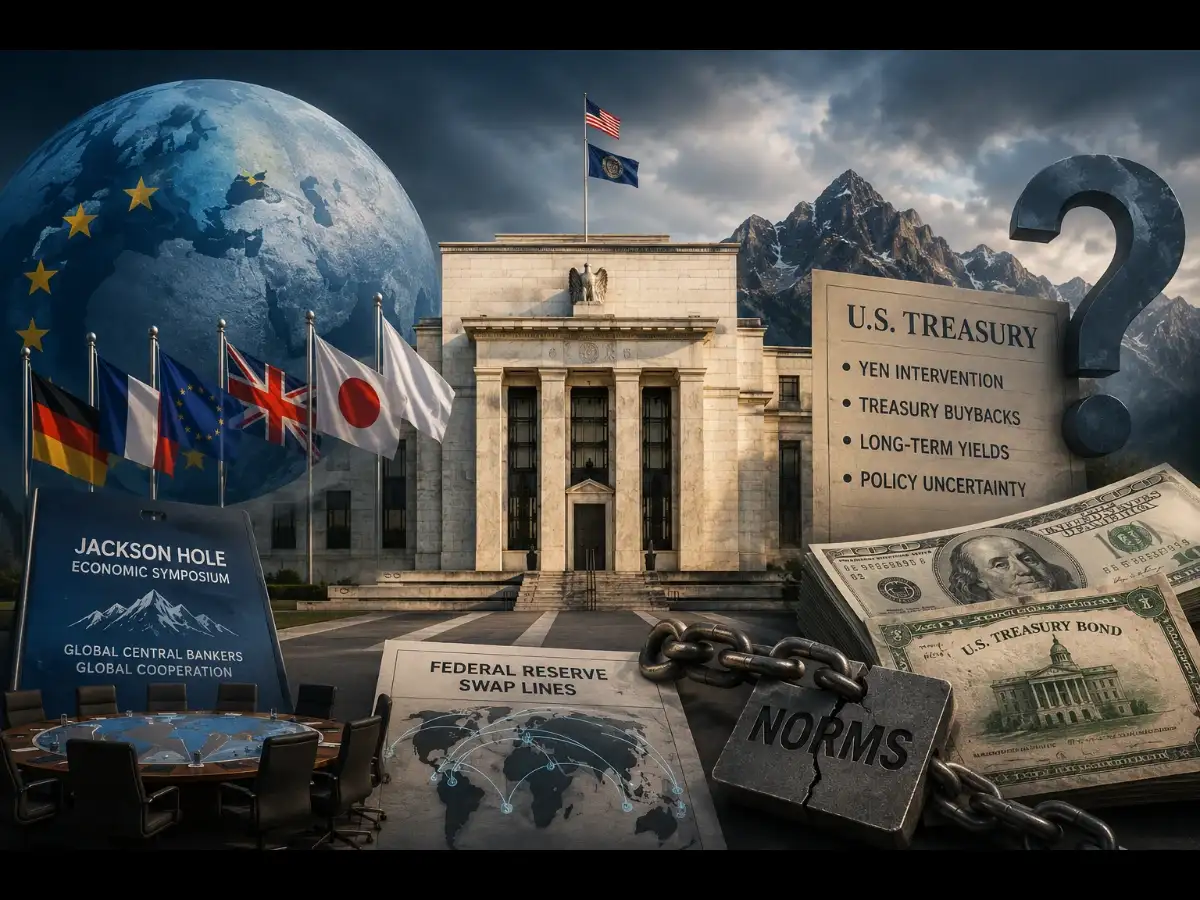
European central bankers left the annual Jackson Hole gathering of global policymakers with concerns that established norms of international financial cooperation could face increasing strain, as uncertainty grows over the relationship between the United States and its allies, Reuters reported.
Federal Reserve policymakers sought to reassure their European counterparts during the gathering, emphasising their commitment to existing international arrangements. However, Fed officials could not provide assurances that U.S. President Donald Trump would not introduce abrupt policy changes, given the separation between the central bank and the administration.
More than half a dozen officials familiar with discussions on the sidelines of the Kansas City Federal Reserve's annual economic symposium said recent U.S. Treasury interventions had heightened concerns among European policymakers.
In particular, the Treasury's intervention to support the Japanese yen and its efforts to reduce longer-term U.S. borrowing costs have raised questions about whether Washington may increasingly depart from established policy norms.
Read more: US stock market: Warsh signals Fed may need to raise rates if inflation remains elevated
The August 1 yen intervention was a particular source of irritation among European officials because the United States did not provide the customary advance notice that euros would be sold as part of the transaction. Treasury Secretary Scott Bessent later confirmed that the Treasury had sold euros to purchase yen, with the foreign exchange assets coming from the Treasury's Exchange Stabilisation Fund.
Some European officials viewed the lack of notification as a serious breach of established communication practices, while others considered that the unusual nature of the transaction could have resulted from an oversight.
The European Central Bank and Federal Reserve declined to comment. A U.S. official said the intervention was intended to counter disorderly movements in the yen and support stability in global financial markets.
Treasury bond buybacks raise further questions
European central bankers were also concerned about Bessent's plans to increase buybacks of longer-dated U.S. government bonds. Such operations could potentially be financed through greater issuance of shorter-term debt.
The officials viewed the move as another indication that the administration is prepared to take unconventional steps to influence borrowing costs.
The concern is particularly significant because longer-term Treasury yields are determined largely by market forces and monetary policy remains under the independent authority of the Federal Reserve.
A U.S. Treasury official said the expanded buybacks were designed to improve liquidity in longer-dated Treasury markets and were not intended as monetary policy or as an effort to impose a ceiling on interest rates.
However, Treasury officials have also indicated that bringing down elevated long-term yields is an important objective for the department, adding to concerns among some European policymakers about the administration's growing involvement in financial markets.
Concerns over Fed swap lines
European officials also raised concerns about the future of the Federal Reserve's dollar swap lines with major overseas central banks.
The facilities are viewed as an important pillar of global financial stability because they provide foreign central banks with access to U.S. dollars during periods of market stress. This helps ensure that banks outside the United States can continue meeting dollar funding requirements without being forced into disruptive asset sales.
Officials said there was currently no indication that the swap arrangements were at risk and expected them to continue unchanged.
The swap lines are authorised by the Federal Open Market Committee and operated by the Federal Reserve rather than the U.S. administration. Treasury officials also stressed that recent actions involving the yen and Treasury buybacks had no implications for the Fed's authority over such facilities.
Nevertheless, European policymakers remain concerned that political pressure on U.S. institutions could eventually extend into areas traditionally insulated from administration policy.
Warsh seeks to reassure European counterparts
Fed Chair Kevin Warsh, who travelled to Europe shortly after taking office, has sought to strengthen relations with European policymakers and has generally made a positive impression, according to the officials cited by Reuters.
His first appearance as Fed chair at Jackson Hole also included the customary photograph with Bank of Canada Governor Tiff Macklem. The gesture carried added significance amid the Trump administration's increasingly contentious trade relationship with Canada.
The European concerns underscore a broader challenge for global policymakers: maintaining established channels of cooperation as U.S. economic and financial policy is increasingly shaped by the Trump administration's willingness to pursue unconventional measures.
While central bankers still expect key mechanisms of global financial cooperation to remain intact, the discussions at Jackson Hole highlighted growing uncertainty about how far Washington may be willing to depart from established practices.
(Disclaimer: Recommendations, suggestions, views, and opinions given by experts are their own. These do not represent the views of The Economic Times.)