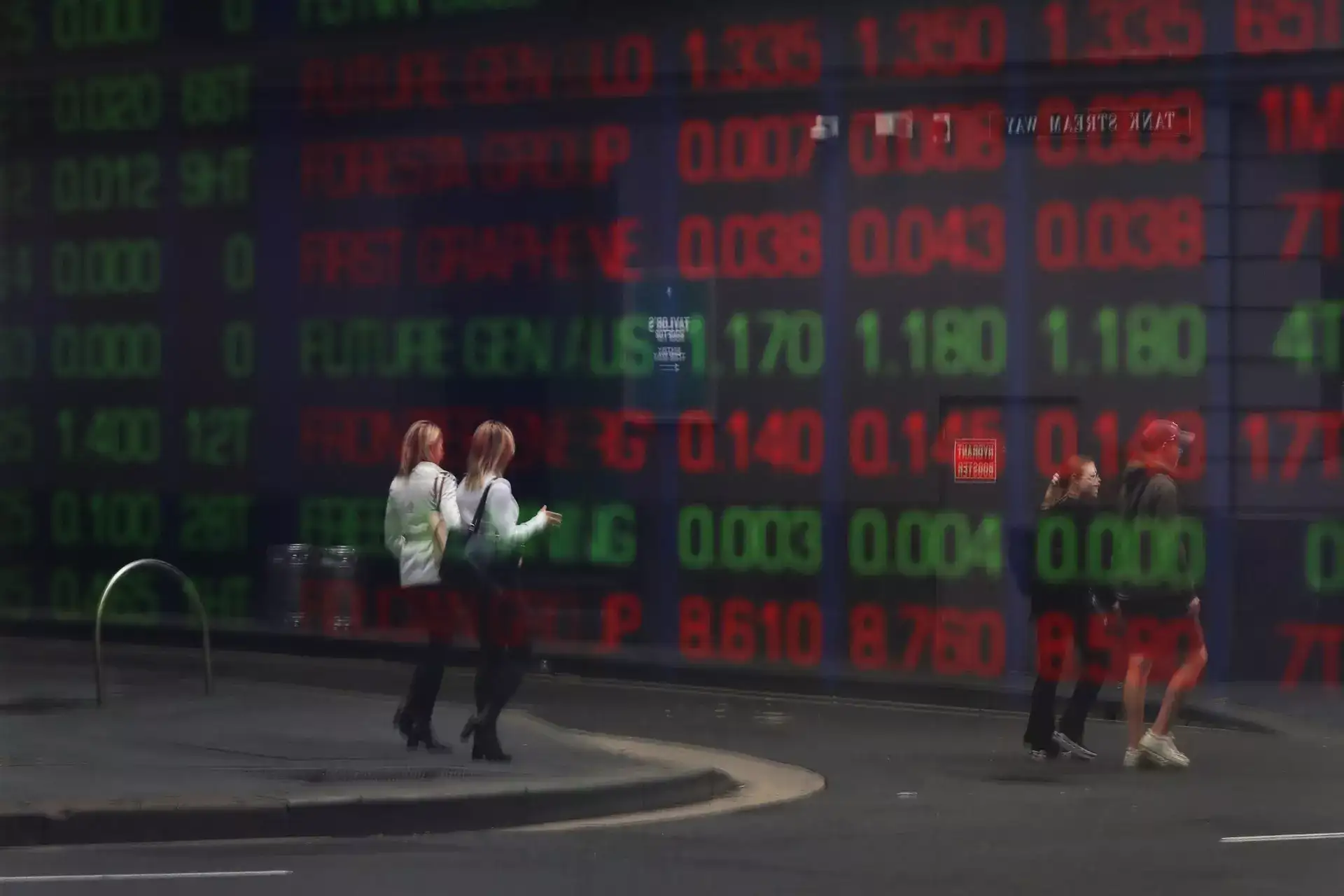
Australian shares finished little changed on Monday, with losses in banks wiping out gains across the resources sub-index, while the lack of progress in a possible U.S.-Iran ceasefire kept risk appetite in check.
The S&P/ASX 200 index ended down 2.3 points at 8,729.40, with trading volumes below the 30-day average. The benchmark rose 1.6% on Friday.
Ongoing efforts for resolution in the Middle East came under scrutiny after the U.S. struck Iranian military sites over the weekend and Iran's Revolutionary Guards said it had targeted a U.S. base in response.
Crude prices rose more than 2%, weighing on sentiment as investors fretted that higher fuel costs could feed into Australia's already-sticky inflation.
"The lack of progress on Iran is providing little support for domestic sentiment. Australia's dependence on imported crude oil leaves the economy exposed to elevated energy costs," said Justin Lin, investment strategist at Global X ETFs.
Ongoing uncertainty around proposed capital gains tax reforms is creating additional confusion for investors, with both factors possibly contributing to a reluctance to deploy capital into domestic assets, Lin added.
Financials lost 0.3%, largely on the back of a 1% decline in top lender Commonwealth Bank of Australia.
CBA and the other "Big Four" banks came under pressure last month on questions of slowing mortgage credit growth following tax changes under the federal budget.
Rate-sensitive real estate and consumer discretionary stocks added to broader weakness, closing down 0.8% and 0.2%, respectively.
Miners bucked the trend to finish at their highest since May 14, extending gains for the second-straight session, on higher copper prices. Rio Tinto gained 1.6% while BHP rose 0.3%, booking an all-time closing high.
Among coal miners, Whitehaven Coal and Yancoal Australia gained 3% and 1.9%, respectively, after production halts in China's Shanxi and Indonesia pushed up prices. That helped energy stocks reverse early losses to finish 0.3% higher.
Healthcare stocks lost 1.7% while the industrials sub-index fell 0.2%.
Markets in New Zealand were closed for a public holiday.