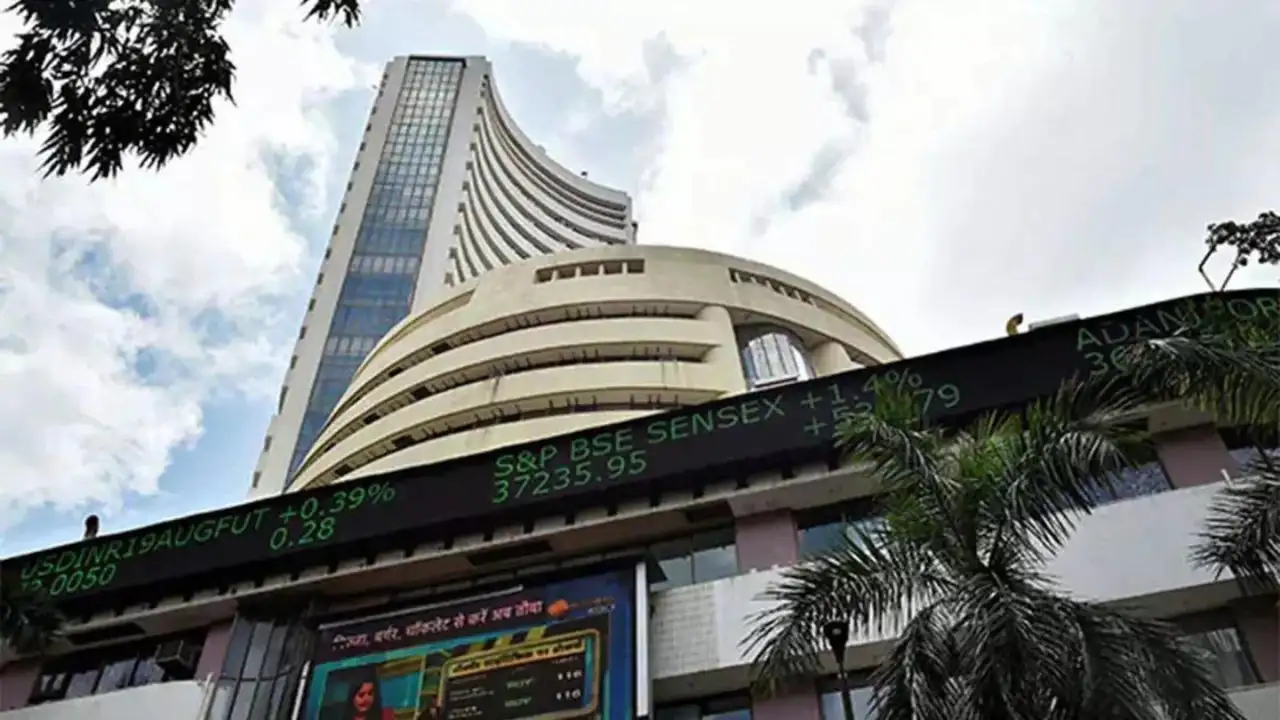


The Indian stock market extended its losses on Wednesday, with the Sensex and Nifty plunging over 2% each to log the worst single-day fall since March-end as surging crude oil prices, weak global cues and renewed geopolitical tensions battered investor sentiment.
The selloff gathered pace in the second half of trade after US President Donald Trump said an interim agreement with Iran to end the war was “over”, stoking fears of a fresh escalation in the Middle East.
Also Read | Trump says ceasefire with Iran is 'over' but negotiations can continue
Sensex crashed 1,677 points to close at 76,503.60, while Nifty 50 plunged around 517 points to end the session at 23,882.05. The sharp decline erased more than Rs 8 lakh crore in investor wealth, dragging the combined market capitalisation of all BSE-listed companies down to less than Rs 472 lakh crore. All Sensex constituents closed in the red, with shares of InterGlobe Aviation, Maruti Suzuki, Hindustan Unilever, Bajaj Finance, Kotak Mahindra Bank, ITC and Bharat Electronics (BEL) falling 3-5% each to lead the losses.
The sharp selloff on Dalal Street came while India VIX, which measures market volatility, surged 26% to 14.68, reflecting heightened investor anxiety. Broader markets also came under pressure, with the Nifty Midcap 100 Index and Nifty Smallcap 100 Index declining by nearly 2% each.
All sectoral indices ended deep in the red, with the Nifty Bank Index, Nifty FMCG Index and Nifty Oil & Gas Index plunging more than 2% each.
The overall market breadth remained sharply negative, with 2,633 stocks declining against just 699 advances on the NSE, while 79 stocks remained unchanged.
5 key factors weighing on Dalal Street today
1) Trump says Iran ceasefire is over
US President Donald Trump said the memorandum of understanding with Iran was "over" and described the country's leaders as "sick people" after a fresh wave of strikes in the Gulf threatened to derail the fragile ceasefire.
"They are scum. They are sick people. They are led by sick people. As far as I am concerned, it is just a waste of time dealing with them," Trump told reporters.
The remarks came after the US and Iran exchanged fresh strikes. Washington carried out airstrikes on Iran and reinstated sanctions on Iranian crude sales, reigniting concerns over stability in the Middle East and the risk of disruptions to global oil supplies.
"US Central Command forces have begun launching a series of powerful strikes against Iran to impose heavy costs for targeting and attacking commercial shipping crewed by innocent civilians in an international waterway," CENTCOM said in a post on X.
According to US Central Command, the strikes were launched in response to Iranian attacks on three commercial vessels passing through the Strait of Hormuz.
Brent crude futures surged more than 6% to near $79 a barrel, while WTI crude futures climbed over 6% to around $75 a barrel on Wednesday afternoon as escalating geopolitical tensions and US President Donald Trump's declaration that the ceasefire with Iran was "over" fuelled fears of supply disruptions through the Strait of Hormuz, a critical global oil shipping route.
Dalal Street mirrored the sharp selloff across global markets amid escalating geopolitical tensions.
European markets tumbled after Trump's remarks, with the UK's FTSE 100, France's CAC 40 and Germany's DAX falling up to 2%. In Asia, Japan's Nikkei declined 1.5%, while South Korea's Kospi plunged 6% as the chip-led selloff intensified.
Meanwhile, after Wall Street's sharp decline overnight, Dow Jones futures were down around 1%, signalling another weak start for US markets later in the day.
US Treasury yields moved higher, adding to pressure on equities. The benchmark 10-year Treasury yield rose to 4.565%, while the 30-year bond yield climbed to 5.068%. The policy-sensitive two-year Treasury yield advanced to 4.197%.
Higher bond yields typically make fixed-income assets more attractive relative to equities, prompting investors to shift away from riskier assets such as stocks.
The Indian rupee dropped to its weakest level in nearly a month, dropping 0.6% to close at 95.5550 against the US dollar as rising crude oil prices and a stronger dollar weighed on the domestic currency.
Jateen Trivedi, Vice President – Research Analyst (Commodity & Currency) at LKP Securities, had expected the rupee to trade in the 94.60–95.30 range, with crude oil prices and foreign fund flows remaining key factors to watch. The breach of the 95.30 level indicates increased pressure on the domestic currency.
What lies ahead?
With renewed US-Iran tensions and the consequent spike in Brent crude prices, the market has once again entered uncertain territory, said VK Vijayakumar, Chief Investment Strategist at Geojit Investments.
"How long this will last and what its consequences will be remain uncertain. The market was gradually gaining strength on the back of positive FII inflows and improving macroeconomic fundamentals. The renewed US-Iran tensions have temporarily cast a shadow over this positive trend. Investors, therefore, need to wait and watch how the situation unfolds," he said.
The analyst added that the weakening global chip trade and foreign institutional investors (FIIs) turning buyers in India remain key positives for the domestic market.
"The uncertainty surrounding the chip trade and the concentration risks associated with investing in a handful of semiconductor stocks are prompting FIIs to shift away from markets such as South Korea and Taiwan towards relatively stable markets like India. If the US-Iran tensions do not escalate further, FII inflows are likely to continue favouring India. However, that could change if the conflict intensifies and crude oil prices surge again, putting pressure on India's macroeconomic fundamentals," he said.
In the near term, higher crude oil prices pose a macroeconomic risk for India, as a sustained rally could widen the country's oil import bill, put pressure on the current account deficit, fuel inflation and weigh on the rupee, said Maulik Patel, Head of Research at Equirus Securities.
"That said, India's economy has become structurally far less energy-intensive over the past two decades. India required around 0.65 mmtoe of energy to generate every $1 billion of GDP in 1998. By 2024, that figure had fallen to around 0.24 mmtoe, a decline of more than 60% over 26 years. Almost every year since 2004 has recorded lower energy intensity than the previous one, despite navigating oil shocks, the global financial crisis, demonetisation, the pandemic and the post-COVID commodity surge.
"Three structural factors have driven this shift: a cleaner and more efficient power grid, the growing share of services in the economy, and sustained improvements in energy efficiency across transportation and appliances," he added.