

Every morning before his shift at a textile factory in Nagpur, 30-year old Ashish Narayan, a machine technician, straps a small recording device to his forehead. For the next several hours, the camera tracks and records everything he does: how he adjusted the tension on a loom, how his fingers calibrated moving parts, how he instinctively eased his grip while fixing a jammed machine without damaging the thread running through it. He is asked to wear the device throughout his shift, and is only allowed to take it off during bathroom breaks, and while having lunch.
Narayan was among hundreds of workers at the factory asked to wear the devices, including machine operators, technicians and stitching workers handling fabric on production lines. The exercise reflects a growing global push by AI and robotics companies to gather what’s being called “egocentric data” — first-person recordings of human activity that can teach machines how people perform physical tasks.
“To me, it feels like working in your own grave, while you make your own casket,” Narayan told The Indian Express. Narayan said that he realises that these videos he’s recording will end up making him redundant in the due course.
Such footage is increasingly valuable because robots still struggle with the subtleties humans perform instinctively: adjusting pressure on a machine lever, gripping delicate material, coordinating both hands, or reacting to tiny changes in movement and texture. According to a report by investment firm Stellaris Venture Partners, released in April, robotics labs have a need for 100 million to 1 billion hours of egocentric pre-training data over the next two to three years.
The end goal of collecting such data is to build robots that can operate in the real world with human-like adaptability and precision. While industrial robots have long handled repetitive tasks in controlled settings, newer AI-driven systems are being designed to work in dynamic environments — warehouses, factories, homes or hospitals — where they must constantly adjust to unpredictable conditions. For that, robotics companies need vast amounts of human behavioural data. The ambition is not merely to automate a single task, but to create machines that can learn physical intelligence itself.
But on factory floors, the technology is also exposing a sharp imbalance of power. Narayan told this paper that his factory’s management told workers the exercise was meant to “improve operations”, but there was little explanation beyond that, and no information was provided by his seniors about the company for which his operation was collecting their videos.
Workers often do not know exactly what is being recorded, where the footage is going, or how it may eventually be used. Employees in such environments are rarely in a position to meaningfully refuse participation, particularly in sectors where jobs are insecure and worker protections are weak. In effect, workers are not only producing garments or maintaining machines, but also generating behavioural data — years of tacit skill, muscle memory and embodied knowledge — with little control over how that data may later help automate parts of their own work, or replace them altogether.
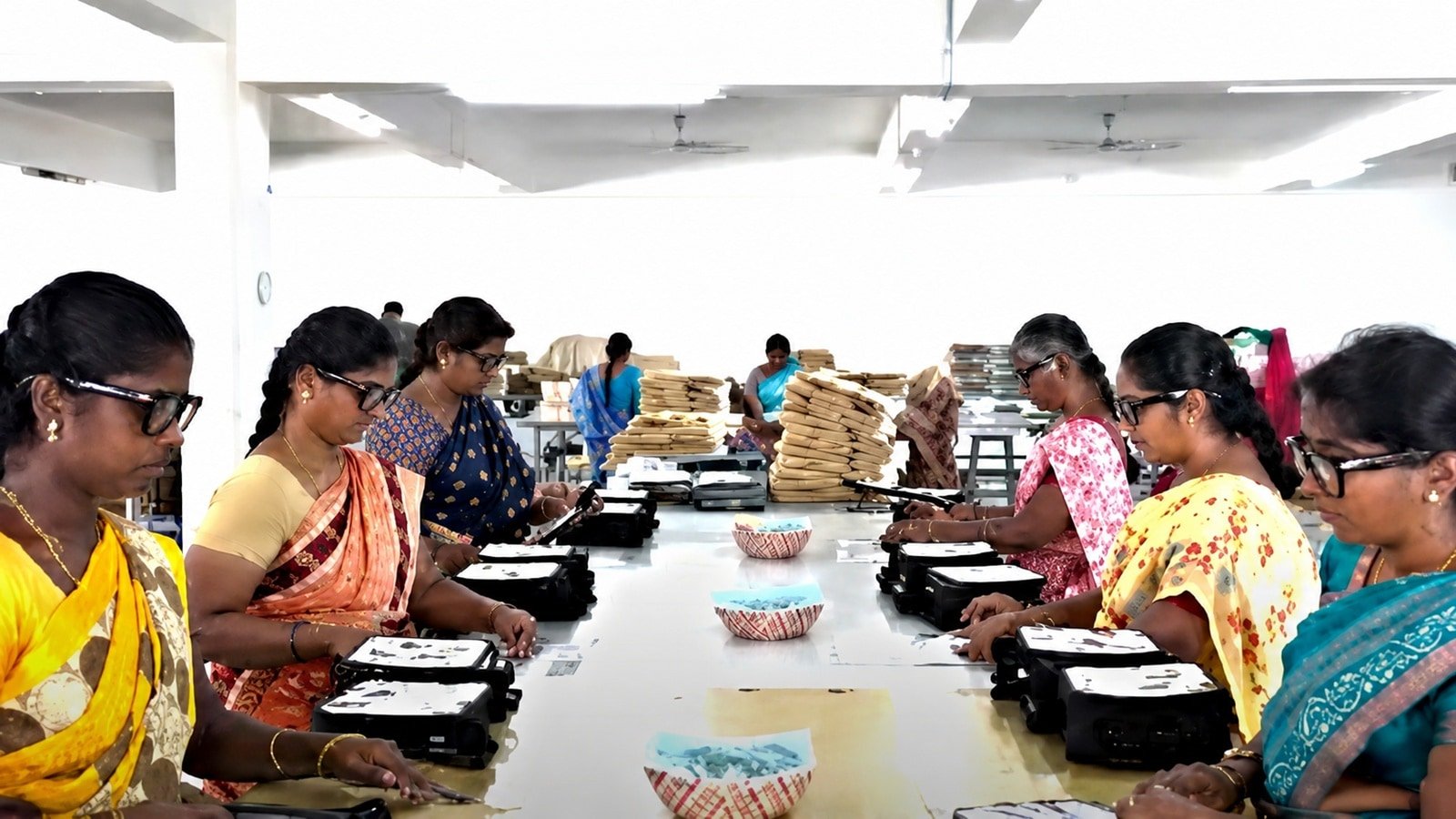
In another textile factory in Tamil Nadu, several women workers are wearing smart glasses made by Meta to record their hand movements as they neatly pack items in plastic covers, one after the other. The manufacturing firm the women work for has a contract with Objectways, a US-based AI data solutions company, which collects such data, annotates it, and then sells it to robotics firms. The company has contracted hundreds of workers in India, across factory floors, and by paying those at home to record tasks such as cutting fruits and vegetables, cleaning utensils, and folding clothes, to collect human-centric data for robotics labs.
Story continues below this ad
Ravi Shankar, President, Objectways, said that unlike general purpose AI systems where the underlying data was available on the Internet to be scraped by bots, there is little data available that can be used to train humanoid robots, which falls under the broader category of physical AI. “We have people in countries like India, USA, Vietnam, Malaysia, Philippines, who are collecting such data for us. Right now, India remains the biggest source,” Shankar told this paper over a phone call.
He said the workers making such videos for Objectways are paid anywhere between Rs 250-Rs 350 per hour, depending on the task they’re recording, and the video’s length and quality, among other things. “For people who are collecting these videos from their homes, we ask them to download our app through which they can record the tasks,” he added.
Shankar agrees that workers’ fears that they may be helping train robots that could one day replace them is a genuine concern, but said that the machines could be used to do tasks that humans do not wish to do, or work in places that humans can not easily access. “I’m not going to sugarcoat this, it is a real concern,” Shankar said. “But, also look at it this way – say there’s an extremely dirty public bathroom. It would be better if a machine was sent to clean it while the people who would have done it otherwise can seek a better living doing something else.”
Manish Agarwal, co-founder of Bengaluru-based Humyn Labs, and former CEO of gaming firm Nazara Technologies, said that today, there is an appetite for “millions and millions of hours” of such data. Earlier this year, the company announced a $20 million commitment to fund data collection operations across India, Southeast Asia, Latin America, and the Middle East. Agarwal said that people collecting such data at their homes might have limited value, as demand may be dictated by the various environments in which robotics companies want to deploy their humanoids.
Story continues below this ad
Narayan, the Nagpur technician, though, still does not know exactly where the recordings from his shifts went, or what they may eventually help build. Said Narayan: “I’m not just recording my tasks, but somewhere I feel, I’m also giving a piece of me. The machine will eventually know who I am.”
