

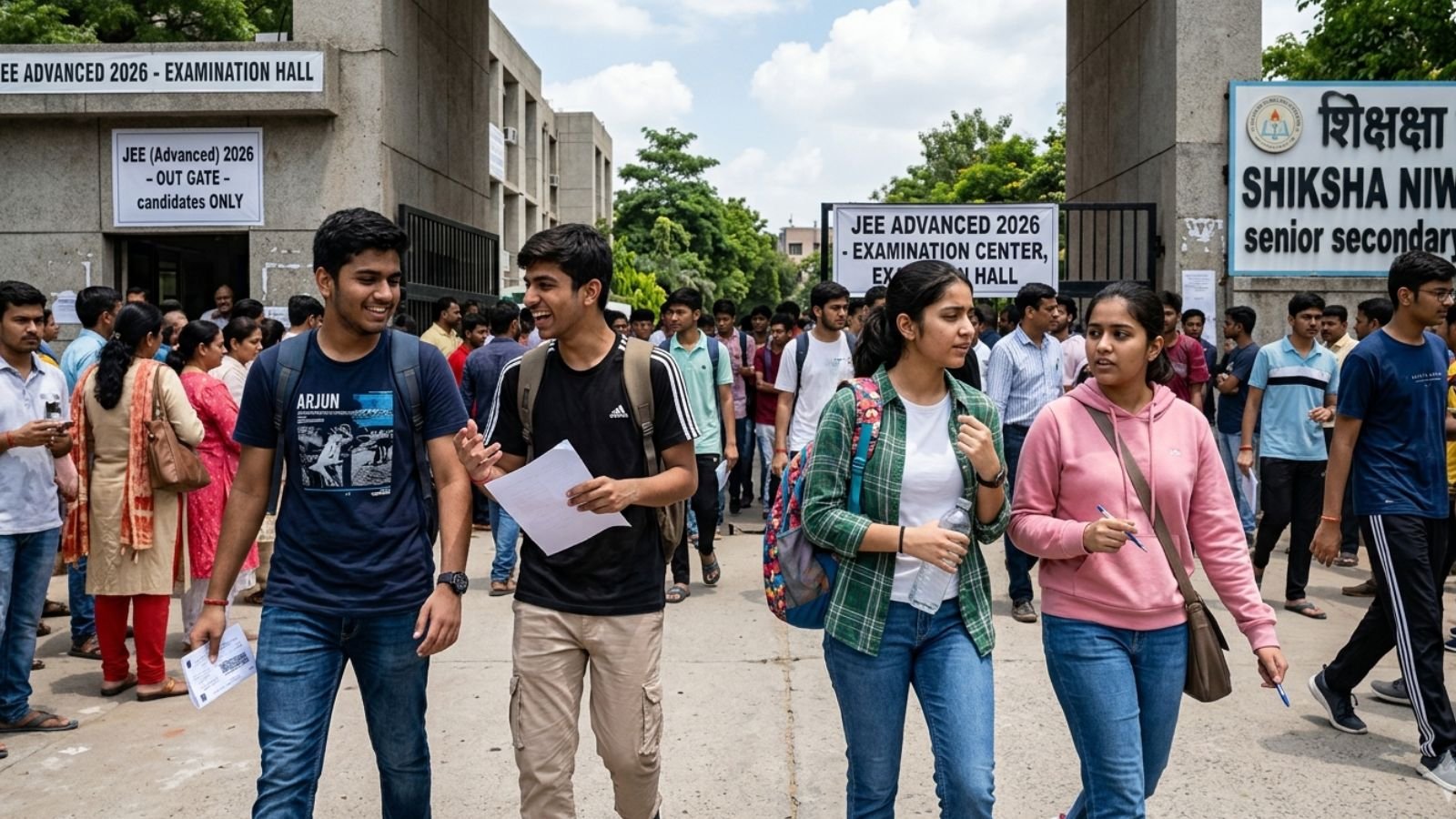
The Indian Institute of Technology, Roorkee, has concluded the paper one for the JEE Advanced 2026.
JEE Advanced 2026 Exam: The Indian Institute of Technology, Roorkee, has concluded the paper one for the JEE Advanced 2026. As per students and teachers, the JEE Advanced paper one was moderate to highly challenging, with Mathematics proving to be the longest and toughest, while Physics required deep conceptual clarity, and Chemistry was tricky and tough.
JEE Advanced 2026 Exam LIVE Updates
The paper pattern comprised 4 SCQs, 4 MCQs, 4 Matrix‑match, and 4 Integer‑type questions, with no negative marking for integer‑type, and -1 mark deduction for MCQ, SCQ, and Matrix‑match questions.
According to Dr Saurabh Kumar, CEO and Founder of Shiksha Nation, the Physics section was difficult and lengthy, featuring multi‑concept problems from Modern Physics (photoelectric effect, radioactive decay), Current Electricity (conceptual and numerical mix), Electrostatics (capacitor‑based), Magnetism and EMI (induced current and application‑based), and Rotation, which was particularly tough.
On the other hand, Ajay Sharma, National Academic Director of Engineering at the Akash Institute, claimed that the Physics section was moderate to difficult in nature. “Questions were asked from most of themajor chapters. A few questions were time-consuming, but overall, the section remainedmanageable for well-prepared students,” said Sharma.
Chemistry was rated moderate by both Sharma and Kumar, with Physical Chemistry covering ionic equilibrium, electrochemistry, thermodynamics, chemical kinetics, and solutions with colligative properties. Organic Chemistry included named reactions, mechanism‑based questions, stereochemistry, and minor weightage to biomolecules, polymers, and practical organic chemistry.
The Mathematics section ranged from moderate to difficult, with questions from definite integration, differential equations, vectors and 3D geometry, matrices and determinants, probability, complex numbers, conic sections, functions and inverse trigonometric functions, and sequence and series. While the questions were lengthy, they remained solvable, though calculations were time‑consuming.
