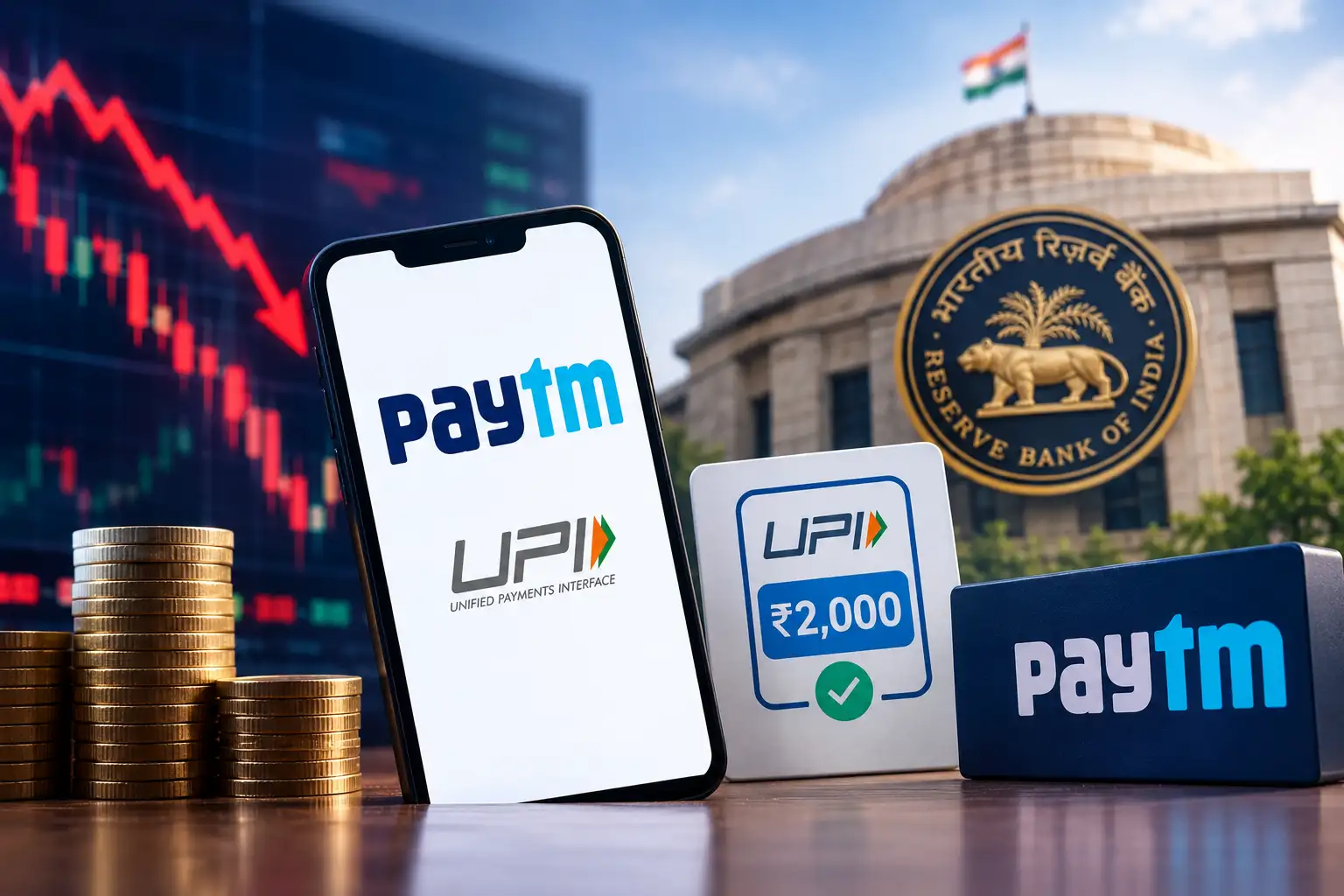
Shares of One 97 Communications, the parent company of Paytm, dropped over 2.5% on Tuesday after the government directed banks and payment system providers not to levy charges on UPI transactions of up to Rs 2,000, leaving investors speculating about what happens to transactions above the said amount.
Paytm shares dropped to Rs 1,761.80 apiece on NSE on Tuesday morning. This comes a session after the stock hit a fresh 52-week high of Rs 1,840 apiece, nearly doubling in less than six months from its 52-week low of Rs 930.6 apiece which the stock had hit in March this year.
As per a gazette notification dated Monday, no bank or system provider would directly or indirectly impose any charge on a person making or receiving a payment through RuPay debit card or UPI transaction of up to Rs 2,000. However, the government did not specify whether charges would be applicable to transactions above Rs 2,000, to be paid by merchants. Currently, there are no charges levied on UPI transactions, irrespective of the amount.
Also read |Banks cannot impose charges on UPI payments of up to Rs 2,000, govt says
The latest notification comes after an amendment to the Payment and Settlement Systems Act, 2007, which provides a framework for imposing a Merchant Discount Rate (MDR) on payments through UPI and other notified electronic payment modes. The government in a statement explained the rationale for imposing charges, stating that with exponential transaction volumes, the system requires significant and continuous upgrades in cybersecurity, fraud prevention, and infrastructure.
Charges were required for market expansion and self sustainability, it said, adding that it is necessary to increase competition by encouraging more companies to expand operations, which requires a self-sustaining revenue model. Reliance on subsidies alone is not viable for the next wave of growth, and a balanced framework is required to ensure that UPI remains robust, inclusive and future-ready, the statement further said.
Why are Paytm shares falling today?
For nearly seven years, UPI became more and more popular as a transaction could be made so quickly without paying any additional charges. By specifically shielding UPI payments only up to Rs 2,000, the government has created the legal and regulatory space for a merchant discount rate, or MDR, to be eventually imposed on selected higher-value merchant transactions. No such charge has yet been announced.
The government has however repeatedly clarified that UPI will remain free for citizens and person-to-person transactions will continue without charges. If MDR is introduced, it would only apply to a limited section of merchant transactions, above a specified threshold, and at a rate substantially below typical debit or credit-card MDR.
Finance Minister Nirmala Sitharaman has said any MDR would apply to merchants and not end-users, arguing that revenues generated within the payments ecosystem would enable banks and fintech companies to invest further in infrastructure, innovation and security.
While discussing the costs of digital-payment infrastructure, RBI Governor Sanjay Malhotra in August said, “Someone has to pay the cost”. He stressed that the RBI wants digital payments to remain accessible, affordable and safe, but also sustainable.
Also read | UPI charges above ₹2000? Government opens door to new merchant fee regime
Should you buy, sell or hold Paytm share price?
Jefferies recently increased its price target for the stock to Rs 2,100 apiece from Rs 1,600 apiece, while maintaining its ‘Buy’ call. The international brokerage highlighted that Paytm stands out on monetisation of its client base in near-zero MDR regime, which is now changing favourably. The fintech platform’s 4.9 crore merchant base and strong loan-origination model should drive 25% revenue CAGR over FY26-29, which, along with operational synergies will aid sharp rise in EBITDA and profit, it added.
Initiative in credit on UPI, cloud AI inference models, wealth offering and foray into overseas markets can lift growth, the international brokerage said, as it increased earnings estimates for FY28-29 by 20-25% to factor 25 bps MDR on UPI.
Bernstein recently named Paytm its top pick, citing robust merchant lending growth, operating leverage and the potential introduction of MDR on UPI as key drivers of earnings growth.
With a target price of Rs 2,200, Bernstein expects Paytm’s EPS to reach Rs 78 by FY29. Even after excluding any potential impact from MDR on UPI, its FY29E EPS estimate stands at Rs 54, still above the Rs 46 consensus estimate.
Also read | Jefferies' 25% CAGR club: Paytm, Groww among 5 financial stocks that can deliver up to 25% returns
Disclaimer: This article has been written by Debaroti Adhikary, who is not a SEBI-registered Research Analyst or an Investment Adviser. Debaroti Adhikary and his/her ‘relative(s)’ (as defined under Section 2(77) of the Companies Act, 2013) do not hold any financial interest in the companies mentioned in this article as of the date of publication. The views/recommendations mentioned in this article, wherever applicable, are those of the respective SEBI-registered Research Analyst/brokerage and have been reproduced/reported with due attribution. They should not be construed as the views or recommendations of The Economic Times Digital or the journalist. Readers are advised to consider the original research report and make their investment decisions based on their own assessment. Brokerage disclaimers here.