

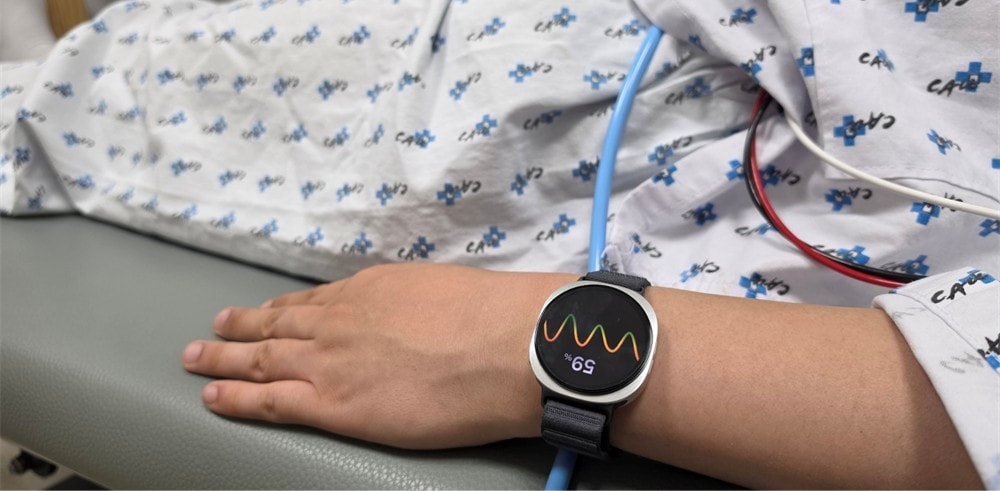
Post Content Galaxy Watch6 was used in a clinical study that explored the early prediction of fainting episodes.(Image: Samsung Newsroom)
Samsung on Thursday, May 7, announced what it calls the world’s first breakthrough in fainting prediction. In a joint clinical study with Chung-Ang University Gwangmyeong Hospital, the smartphone maker has demonstrated that the Galaxy Watch6 can predict vasovagal syncope (VVS) with high accuracy. The development can likely pave the way for real-time warning systems that alert users before a fainting episode occurs.
Vasovagal syncope is a condition in which the heart rate and blood pressure suddenly drop, and it is often triggered by excessive stress, causing a temporary loss of consciousness. Although the episode itself is not fatal, sudden falls can lead to secondary injuries such as fractures or concussions. Therefore, early detection is considered key to reducing such risks.
Professor Junhwan Cho from the Department of Cardiology at Chung-Ang University Gwangmyeong Hospital said that up to 40 per cent of people may experience vasovagal syncope, and an early warning could help them move to safety or call for help.
Also Read | Samsung Electronics appoints new TV chief amid mounting competition
According to the company, the joint research team led by Cho evaluated 132 patients with suspected VVS symptoms during induced fainting tests. Using a photoplethysmography (PPG) sensor built into the Galaxy Watch 6, researchers analysed heart rate variability (HRV) data through an artificial intelligence algorithm. The results showed that the model was able to predict an impending fainting episode up to five minutes in advance with an accuracy of 84.6 per cent.
Meanwhile, Jongmin Choi, head of the Health R&D Group at Samsung Electronics’s Mobile eXperience business, said the study shows how wearable devices could shift healthcare towards preventive care, adding that the company will continue to expand health monitoring across its wearables. The findings have been published in Volume 7, Issue 4 of European Heart Journal-Digital Health.
Also Read | Just 10 minutes of AI use can hurt your thinking skills, study finds
According to Samsung, this is the first study to demonstrate the potential of a commercial smartwatch to provide early prediction of syncope. Going forward, the company said it has plans to deepen collaboration with medical institutions as it pushes for more personalised preventive health solutions.
Story continues below this ad
(This article has been curated by Shivani P Menon, who is an intern with The Indian Express)
© IE Online Media Services Pvt Ltd
